
IGCSE Past Papers: How Students Should Actually Use Them


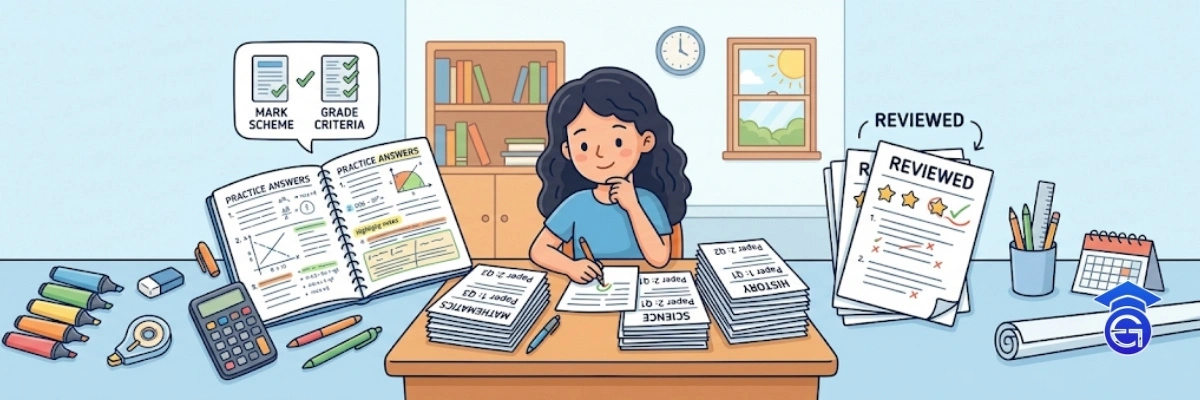
A student I worked with a while back had done something like twenty past papers before her mock exam, by her own count, and still came out with a grade that didn’t reflect anywhere near that much effort. She was baffled, and a little deflated. Twenty papers is a genuinely serious amount of work. The problem wasn’t effort. It was that she’d been doing them the same way each time, paper, mark, next paper, without ever actually stopping to figure out why the same type of question kept costing her marks. Past papers are one of the most effective IGCSE revision tools that exist. They’re also one of the easiest to do a lot of without actually improving much, and the difference comes down to how they’re used, not how many get ticked off.
What this covers
Why Past Papers Genuinely Work, When Used Properly
Here’s the direct answer before the explanation: past papers work because they’re the closest thing to the real exam a student can practise against, in the exact format, the exact phrasing style, and the exact time pressure the actual paper will use. Revision notes teach content. Past papers teach the application of that content under exam conditions, which is a genuinely different skill, and it’s the one the exam actually tests.
A lot of students know the content perfectly well in isolation and still underperform, simply because they’ve never practised retrieving it fast enough, or in the specific format the exam board favours. Past papers close exactly that gap, provided they’re used to practise the real conditions rather than as another form of content review.
The Mistake Almost Everyone Makes Without Realising It
The single biggest issue, and it’s remarkably common, is treating a past paper as a box to tick rather than a diagnostic tool to learn from. Do the paper, mark it, note the score, move to the next one. That approach genuinely feels productive, and it’s part of why it’s so widespread. But the score itself is the least useful piece of information a past paper gives you. What actually matters is which specific questions went wrong, and why.
That student I mentioned earlier had been losing marks on the same type of extended response question, again and again, across paper after paper, without ever noticing the pattern because she was only looking at the total score each time, not the breakdown underneath it. Once we actually sat down and went through where those marks were going, the fix was specific and fast. The past papers hadn’t failed her. The way she’d been using them had.
How to Actually Work Through a Past Paper
A few adjustments make a genuinely large difference to how much a past paper actually teaches, rather than how much it merely occupies revision time.
- Sit it under real timed conditions once you’re past the early learning stage, since time pressure is part of what the exam actually tests
- Mark it against the official mark scheme yourself before checking any model answer, so you’re forced to genuinely evaluate your own reasoning
- Write down, in a sentence, why each lost mark was lost, a misread question, a missing step, a concept gap, rather than just noting the final score
- Revisit the specific topic behind repeated mistakes before attempting the next paper, rather than plowing straight ahead
That last point is the one most commonly skipped, understandably, since it feels slower than just moving on to the next paper. It’s also the step where almost all the actual improvement happens. Skipping it is how a student ends up doing twenty papers and repeating the same mistake twenty times.
Mark Schemes: The Most Underused Part of the Whole Process
Mark schemes get treated as an answer key, checked quickly to see if a number matches, when they’re genuinely one of the richest resources available for understanding how an exam board actually awards marks. They show exactly which specific words, steps, or pieces of reasoning earn credit, which is often narrower and more particular than students assume from just knowing the content.
A student can write a technically correct answer and still lose marks for not phrasing it the way the mark scheme rewards, missing a required unit, skipping a working-out step that’s worth its own mark independent of the final answer, that kind of thing. Reading the mark scheme closely, not just the final numbers but the actual awarding criteria, teaches exam technique in a way that pure content revision never quite manages.
Worth trying: after marking a paper, go back through any answer that lost marks and rewrite it exactly the way the mark scheme would award full credit. It’s a small extra step, but it trains the specific phrasing and structure examiners are actually looking for.
If you’re doing plenty of papers but the grade still isn’t moving
Spotting your own repeated mistakes is genuinely hard to do alone, since it’s easy to just remember the score and move on rather than dig into the pattern underneath it. If that sounds familiar, it might be worth having a quick chat with Edugravity’s team about what focused, mark-scheme-led exam practice could look like.
WhatsApp Edugravity Book Free DiagnosticHow Many Past Papers Is Actually Enough
There’s no perfect answer here, and anyone who gives you an exact number with total confidence is probably oversimplifying. As a rough guide though, somewhere around eight to ten full past papers per subject, spread across different exam sessions rather than the same year or two repeated, tends to give a reasonable spread of question styles without becoming pure repetition.
What matters more than hitting a specific number is variety and genuine review. Ten papers done properly, each one reviewed for its specific mistakes, will move a grade further than twenty-five done on autopilot. If a student is doing papers faster than they’re reviewing them, that’s usually the clearest sign the balance has tipped too far toward quantity.
When to Start, and Why Too Early Backfires
This is a genuine trade-off worth being honest about. Starting past papers too early, before a reasonable chunk of the syllabus has actually been taught, mostly just measures how much content is still missing, which is discouraging without being especially useful. A student attempting a full paper in October when half the syllabus hasn’t been covered yet is mostly testing gaps that a revision timetable, not a past paper, is meant to address.
Starting too late has the opposite problem, not enough runway to actually act on what the papers reveal. A sensible middle ground is beginning with topic-based past paper questions as each unit is completed, then moving into full timed papers once a solid majority of the syllabus is in place, usually somewhere in the final few months before the exam rather than right at the very start of the course.
The One Thing Worth Remembering
A past paper is only as useful as the review that happens after it. The score tells you where you stand today. The mistakes, looked at properly against the mark scheme, tell you what to actually fix before the next one. Skip that second part, and even twenty papers can leave a grade exactly where it started.
The calm next step isn’t doing more papers. It’s slowing down on the ones you’ve already done, and making sure every lost mark actually gets understood before moving on to the next attempt.
Want your past paper practice to actually move the needle?
Edugravity’s free diagnostic pinpoints exactly which question types and topics are costing marks, so revision time goes toward what genuinely needs fixing. In-person in Sharjah at 107 Al Reem Plaza, Corniche Street, or online across the UAE.
WhatsApp Edugravity Book Free DiagnosticKey Takeaways
- Past papers work because they train exam technique and timing, not just content, which is a different skill from ordinary revision
- The score from a past paper matters far less than understanding exactly why each mark was lost
- Mark schemes reveal precisely how marks are awarded, often more specific than students assume, and are worth reading closely rather than skimming
- Around eight to ten full papers per subject, spread across sessions and reviewed properly, tends to beat a much larger number done on autopilot
- Full timed papers work best once a solid majority of the syllabus has actually been covered, not right at the start of the course