
How to Actually Identify Your Child’s Academic Strengths and Weaknesses


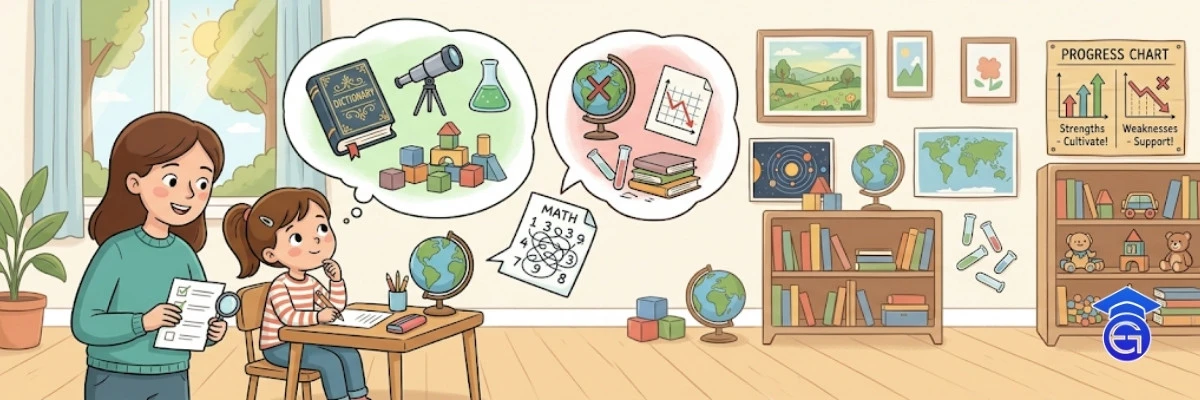
A report card lands on the table, and it says the same thing report cards always say. Strong in English, needs to improve in maths, “could apply herself more consistently” scrawled somewhere near the bottom in a teacher’s rushed handwriting. It tells you what happened. It doesn’t tell you why, and why is the part that actually matters if you want to help. Most parents can name their child’s favourite subject in half a second. Far fewer could explain, specifically, what’s actually going wrong in the subject that isn’t working, and that gap is worth closing.
What this covers
- Why grades alone don’t tell you what you think they do
- Subject weakness or skill weakness? They’re not the same thing
- The signals actually worth watching for
- What homework time reveals, and what it doesn’t
- The mistakes parents make most often here
- When observation stops being enough
- Questions people are actually asking
Why Grades Alone Don’t Tell You What You Think They Do
Here’s the honest starting point: a grade is an outcome, not a diagnosis. It tells you the result of a test on a particular day, under particular conditions, covering a particular slice of content. It doesn’t tell you whether a low maths mark came from a genuine gap in understanding, a bad night’s sleep before the test, a topic that was taught while the class was disrupted for two weeks, or simply a student who rushed the final page because time ran out.
None of that makes grades useless, they’re a useful early flag. But treating a single number as the full picture of a child’s academic strengths and weaknesses is a bit like judging someone’s fitness from one uphill sprint. It tells you something happened. It doesn’t tell you the shape of the problem, and the shape is what actually determines what helps.
Subject Weakness or Skill Weakness? They’re Not the Same Thing
This distinction changes almost everything about how you respond, and it’s the one most parents skip past without realising it. A child who’s weak at “maths” as a whole subject needs something quite different from a child who’s fine with calculation but falls apart the moment a question is dressed up in a paragraph of written text.
I worked with an eleven-year-old a while back whose parents were convinced she simply wasn’t a maths person. Straightforward number work, she was genuinely solid at. Word problems, the kind that bury a calculation inside two or three sentences of context, she’d stall on completely. It turned out the actual gap wasn’t mathematical at all. It was reading comprehension, specifically pulling out the relevant numbers and relationships from a wall of sentences, wearing a maths costume. Once that was clear, the fix looked nothing like more maths drilling. It looked like practising how to break down word problems into their component parts, a reading skill applied to a maths context.
That’s the pattern worth hunting for. Ask not just “which subject” but “which specific type of task within that subject.” The answer is often narrower, and more fixable, than the subject label suggests.
The Signals Actually Worth Watching For
A few things tend to reveal more than a report card ever will, if you know to look for them.
- Consistency over time, one bad test result means far less than the same type of mistake showing up across several weeks or months
- Which specific question types trip a child up, not just which subject, calculation versus word problems, recall versus explanation, reading versus writing
- How a child talks about a subject unprompted, genuine avoidance and quiet dread sound different from ordinary teenage grumbling about homework in general
- Where confidence and actual ability diverge, a child who’s quietly strong but underselling themselves needs something very different from one who’s confident but genuinely shaky
None of these show up clearly from a single data point. They show up from paying attention over a few weeks, which is admittedly harder than glancing at a report card twice a year, but far more accurate.
Worth trying: keep a rough, informal note for a few weeks, just which topics come up as genuinely hard versus merely annoying. The pattern usually becomes obvious faster than you’d expect once it’s written down instead of just remembered vaguely.
What Homework Time Reveals, and What It Doesn’t
Watching a child do homework tells you more than most parents give it credit for, particularly around effort, frustration points, and which specific questions cause hesitation versus which ones get breezed through. A child who reads a question three times before attempting it is telling you something different from one who attempts it instantly and gets it wrong.
But it has real limits too, and it’s worth being honest about them rather than treating homework-watching as a complete diagnostic tool. It’s genuinely hard to tell, just from watching, whether a struggle is a fresh skill gap or something older quietly causing trouble underneath, a concept misunderstood months ago that everything since has been built on top of, shakily. Homework observation is a strong first layer. It’s not the whole picture, and pretending it is tends to lead to fixing the visible symptom while missing the actual root.
The Mistakes Parents Make Most Often Here
A few patterns come up again and again, worth naming honestly since they’re genuinely easy to fall into.
Comparing siblings is probably the most common one, and understandably so, it’s a natural reference point sitting right there in the same house. But it tends to obscure more than it reveals, since two children can have completely different cognitive strengths and the comparison mostly just adds pressure without adding useful information.
Mistaking effort for ability, or the reverse, is another. A child who works hard and still struggles isn’t lazy, and a child who barely tries but does fine isn’t necessarily gifted, they might just not have hit their actual ceiling yet. And there’s a specific, quietly damaging one worth calling out directly: attaching a permanent label early, “she’s just not a maths person,” said often enough, in front of the child, has a way of becoming a self-fulfilling belief rather than a neutral observation. Kids absorb that framing more than parents usually realise, and it tends to shape effort going forward, sometimes in the wrong direction.
If you’ve watched closely but still can’t pin down the actual gap
Home observation gets you a long way, but it has a ceiling, especially when a struggle has been quietly building for a while. If that sounds like where things stand, it might be worth having a quick chat with Edugravity’s team about what a proper diagnostic could reveal.
WhatsApp Edugravity Book Free DiagnosticWhen Observation Stops Being Enough
Home observation is genuinely useful, but it has an honest limit, and it’s worth naming rather than pretending a parent can always figure everything out solo. When a pattern has held steady for a term or more without meaningfully shifting, or when the struggle clearly isn’t about effort or confidence but something more specific that’s hard to name from the outside, that’s usually the point where a structured, outside look helps more than another few weeks of watching.
This isn’t about outsourcing parental instinct, which is often right about the broad shape of the issue. It’s about getting a clearer, more specific answer than instinct alone can usually provide, the kind that comes from someone trained to separate a reading gap from a maths gap from a confidence gap, rather than lumping them all under “struggles with maths.” There’s a real relief that comes with that clarity, the sense of finally knowing what you’re actually dealing with, rather than guessing at it every homework session.
Questions People Are Actually Asking
The One Thing Worth Remembering
A report card tells you what happened. It’s the patterns underneath, the specific task types, the consistency over time, the way a child talks about a subject when nobody’s asking, that actually tell you why. Chasing that why is what turns “needs to improve in maths” from a vague, slightly demoralising line on a form into something specific enough to actually act on.
The calm next step isn’t overhauling anything overnight. It’s watching a little more closely for a few weeks, writing down what you notice, and treating the subject label as a starting point rather than the full answer.
Want a clear, specific answer instead of a guess?
Edugravity’s free diagnostic looks past the subject label to the actual skill gaps underneath, so support goes exactly where it’s needed. In-person in Sharjah at 107 Al Reem Plaza, Corniche Street, or online across the UAE.
WhatsApp Edugravity Book Free DiagnosticKey Takeaways
- A grade is an outcome, not a diagnosis, so treat it as a starting flag rather than the full picture
- Look for the specific skill causing trouble within a subject, not just the subject label itself, since the fix depends entirely on which one it is
- Consistency over several weeks reveals far more than any single test result or report card comment
- Homework observation is genuinely useful but has real limits, especially for spotting older, quietly compounding gaps
- Comparing siblings and attaching permanent labels early tend to obscure the real picture rather than clarify it