UAE Schools Tighten Hair, Hoodie and Food Rules for 2026-27: What Parents Should Know


A friend of mine got a call from her son’s school in the first week of this term, the kind of call that makes a parent’s stomach drop for a second before you find out it’s actually about a haircut. Her twelve-year-old had gone in with a fresh undercut, sides shaved, top left long, and been quietly pulled aside about it. She hadn’t seen anything about it in the enrolment pack from two years ago. Turns out a lot has changed since then, and it’s not really about one haircut. UAE schools have genuinely tightened up rules around grooming, uniforms and food this year, and it’s worth understanding what’s actually behind it before assuming it’s just one strict school being difficult.
What this covers
- What’s actually changing this year
- Why schools say they’re doing this
- The hairstyle rules, and where they get complicated
- Hoodies: a small rule with a bigger point
- Energy drinks and food restrictions
- What actually happens if a student doesn’t comply
- What this means for your family this term
- Questions people are actually asking
What’s Actually Changing This Year
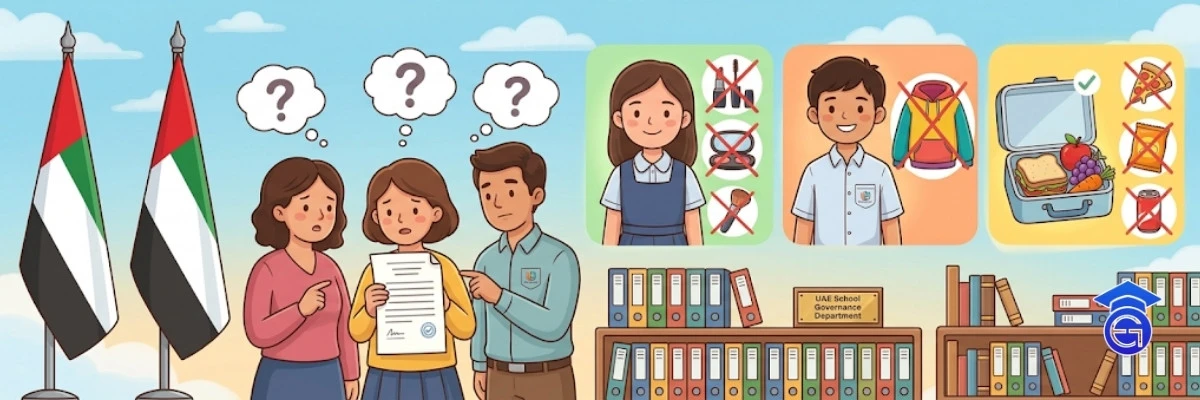
As the 2026-27 academic year got underway, a number of schools across the UAE started putting renewed emphasis on student appearance, uniform standards, and food choices on campus. Some are restricting what they call extreme hairstyles, others are cracking down on hoodies being worn during class, and several have expanded what’s actually allowed in terms of food and drinks students bring in, energy drinks especially.
It’s not one single nationwide rulebook, though, which is the part that trips a lot of families up. Schools are applying this differently, and the specifics genuinely vary from one campus to another, which means the enrolment pack from a couple of years ago, or what an older sibling experienced, isn’t necessarily still accurate.
Why Schools Say They’re Doing This
Several school leaders have been fairly direct about the reasoning, and it’s worth taking at face value rather than assuming it’s arbitrary. The general framing across multiple schools is that these measures are meant less as punishment and more as a way of building a focused, consistent learning environment, alongside genuine health and wellbeing goals.
At Credence High School, CEO-Principal Deepika Thapar Singh has pointed to the school’s Uniform and Behaviour Policy as existing to reinforce discipline, equity, and a shared sense of identity among students, alongside supporting their overall wellbeing. At GEMS Founders School, Executive Principal Matthew Burfield described the goal in similar terms, building a shared community where the focus stays on learning, character, and positive relationships, with uniform and grooming standards supporting that sense of identity and equality rather than existing for their own sake.
Whether every family agrees with the framing is a separate question, but it’s genuinely not being presented as strictness for its own sake, at least according to the schools themselves.
The Hairstyle Rules, and Where They Get Complicated
This is the part with the most genuine nuance, and it’s worth being honest about rather than presenting as one uniform national policy. A number of schools have introduced restrictions on cuts where parts of the head are shaved while other sections are left long, along with general limits on long hair for male students.
But not every school is applying an identical standard, and that’s a meaningful trade-off worth naming. At Diyafah International School in Abu Dhabi, Principal Nicole Haynes has said the school doesn’t specifically prohibit shaved hairstyles, noting that hairstyle choices can reflect personal, cultural, or religious identity, while the school still follows the Abu Dhabi Department of Education and Knowledge’s Code of Conduct on appearance and dress standards. Shining Star International School, by contrast, has adopted more detailed grooming requirements restricting shaved designs and extreme hairstyles outright, with its policy aiming for what the school describes as a neat, modest, and culturally appropriate appearance in line with Adek expectations.
So the honest answer to “is my child’s haircut allowed” genuinely depends on which specific school they attend, not on a single UAE-wide rule. That’s mildly frustrating if you’re trying to plan a haircut before term starts, but it’s the accurate picture rather than a simpler, tidier one that doesn’t quite match reality.
Hoodies: A Small Rule With a Bigger Point
Several schools have restricted hoodies being worn inside school premises, part of a broader push to standardise uniforms and keep the learning environment feeling consistent. It’s a smaller rule on paper, but it comes up constantly in practice, since a hoodie is such an ordinary, comfortable thing for a student to reach for without thinking twice.
At Credence High School, the actual policy is a bit more specific than a blanket ban. The school jersey does include a hood, but students aren’t permitted to wear it up during class or across school hours generally, with hood use mostly reserved for genuinely cold conditions, particularly during bus travel. That’s a more workable middle ground than an outright hoodie ban, and it’s worth checking whether your own child’s school takes a similarly specific approach rather than assuming the strictest possible reading.
Worth doing this week: re-read your school’s most recent uniform circular in full, not just skim it. A lot of these updates land as a single email early in the term and get buried under everything else that arrives during back-to-school season.
Energy Drinks and Food Restrictions
This is arguably the least controversial part of the whole shift, since it’s tied fairly directly to documented health guidance rather than a more subjective appearance standard. Several schools have restricted or outright banned energy drinks on campus, alongside tighter limits on processed and sugary food and drinks brought in from home or bought in the canteen.
At Diyafah International School, this is explicitly linked to Abu Dhabi’s Healthy Food and Nutrition Policy and to the broader body of evidence around health risks associated with energy drink consumption in children and teenagers. Shining Star International School has gone further still, restricting energy drinks, high-calorie drinks, and certain foods in its canteen entirely as part of a wider healthy eating approach. This one genuinely seems to have the least pushback from families, understandably, since it’s hard to mount much of an argument in favour of a ten-year-old drinking a can of energy drink before a maths test.
If the new term has already felt like a lot to keep track of
Between new policies, new routines, and settling back into schoolwork, the start of a school year can genuinely feel like a lot at once. If academics are one part of that picture you’d like a clearer read on, it might be worth having a quick chat with Edugravity’s team about what a tailored plan could look like for the term ahead.
WhatsApp Edugravity Book Free DiagnosticWhat Actually Happens If a Student Doesn’t Comply
Worth knowing upfront, since it genuinely eases a lot of the anxiety around this: most schools describe a fairly measured, graded response rather than jumping straight to punishment. At Shining Star International School, Head of Inclusion and Safeguarding Aby Daniel described the approach as starting with individual or group guidance explaining the expectation and reasoning behind it, moving to verbal warnings and parent communication if the issue continues, with formal disciplinary action reserved for repeated non-compliance under the Adek Student Behaviour Policy.
At GEMS Founders School, Burfield described a similar pattern, a constructive conversation first, guidance offered, and parents contacted where needed, adding that in the vast majority of cases these get resolved quickly through ordinary cooperation between school and family rather than escalating into anything formal.
What This Means for Your Family This Term
A few practical steps make this a lot less stressful than discovering a rule the hard way, the way my friend did with that haircut call.
- Read the current term’s uniform and behaviour circular in full, since policies genuinely differ school to school and year to year
- If your child wants a distinctive haircut, check with the school first rather than after the fact, particularly around anything involving shaved sections or extreme styling
- Check the specific hoodie policy, since some schools allow it in cold conditions like bus travel even while restricting it during class
- Clear out energy drinks and heavily processed snacks from the school bag rotation, since this is the rule with the least ambiguity across schools
None of this needs to feel adversarial. Most schools genuinely do want to work with families rather than catch students out, and a five-minute read of the actual circular saves a fair bit of first-week friction.
Questions People Are Actually Asking
The One Thing Worth Remembering
These rules genuinely aren’t uniform across the UAE, and treating any single school’s policy as the national standard is where most of the confusion, and the occasional first-week surprise, comes from. The schools themselves are fairly consistent in framing this as being about focus and wellbeing rather than control for its own sake, and the actual consequences for non-compliance tend to be far more measured than a worried parent might assume.
The calm next step is simple: read this term’s circular properly, ask the school directly if anything’s unclear, and treat it as a five-minute task rather than something to worry about after the fact.
Want the academic side of the new term sorted too?
Edugravity’s free diagnostic gives an honest read on where your child stands right now, so the term ahead starts with a clear plan rather than a guess. In-person in Sharjah at 107 Al Reem Plaza, Corniche Street, or online across the UAE.
WhatsApp Edugravity Book Free DiagnosticKey Takeaways
- UAE schools have tightened rules on hairstyles, hoodies, and energy drinks for the 2026-27 academic year, but policies vary meaningfully by school
- School leaders frame the changes around focus, discipline, equity, and wellbeing rather than punishment for its own sake
- Hairstyle rules aren’t uniform, some schools restrict shaved or extreme styles outright, others explicitly account for cultural and religious choice
- Hoodie rules often have practical exceptions, such as allowing hoods up in cold conditions like bus travel while restricting them in class
- Non-compliance typically triggers guidance and parent communication first, with formal discipline reserved for repeated issues