How to Choose a CBSE Tuition Centre in Sharjah: What Parents Need to Know
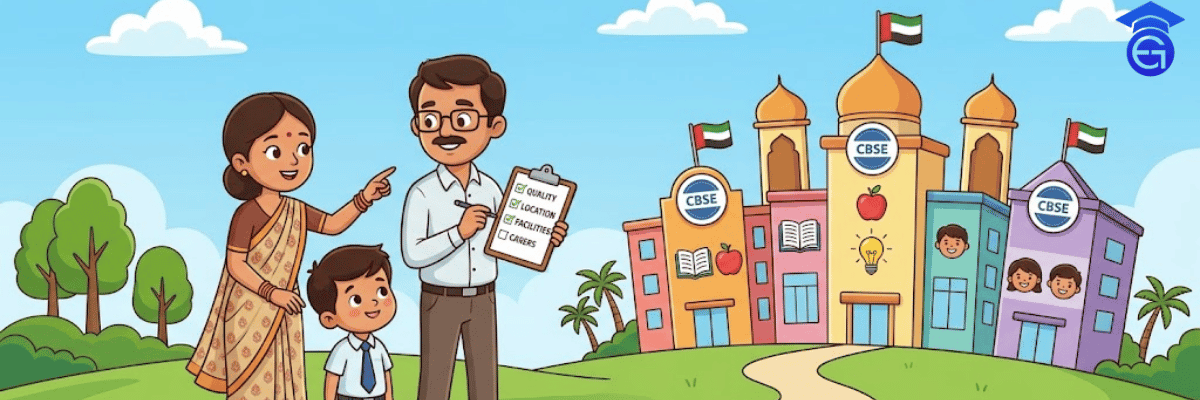
Every parent searching for CBSE tuition in Sharjah hits the same wall. Dozens of options, all claiming to be the best. Everyone’s got qualified teachers. Everyone’s got small groups. Everyone has a success story or two ready to share when you call. The hard part isn’t finding a tuition centre — it’s knowing which questions to actually ask to separate the good ones from the rest.
What this covers
- Why CBSE tuition in Sharjah is different from general coaching
- The questions that actually reveal whether a centre is worth it
- Why class size matters more than location or price
- What to look for based on which grade your child is in
- Red flags that look fine until they aren’t
- Online vs offline CBSE tuition in Sharjah
- What Edugravity offers for CBSE students
- Questions parents ask most often
Why CBSE Tuition Is Different from General Coaching
Sharjah has a large CBSE community. There are well-established CBSE schools across the emirate, and the student population following the Central Board of Secondary Education curriculum is significant enough that tuition demand is high. Which means there’s a lot of supply. And like most markets with high supply, quality varies considerably.
The specific challenge with CBSE is that it’s not a generic curriculum. The CBSE Class 10 Mathematics paper has its own question style, its own marking structure, its own weighting of topics. A tutor who’s excellent at teaching Maths generally but hasn’t spent time with CBSE papers specifically is going to miss things that matter. The same is true across Sciences. CBSE Chemistry at Class 12 has particular areas of emphasis — electrochemistry, coordination compounds, surface chemistry — that carry more weight in the board exam than a general Chemistry tutor might prioritise.
This sounds like a technicality. It isn’t. The difference in marks between a student prepared by someone who knows CBSE board patterns and one prepared by a generalist shows up in the actual exam, particularly in the three to four markers where knowing the expected answer format is as important as knowing the content.
So the first thing to establish when looking at any CBSE tuition centre in Sharjah is: do the tutors actually know the CBSE syllabus and board paper patterns, or do they know the subject? Both is ideal. One without the other is significantly less useful.
The Questions That Actually Reveal Whether a Centre Is Worth It
Most parents ask the obvious questions and get the obvious answers. “Are the teachers qualified?” Yes. “Do you have small groups?” Yes. “Have you had good results?” Yes. None of that tells you much because every centre answers the same way regardless of whether it’s true.
The questions that reveal something real are more specific.
How do you identify what a student needs before starting? A centre that says “we’ll cover the syllabus from the beginning” has no diagnostic process. One that describes an initial assessment that identifies specific gaps by topic and skill type is doing something different and more useful. For a student who’s already three months into the school year and has specific weak chapters, starting from the beginning of the syllabus wastes everyone’s time.
How do you teach exam technique alongside content? CBSE board exams have specific marking patterns. A one-mark question wants a specific type of answer. A three-marker wants three distinct points or a structured explanation of one. A five-marker wants a diagram in most Science subjects. These aren’t tricks — they’re patterns the examiner uses, and students who know them consistently outperform students who know the same content but don’t understand the answer format expected.
How do you update parents on progress? Monthly reports, quick messages after class, nothing at all? The answer tells you how accountable the centre expects to be. Centres that communicate regularly are the ones where problems surface early. The ones that communicate only when you ask are the ones where you find out in April that December was already going badly.
What happens when a student misses a class? CBSE students miss classes. Exams at school, family travel, illness. A centre that has no answer for this leaves students with uncovered material. One that records sessions or offers catch-up slots is taking the cumulative learning seriously.
The most revealing question of all: ask the centre to describe a student who struggled there and what they did about it. Centres with genuine engagement can usually point to a specific situation where they adapted. Centres running a production line tend to answer with general statements about their teaching approach. The difference is apparent.
Why Class Size Matters More Than Location or Price
Parents in Sharjah often prioritise proximity and cost when choosing tuition. Both make sense. Neither is the right primary filter.
Here’s why. A large group class at a well-located centre at a reasonable price delivers something that looks like tuition but functions more like additional school time. The student is physically present, the teacher is covering content, and if the student follows along, they absorb something. But there’s no individual feedback loop. The tutor doesn’t know what each student specifically got wrong in last week’s test. They don’t notice that one particular student hesitates every time a particular type of question comes up. They can’t stop mid-session to address one student’s specific confusion without losing the rest of the group.
For CBSE students heading towards Class 10 boards or Class 12 boards, this isn’t good enough. Board exams are individual. The marks on your paper reflect what you specifically understood and how you specifically answered. Generic group instruction that doesn’t account for individual gaps produces modest improvement at best.
Six students in a group is about the threshold where individual attention becomes possible. At six, a tutor can check each student’s working during a problem-solving session. At six, there’s enough time to ask each student a follow-up question about their understanding. At six, nobody hides. Something goes wrong with a student’s understanding that week, and the tutor will know.
Anything larger than that, and the benefits of tuition over school instruction start to shrink. You’re paying for smaller class sizes but not getting the individual attention that makes smaller class sizes matter.
Something to ask directly: “What is the maximum number of students in a group?” Not “what’s the usual class size” — that allows for exceptions. Maximum. A centre that hard-caps at six and enforces it is meaningfully different from one that targets eight but accepts twelve when demand is high.
What to Look for Based on Your Child’s Grade
Classes 6 to 9: Foundation matters more than you think
Many parents treat the middle school years as low-stakes and wait until Class 10 or 12 to get serious about tuition. That’s understandable, but the CBSE curriculum in Classes 7, 8, and 9 builds exactly the foundational knowledge that Class 10 boards test. Algebra introduced in Class 8 reappears in Class 10. Chemistry concepts from Class 9 are assumed knowledge in Class 10 Science.
A student who develops solid understanding through Classes 7 to 9 reaches Class 10 in a fundamentally better position than one who coasts through those years and tries to build everything from scratch in the run-up to boards. If you’re considering tuition for a younger student, it’s worth starting earlier than you think you need to.
Class 10: The boards that set the trajectory
Class 10 board results in CBSE directly influence which stream and subjects are available to a student at Class 11. A strong performance opens options. A weak one closes them. The pressure is real and the timeline is fixed.
For Class 10 students, the most useful tuition combines conceptual clarity in core subjects (Mathematics, Science, English, Social Science) with specific board exam preparation. Past paper practice is essential here — not as a substitute for understanding, but as a tool that builds familiarity with how CBSE questions are framed and what full-mark answers look like.
Class 11 and 12: Stream-specific preparation
By Class 11, students have chosen a stream — Science, Commerce, or Humanities — and the subject demands diverge significantly. Science stream students need genuine subject expertise in Physics, Chemistry, Biology or Mathematics. Commerce stream students frequently struggle with Accountancy and Economics. Humanities students often need focused English support for the extended writing components.
For Class 12 specifically, the combination of board exams and entrance exam preparation is a significant workload. Students who have structured tuition support tend to manage that pressure more effectively than those trying to coordinate everything independently. A good tuition centre at this stage also helps students understand which entrance exams are realistic targets, given the board results they’re actually tracking towards.
Red Flags That Look Fine Until They Aren’t
A few things that come up regularly and are worth knowing before you commit to a centre.
Very low prices for individual or very small group tuition. Below a certain threshold, the economics don’t support subject specialists or experienced tutors. Extremely cheap tuition is almost always delivered by newly qualified or underqualified tutors, which might be fine for foundational subjects but becomes a problem for the harder content in Class 11 and 12 Science.
No trial session or assessment before enrolling. A centre that asks you to commit to a term or semester without any introductory session has no particular incentive to find out whether their approach fits your child. Centres confident in what they offer will let a student attend a session or complete an assessment first. If that option isn’t available, that’s a signal.
Tutors who change frequently. This is harder to assess from the outside, but worth asking about directly. High tutor turnover means students constantly readjust to new teaching styles and new personalities. Continuity matters for trust, and trust matters for whether a student feels comfortable admitting they don’t understand something.
A centre that claims to cover everything. CBSE plus Cambridge plus IB plus SAT prep plus entrance exam coaching at the same centre with the same teachers is a stretch. Subject expertise developed across too many curricula is usually shallow across all of them. If you’re choosing CBSE tuition specifically, a centre that focuses on what it knows deeply is a better bet than one promising everything.
Online vs Offline CBSE Tuition in Sharjah
Both work. The question is what works for your specific child.
Offline tuition at a Sharjah centre has the obvious advantage of physical presence. For students who find it hard to stay focused without someone in the room, that matters. The commute also creates a routine and a psychological transition into study mode that online sessions can lack. And for subjects with diagram-heavy content, drawing on a whiteboard together in person has a natural feel that digital alternatives approximate but don’t quite replicate.
Online CBSE tuition in the UAE has become significantly more functional since platforms improved. Interactive whiteboards handle equations and diagrams reasonably well. Screen-sharing works for going through papers. For students who are motivated enough to maintain focus without physical presence, the convenience is real — no commute, no traffic, and session recordings are easier to provide.
For shy students, online can sometimes be the better option initially. Asking a question in a video call of five students is less intimidating than the same question in a room. The social pressure is lower, which for students who tend not to ask questions in class means they actually ask more.
Edugravity offers both. The in-person sessions run at the Sharjah centre on Corniche Street. Online sessions run with the same group size and the same tutors. Students from Dubai, Ajman, and further afield attend online. If you’re not sure which format suits your child, the diagnostic session is a reasonable way to find out before committing either way.
What Edugravity Offers for CBSE Students in Sharjah
Edugravity is based at 107 Al Reem Plaza on Corniche Street in Sharjah. For CBSE students specifically, they cover Mathematics, Physics, Chemistry, Biology, and English from Class 6 through Class 12.
The group cap is six students. Not “usually six” — maximum six, enforced. This is the same standard they apply to their British curriculum work and it holds across all their CBSE sessions too.
Every student who joins starts with a diagnostic assessment that identifies the specific gaps in their current understanding, not just which topics they’ve covered. For CBSE students, this means mapping their knowledge against the actual board syllabus and identifying where the mark losses are likely to come from. That’s the starting point for the tuition programme, not a generic coverage of the syllabus from the beginning.
Exam technique is explicitly built into the sessions. CBSE board papers have predictable patterns in how marks are allocated. Students who understand those patterns — how a three-marker wants to be answered, what a diagram in a five-mark Biology question needs to include, how marks are awarded in Chemistry numericals — consistently perform better than those who know the content but haven’t been shown how the examiner thinks.
Progress is communicated to parents regularly. Monthly updates, not end-of-term reports. If something is going wrong in a subject, the window to fix it is measured in weeks, not months. Getting that information early makes a real difference to what’s possible by the time the exam arrives.
Looking for CBSE tuition in Sharjah?
Edugravity offers CBSE tuition for Classes 6 to 12 in Mathematics, Physics, Chemistry, Biology and English. Small groups of maximum 6 students, board-specific exam technique, and a free diagnostic to show you exactly where your child stands. In-person on Corniche Street, Sharjah, or online across the UAE.
WhatsApp Us Book Free DiagnosticQuestions Parents Ask Most Often
The Decision That Actually Matters
The right CBSE tuition centre in Sharjah is the one where your child’s specific gaps get identified, addressed, and tracked over time. Not the closest one. Not the cheapest one. Not the most-advertised one.
Most parents settle for a centre that’s adequate rather than looking for one that’s genuinely right for their child’s situation. The difference shows up slowly, usually not until a mock result or an end-of-term assessment makes it visible. By then, the exam timeline has already compressed.
The free diagnostic session is worth treating seriously. Not as a sales call, but as useful information about where your child actually stands relative to where they need to be. That information is worth having regardless of whether you enrol anywhere.
Book a free diagnostic at Edugravity to get a clear subject-by-subject picture of where your child stands against the CBSE board syllabus. In-person in Sharjah at 107 Al Reem Plaza, Corniche Street, or online. Register here.
Key Takeaways
- CBSE-specific knowledge matters — a tutor who knows the board paper patterns and marking schemes consistently produces better results than a generalist who knows the subject broadly
- Class size is the most important factor after subject knowledge — six students or fewer is where individual feedback becomes genuinely possible
- Ask about the diagnostic process, exam technique, parent communication, and what happens when a student misses a session before choosing any centre
- Starting tuition earlier than the board year is significantly better than scrambling in the run-up to exams — foundation gaps don’t disappear under pressure, they compound
- Both online and offline CBSE tuition work well in Sharjah — the format matters less than the group size and the tutor’s specific board knowledge