CBSE Grade 12 Results 2026 Are Out: How UAE Students Can Check Scores and What to Do Next
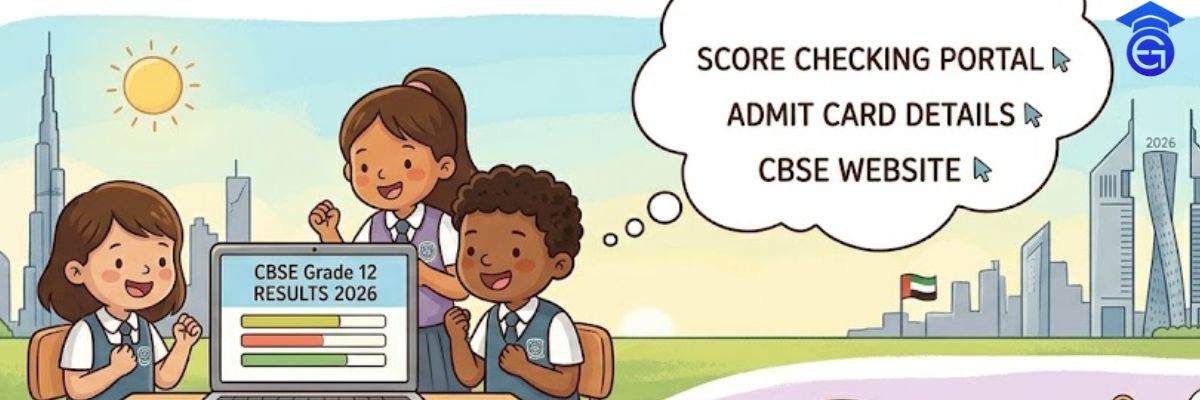
The results are out. Right now, students across the UAE are refreshing the same page over and over, watching it load slowly, and feeling the particular stomach-drop that comes with a loading bar that stops at 90%. The CBSE Class 12 results for 2026 have been declared, and if you’re trying to figure out how to actually get to your scorecard or what to do once you have it, this is the guide to read first.
What this covers
How to Check Your CBSE 12th Result Right Now
There are four ways to get your result. Use whichever one is working — on results day, traffic is high and the official site is always the slowest of the four.
Option 1: Official CBSE website
Go to cbseresults.nic.in. Click the Class 12 result link. Enter your roll number, school number, admit card ID, and date of birth. Your scorecard will appear on screen. Download and save it. If the site won’t load, move straight to Option 2.
Option 2: DigiLocker (most reliable on results day)
Go to digilocker.gov.in or open the DigiLocker app. Log in using your registered mobile number or Aadhaar details. Your official CBSE marksheet will be available directly under the CBSE section. Students who have linked their Aadhaar number don’t need to enter any additional login credentials. This tends to be significantly faster than the official CBSE site when traffic is high.
Option 3: UMANG app
Download the UMANG app if you don’t already have it, or visit web.umang.gov.in. Search for CBSE services, select Class 12 results, and enter your details. Another reliable alternative when the main site is struggling.
Option 4: SMS (works even without internet)
Open your messages app and type: cbse12 [your roll number] and send it to 7738299899. Your result will be sent back to you by SMS. This is the best option if you’re somewhere with poor data connection or if all the websites are timing out.
For UAE students specifically: the SMS option works from UAE numbers. Standard international SMS rates from your UAE network to an Indian number apply. The websites and apps work normally on any internet connection. You don’t need to be in India to access any of these methods.
When the Website Won’t Load — What to Actually Do
This happens every single year without fail. The CBSE results website goes live, a few million students hit it simultaneously, and it bogs down within minutes. If you’re getting errors, timeouts, or a page that just spins endlessly, you are not doing anything wrong. The server is simply overwhelmed.
Go straight to DigiLocker. It handles the traffic better because the load is distributed differently. If DigiLocker is also slow, try the SMS route — it bypasses internet traffic entirely and works off mobile networks, which are significantly more stable on days like this.
Don’t keep refreshing the official site on a loop. That makes the problem worse, adds to the traffic load, and just delays you getting to your result. Pick one of the alternatives, get your scorecard, and then check the official site later if you want the original page.
Also: your result doesn’t change while you wait. Whether you check now or in two hours, the number on the paper is the same. Take a breath.
What Your CBSE Grade 12 Grades Actually Mean
CBSE uses a 9-point grading scale for Class 12. Here’s the full breakdown so you know exactly where you stand.
| Grade | Marks Range | Descriptor |
|---|---|---|
| A1 | 91 – 100 | Outstanding |
| A2 | 81 – 90 | Excellent |
| B1 | 71 – 80 | Very Good |
| B2 | 61 – 70 | Good |
| C1 | 51 – 60 | Above Average |
| C2 | 41 – 50 | Average |
| D | 33 – 40 | Pass |
| E1 / E2 | Below 33 | Fail |
A few things worth knowing about how CBSE calculates the final result. Your scorecard is based on the best of five subjects, not all subjects taken. You need at least 33% in each subject individually to pass — an overall average above 33% doesn’t save you if one subject is below that threshold. Where applicable, theory and practical marks are both factored in, each with their own minimum qualifying requirement.
CBSE also has a grace marks provision for students who narrowly miss the passing cut-off in a subject. This isn’t guaranteed and it’s not something students apply for — the board applies it automatically where it determines the criteria are met. If you’re borderline in one subject, it’s worth knowing this exists.
One thing students miss: this year CBSE evaluated all Class 12 answer scripts using its On-Screen Marking (OSM) system, where scanned copies of papers were assessed digitally rather than physically. The process was designed to improve accuracy and reduce handling errors. If you’re considering verification of marks, understanding how the papers were marked is relevant context.
The 2026 Pass Rate in Context
Just under 18.6 lakh students appeared for the CBSE Class 12 exams in 2026, which ran from February 17 to April 9 across 7,574 exam centres. That’s a substantial cohort, and the results have been consistent with the board’s recent upward trend.
Pass percentages over recent years have been: 87.33% in 2023, 87.98% in 2024, and 88.39% in 2025. The 2026 figure isn’t officially published as a single declared number, but the direction has been consistently positive across the last several cycles.
For UAE-based CBSE students, the context is the same exam, the same marking, the same certificate. The school is in the UAE but the board is the same one used across India. Your result sits within that national picture regardless of where you studied.
What to Do If Your Result Isn’t What You Were Expecting
First: don’t make any decisions in the next hour. Results day is not the right moment for major choices about the future. The number on the screen is real, but your response to it doesn’t have to be immediate.
If you failed a subject or your overall grade is significantly below what you needed, you have structured options.
Verification of marks
This is the process for checking whether any totalling or transfer errors occurred in your paper. It doesn’t involve re-marking — it’s a check that the marks were correctly added and correctly transferred to your scorecard. CBSE charges a fee for this and releases the schedule shortly after results. It’s worth doing if your result in any subject seems sharply inconsistent with your performance through the year.
Revaluation of answer scripts
This is actual re-marking of your paper. A different examiner looks at your answers against the marking scheme. Results of revaluation can go up or stay the same — they can’t go down. The fee is higher than verification, and the process takes longer, but for subjects where you felt confident and the result doesn’t reflect that, it’s a legitimate avenue. CBSE announces the revaluation window and deadline soon after results, so watch the official communications closely.
Compartment exams
If you failed one or two subjects, you’re eligible for compartment exams, which are a second attempt at those specific papers. Passing the compartment exam means you receive a full pass result for that year. The compartment exams are typically held a few months after the main results, and CBSE notifies eligible students directly through their schools.
Retaking subjects in the next cycle
For students who want to significantly improve a grade for university admission purposes, appearing as a private candidate in the following year’s exams is also an option. This allows you to retake specific subjects while the rest of your result stays on record.
A word of caution about social media right now: results day brings a lot of noise online — people sharing their scores, comparisons, rumours about cut-offs, speculation about university requirements. Most of it is neither accurate nor useful. Get your result, look at it, sit with it for a bit, and then look at verified information from CBSE and the universities you’re applying to. The WhatsApp group chatter is not a reliable source for anything today.
Planning What Comes Next After Grade 12
Whether the result was everything you hoped for or not quite, the question that follows is the same: what now?
Students with strong results will be focused on university applications, either in India through JEE or NEET for science streams, through management entrance exams for commerce, or through international university applications if they’re planning to study abroad. UAE-based students have the additional option of UAE universities, which accept CBSE results alongside other curricula.
Students who want to improve their scores, whether for a specific university threshold or for personal satisfaction, have two main routes: retaking subjects privately in the next CBSE cycle, or exploring alternative qualifications like A-Level or SAT that might meet a different university’s requirements.
And students who are still figuring out what they want are in a position that’s more common than it looks from the outside. Grade 12 results feel definitive in the moment. They’re actually just one data point in a much longer process. Universities are not the only path forward, and the path forward doesn’t have to be decided this week.
Not sure what to do with your Grade 12 result?
Whether you’re looking to improve specific subject grades, explore A-Level or SAT as a next step, or need academic support heading into university, Edugravity works with students across Sharjah and the UAE. Free consultation to talk through your options — no pressure, just clarity. In-person in Sharjah or online.
WhatsApp Us Book Free ConsultationQuick Answers to What People Are Asking Right Now
A Note for the End of Results Day
Every year, two types of students get to results day. The ones who open the page and feel relief. And the ones who open it and feel something sink.
If you’re in the first group, that result is real and you earned it. Take today to feel good about that.
If you’re in the second group, the result is also real — but it’s not the end of the story. Grade 12 is not the last decision point in your life, even though it feels that way right now. There are specific, structured routes forward: revaluation, compartment exams, retaking subjects, switching tracks. None of those paths close today.
Give yourself time before deciding anything. Talk to people who know your situation. And when you’re ready to work out what comes next, there are people who can help you figure that out clearly and without drama.
If you want to talk through next steps with someone who knows the options: Edugravity offers a free consultation for students and parents navigating what comes after Grade 12 results. Whether it’s improving grades, switching curricula, or planning for university entry, we’ll help you see the full picture. Book the consultation here.
Key Takeaways
- CBSE Class 12 results 2026 are declared — check via DigiLocker or SMS if the official site is slow, as both are more reliable on results day
- You need at least 33% in each subject individually to pass; overall aggregate alone is not sufficient if any single subject is below the threshold
- CBSE’s grading scale runs from A1 (Outstanding, 91-100) down through A2, B1, B2, C1, C2, D (Pass at 33-40), to E1/E2 (Fail)
- Students unhappy with their result can apply for verification or revaluation — revaluation marks can only go up or stay the same, never down
- Results day is not the right moment for major decisions — get your result, understand what it means, and then look at what comes next with a clearer head