
ICT or Computer Science: Which One Should Your Child Choose?


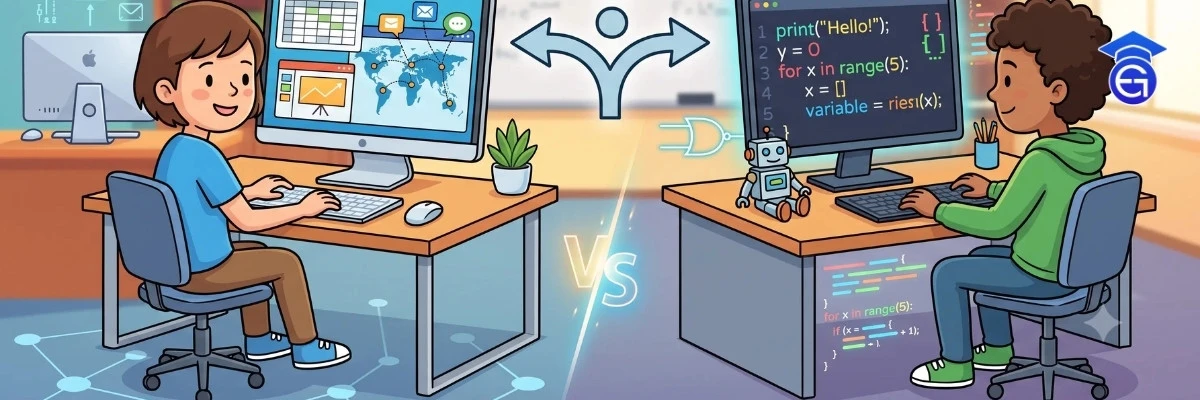
Option forms land home from school, and there it is: ICT or Computer Science, pick one. Most families assume this is a difficulty question, easy subject versus hard subject, and make the choice on that basis. That’s actually the wrong question, and it’s worth untangling before your child commits to two years of one or the other.
What this covers
- The question this actually is, once you strip away the assumptions
- What each subject actually tests
- Who tends to suit which subject
- The “ICT is the easy option” myth, and why it’s wrong
- Does this choice affect university or career options later?
- Can a student switch, or take both?
- Questions people are actually asking right now
The Question This Actually Is, Once You Strip Away the Assumptions
Here’s the framing that trips up a lot of families: treating ICT and Computer Science as two difficulty settings on the same subject, like choosing Foundation versus Higher tier in Maths. They’re not that. They’re genuinely different subjects that happen to share a school department and a shelf of similar-sounding names.
ICT is about using software, word processors, spreadsheets, databases, presentation tools, website builders, to solve practical tasks, alongside a theory paper on how technology works and affects the world around it. Computer Science is about programming, algorithms, and computational thinking, assessed mostly through written exam papers rather than live coding. Once that’s clear, the actual decision becomes a lot more specific than “which one is easier,” which is genuinely the wrong question to be asking.
What Each Subject Actually Tests
Worth being concrete here rather than vague, since the specifics are exactly what should drive the decision.
Cambridge’s IGCSE ICT splits its marks 40% theory and 60% practical, with the practical component split across two computer-based papers covering document production, databases, presentations, spreadsheets, data analysis, and website authoring. Every practical task is graded against precise written instructions, the right file name, the right save format, the right formula structure, under a strict time limit. It’s genuinely a subject about precision under pressure, not just software familiarity.
Computer Science, by contrast, is mostly a written subject, even though it sounds like the more “technical” option. A large share of the marks in Cambridge’s 0478 or Edexcel’s 4CP0 come from tracing algorithms by hand on paper, writing pseudocode in the board’s specific syntax, and explaining computer systems theory, binary, logic gates, networks, in written prose. Actual programming happens too, but a lot of the exam is closer to structured written maths than to sitting at a keyboard building something.
Worth knowing: a student who imagines Computer Science as “the subject where you build apps” and ICT as “the subject where you learn Word and Excel” has roughly the right idea about the day-to-day feel of each, but underestimates how exam-specific and precise both actually get once results are on the line.
Who Tends to Suit Which Subject
I’d rather give an honest, specific answer here than a diplomatic non-answer, so here’s a genuine attempt at one, acknowledging upfront that no framework like this is perfect for every student.
Computer Science tends to suit students who enjoy structured, logical problem-solving and don’t mind abstract written reasoning, the same instinct that shows up in students who are comfortable with algebra or step-by-step maths proofs, applied to algorithms instead. A student who genuinely likes figuring out why something doesn’t work, tracing back through steps to find an error, tends to do well here, and that instinct matters more than whether they’ve already learned to code.
ICT tends to suit students who are naturally organised, detail-oriented, and comfortable following a specific set of instructions precisely, since that discipline is exactly what the practical papers reward. A student who enjoys building a well-formatted document or a clean spreadsheet, who notices when something doesn’t quite match a specification, often does well here, independent of whether they’ve ever written a line of code.
There’s a genuine trade-off worth naming honestly. A student who’s a confident casual programmer at home, building small projects for fun, isn’t automatically suited to Computer Science’s exam style, since that’s a different skill from the written, paper-based reasoning the actual exam demands. And a student who’s simply “good with computers” in a general sense isn’t automatically suited to ICT either, since general comfort with software doesn’t guarantee the precision the practical papers actually test. Neither subject is a safe default just because a student uses technology confidently day to day.
Genuinely not sure which fits your child better?
A short diagnostic covering both a Computer Science-style pseudocode task and an ICT-style practical task under real time pressure tends to surface a clear preference fairly quickly, more reliably than guessing from a student’s general comfort with computers.
WhatsApp Edugravity Book Free DiagnosticThe “ICT Is the Easy Option” Myth, and Why It’s Wrong
This is worth addressing directly, because it’s a genuinely common assumption and it does families a disservice when it drives the choice.
ICT gets treated as the softer option partly because it doesn’t involve programming, and programming has a reputation, fairly or not, as the more academically serious skill. But being demanding and being about programming aren’t the same thing. ICT’s practical papers punish imprecision ruthlessly, a single wrong save format or an incorrectly referenced cell can cost real marks even when the underlying work is otherwise strong. That’s a genuinely exacting standard, just a different kind of exacting than Computer Science’s abstract algorithmic reasoning.
I’ve watched capable, conscientious students underperform in ICT because they assumed it would be straightforward and didn’t practise the specific discipline of following instructions to the letter under time pressure. I’ve also watched confident home coders struggle with Computer Science because they’d never practised explaining an algorithm in writing, only ever running it on a screen where mistakes show up and get fixed instantly. Both subjects have a real way of catching students who underestimate them.
Does This Choice Affect University or Career Options Later?
Less than most families assume, and it’s worth saying that plainly rather than adding pressure to a decision that’s genuinely reversible in most cases.
Most university computing, software engineering, and related degree programmes look at A Level or equivalent subject choices closer to application, not IGCSE-level choices made two or three years earlier. Taking ICT rather than Computer Science at IGCSE doesn’t close the door on studying Computer Science at A Level. It does mean a student starting programming from a slightly earlier point in that A Level course rather than having two years of IGCSE programming already behind them, which is a real but manageable catch-up, not a disqualifying gap.
The reverse is also true. A student who takes Computer Science at IGCSE and later decides they’d rather pursue a career built more around digital literacy, project management, or applied technology use than programming specifically, hasn’t wasted the choice either. The analytical thinking Computer Science builds transfers reasonably well, even if the specific subject path shifts.
Can a Student Switch, or Take Both?
Depends entirely on the specific school’s timetable and option block structure, so this is a direct question worth putting to the school rather than assuming an answer either way.
Some schools do allow both subjects to be taken alongside each other, which can genuinely work well for a student who’s honestly undecided and wants to test both before narrowing down, though it does mean committing two option slots rather than one, with whatever trade-off that creates elsewhere in the timetable. Switching from one to the other after starting is less common and depends heavily on how far into the syllabus a student already is, since Computer Science in particular builds cumulatively in a way that makes a late switch harder the further in it happens.
If genuine indecision is the honest situation, raising it with the school directly and early, rather than defaulting to a guess, tends to produce better options than assuming the choice is locked the moment the form goes in.
Questions People Are Actually Asking Right Now
The One Thing Worth Deciding First
Before picking a subject, it’s worth figuring out which kind of precision your child actually enjoys, or at least tolerates: following a detailed instruction exactly under time pressure, or reasoning through an abstract problem on paper without the immediate feedback a running programme gives you. That’s the real fork in the road, not a difficulty ranking.
Neither subject rewards a student for merely being generally comfortable with technology. Both reward a specific kind of discipline, and figuring out which one actually matches your child’s instincts is worth more than any general reputation either subject carries.
Want a clearer answer before the option form is due?
Edugravity’s Computer Science and ICT programmes both start with a diagnostic that shows which style of thinking actually suits a student, rather than guessing from general tech comfort. In-person in Sharjah at 107 Al Reem Plaza, Corniche Street, or online across the UAE.
WhatsApp Edugravity Book Free DiagnosticKey Takeaways
- ICT and Computer Science are genuinely different subjects, not different difficulty tiers of one subject
- ICT weights heavily toward precise, timed practical tasks; Computer Science weights heavily toward written algorithmic reasoning and theory
- Neither casual software comfort nor home coding automatically predicts success in either subject’s actual exam style
- The choice rarely closes doors permanently, most university computing routes look at A Level choices, not IGCSE ones
- Some schools allow both subjects together, or switching, depending on timetable structure, worth asking directly