What Happens If a Cambridge or Edexcel Paper Is Leaked?


A message lands in a WhatsApp group an hour before your exam. Someone says a paper’s been leaked. Screenshots start circulating. Your stomach drops, and suddenly you’re not thinking about revision anymore, you’re wondering if the whole exam is compromised, whether you’ll have to resit, whether looking at the message even by accident has put you at risk. Take a breath. Here’s what actually happens, based on how Cambridge and Edexcel have genuinely handled this in recent years, not on whatever’s circulating in the group chat.
What this covers
- What actually counts as a leak, and what usually doesn’t
- How leaks actually get detected
- What Cambridge and Edexcel actually do once a leak is confirmed
- Real cases from recent series, not rumours
- The part that genuinely matters most: malpractice risk
- What to actually do if you see one
- Questions people are actually asking right now
What Actually Counts as a Leak, and What Usually Doesn’t
A genuine leak means exam content becoming accessible to some candidates before the official sitting time, a full paper circulating early, or even just a handful of questions shared in a group chat hours before the exam starts. That’s the real definition, and it’s worth holding onto, because most of what circulates during exam season isn’t that.
A lot of what gets called a “leak” turns out to be an old paper recycled and passed off as new, or content invented entirely to cause panic. Exam boards verify every report before acting, precisely because false alarms are common and genuine leaks, while they do happen, are the exception rather than the rule.
How Leaks Actually Get Detected
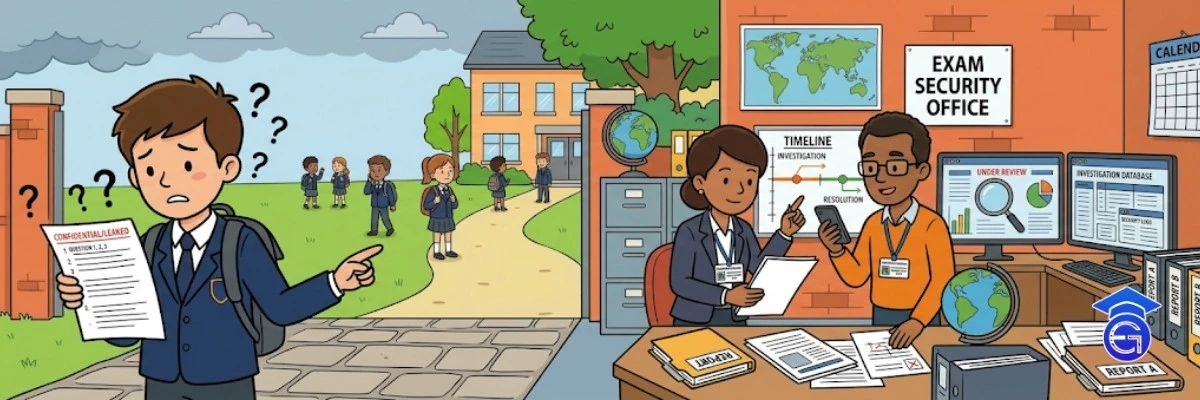
Neither board is relying on luck here. Cambridge and Edexcel actively monitor social media, forums, and messaging platforms where leaked content tends to surface, and a significant share of genuine reports come from students, teachers, and parents who spot something and flag it. Schools are expected to report anything suspicious to the board immediately rather than sitting on it.
Once something’s flagged, the first step is verification, checking whether it’s genuinely new exam content or an old paper being recirculated. Only confirmed material triggers a formal investigation, which typically looks at how far the content spread, which specific centres or regions were affected, and how it got out in the first place.
What Cambridge and Edexcel Actually Do Once a Leak Is Confirmed
Both boards keep contingency papers in secure storage specifically for this scenario. If a leak is confirmed before the exam starts, a school can be issued a replacement paper on exam day, so students sit a valid, uncompromised exam without losing time. That’s the most common outcome when a leak is caught early enough.
Where a leak is only confirmed after the exam has already happened, the response shifts toward protecting results rather than replacing the paper. Cambridge and Edexcel use statistical adjustment and grade boundary changes to make sure students aren’t penalised because a paper was compromised somewhere they weren’t involved. Confirmed leaks have tended to affect specific centres or regions rather than the entire global cohort, which is exactly why this kind of targeted, evidence-based adjustment works rather than requiring a blanket response affecting every student worldwide.
The reassuring part, said plainly: if you weren’t involved in a leak and you sat the paper honestly, the systems in place are specifically built to protect your result, not put it at risk. That’s true even when a leak makes headlines or spreads widely on social media.
Real Cases From Recent Series, Not Rumours
Worth grounding this in what’s actually happened rather than speculation, since real cases show the process working the way it’s meant to.
In 2024, a single Cambridge A-Level Mathematics paper was confirmed leaked. Cambridge’s response was to award affected students assessed marks based on available evidence, and offered a free resit in the following November series for anyone who wanted one, rather than forcing a mandatory resit on everyone involved.
In 2025, parts of three separate A-Level papers, Mathematics Paper 12, Mathematics Paper 42, and Computer Science Paper 22, were confirmed to have been partially shared before their scheduled sittings. And the May/June 2026 series saw a genuinely larger wave of leak allegations circulating on social media than in previous years, screenshots, claims of early access, and a fair amount of noise that made verifying what was actually real harder than usual for students caught in the middle of it.
The pattern across these cases is consistent: incidents get confirmed and addressed centre by centre or region by region, not treated as invalidating an entire global paper, and the response has generally involved crediting affected students fairly rather than punishing them for something outside their control.
The Part That Genuinely Matters Most: Malpractice Risk
I want to be direct here, because this is the one part of the whole topic where the stakes are real and worth taking seriously, more seriously than the leak itself in most cases.
Cambridge’s own guidance is explicit that engaging with anyone claiming to have leaked exam content, buying it, downloading it, opening a file someone sends you, saving it, forwarding it, or even just discussing its contents, can be treated as malpractice. That applies even if the content turns out to be fake. The stated penalty isn’t limited to the one paper in question. It can mean disqualification across every subject in that exam session, an entire session’s worth of work, gone, over something that started as curiosity or a screenshot passed along in a group chat.
Here’s the part worth sitting with for a second: confirmed leaks are usually partial and get addressed through the mark adjustments described above, meaning the actual advantage from seeing leaked content is often close to zero once the response kicks in. The downside, disqualification from your entire session, is enormous by comparison. That’s about as lopsided a risk as exists anywhere in the exam calendar, and it’s worth making sure that’s understood clearly, not glossed over.
If a leaked paper lands in your group chat: don’t open it, don’t screenshot it, don’t forward it, and don’t discuss what’s in it, even to say “this looks fake.” The safest response to anything claiming to be a leaked paper is not engaging with it at all, and reporting it instead.
What to Actually Do If You See One
A short, practical list, since clarity matters more than length here.
- Don’t open, screenshot, save, or forward anything claiming to be a leaked paper
- Avoid discussing its contents with classmates, even to speculate about whether it’s real
- Report it immediately to your exams officer, school, or the exam board directly
- Don’t engage with any account or website offering to sell or share papers, most are scams, and engaging carries risk regardless
- Wait for official communication from your school or the exam board rather than acting on anything circulating on social media
Reporting protects you and everyone else sitting the exam honestly. Boards have been consistent about this: they’re interested in protecting fairness, not punishing students who did the right thing and flagged a concern.
If exam-season anxiety is eating into actual preparation time
The most reliable answer to leak panic is genuinely being prepared, so a rumour in a group chat doesn’t feel like the only thing standing between you and a good result. Edugravity’s structured, board-specific past paper practice is built around exactly that kind of real readiness.
WhatsApp Edugravity Book Free DiagnosticQuestions People Are Actually Asking Right Now
The One Thing Worth Remembering
A leak, when it’s genuine, is rare, and the systems built to handle it exist specifically to protect students who had nothing to do with it. The actual danger for most students isn’t the leak itself. It’s the temptation to look, just to see, when curiosity feels harmless and the consequences feel abstract until they’re not.
The honest, calmer path through exam season is the boring one: don’t engage with anything claiming to be leaked content, report it if you see it, and put the energy that panic would otherwise consume into preparation you actually control.
Focus the energy on preparation that’s actually yours
Edugravity’s diagnostic-first, board-specific past paper practice gives students something more reliable than exam-season rumours to hold onto. In-person in Sharjah at 107 Al Reem Plaza, Corniche Street, or online across the UAE.
WhatsApp Edugravity Book Free Trial ClassKey Takeaways
- Most reported “leaks” turn out to be hoaxes or recycled old papers, exam boards verify before acting
- Confirmed leaks are typically regional or centre-specific, not global, and honest students elsewhere aren’t affected
- Contingency papers and statistical grade adjustment exist specifically to protect results, resits are rare
- Real confirmed cases include a 2024 leaked A-Level Maths paper (assessed marks plus free resit) and partial 2025 leaks across three A-Level papers
- Engaging with leaked content in any way, even just opening or discussing it, can risk disqualification across an entire session, far outweighing any possible advantage