
How to Transition from Year 10 to IGCSE Year 11 Without the Usual Stress
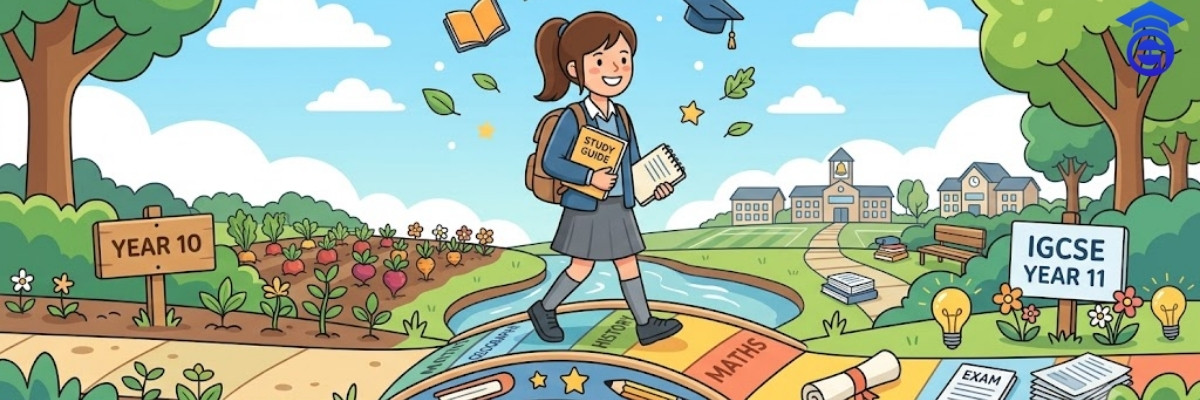
Most students finishing Year 10 feel one of two things about September. Either vague, low-level dread — “Year 11 is supposed to be hard” — or a kind of confident dismissal — “It’s probably just like Year 10 but more.” Neither of those is quite right. Year 11 is different in specific ways that are worth understanding before you get there, rather than discovering them the hard way in October.
What this covers
- What actually changes between Year 10 and Year 11
- Why September itself is often the hardest bit
- Where the jump is steepest, subject by subject
- The summer gap problem and what it quietly does
- What students can actually do before September
- What parents can do that isn’t just pressure
- The mindset thing that nobody says out loud
- Questions students and parents ask
What Actually Changes Between Year 10 and Year 11
The honest answer is: the content doesn’t change as dramatically as the conditions around it. Year 11 Maths isn’t somehow a completely different subject from Year 10 Maths. But there are three specific things that shift in Year 11 that make it feel harder.
The pace is faster. Teachers know that the IGCSE exams are less than a year away when Year 11 starts, and the syllabus coverage has to fit into the time available. In Year 10, there was more room to linger on a topic, loop back, explain it again. In Year 11, that room shrinks. If a concept doesn’t land the first time, catching up becomes the student’s problem to manage independently.
The stakes feel higher. This is partly real and partly psychology. The grades students earn at IGCSE directly affect which subjects they can take at A-Level, which affects university applications. That weight is real. But it also produces a particular kind of performance anxiety in students who’ve never really had to sit a high-stakes external exam before, and anxiety doesn’t always do good things to learning.
The dependency on Year 10 foundations is total. This is the one that catches students most off guard. Year 11 content doesn’t reteach what Year 10 covered. It assumes it’s there and builds on it. A student with shaky Year 10 Algebra who arrives in Year 11 Maths expecting to catch up as they go will find that the catch-up moment doesn’t come — because the class moved on the day they fell behind.
The transition in one sentence: Year 11 isn’t harder because the content is more complex — it’s harder because the conditions are less forgiving. Same subject, faster pace, higher stakes, and no time to rebuild foundations that weren’t solid to begin with.
Why September Itself Is Often the Hardest Bit
I’ve watched students start Year 11 for a long time, and September is consistently the month where things feel most unsettled. Not because Year 11 is at its most demanding in September — the hardest content is usually later in the year. It’s because of what happened over summer.
Two months of not actively studying means Year 10 material has faded. Not disappeared — but the edges get soft. Topics that felt reasonably solid in June feel hazy by early September. And the first few weeks of Year 11 depend on that Year 10 material being accessible, because teachers are introducing new content that sits on top of it.
So a student arrives in Week 1 of Year 11 Maths, the teacher introduces quadratic equations, and somewhere underneath that is a piece of algebra from Year 10 that’s now fuzzy. The student can’t quite follow, falls slightly behind, spends Week 2 trying to catch up, meanwhile Week 2 content arrives. Within three weeks, there’s a gap that wasn’t there in June but is now established, and it’s one of those gaps that’s hard to close once the term is fully underway.
That’s the September problem. It’s not the Year 11 content itself. It’s the re-entry after a long break, compounded by the fact that Year 11 won’t wait for anyone to get up to speed.
Where the Jump Is Steepest, Subject by Subject
Not every subject is equally sensitive to the Year 10 to Year 11 transition. Some are genuinely fine — a student who did okay in Year 10 History or Geography will generally find Year 11 a step up but not a cliff edge. Others are more unforgiving.
Mathematics
The cumulative subject above all others. Year 11 IGCSE Maths introduces topics like quadratics, trigonometry at a higher level, functions, and simultaneous equations in more complex forms. Every single one of these depends on Year 10 algebra being solid. A student who could solve basic linear equations in Year 10 but was shaky on rearranging formulae or working with indices is going to hit a wall in Year 11, and hit it early.
The specific Year 10 topics worth checking before September: indices and surds, factorisation, linear equations and inequalities, basic coordinate geometry, and the foundations of probability and statistics. These aren’t optional background — they’re the ground that Year 11 Maths stands on.
Sciences — Physics, Chemistry, Biology
Each of the three sciences has its own version of this dependency problem, and the version differs by subject.
In Chemistry, atomic structure is the keystone. Bonding, reactions, organic chemistry — all of it connects back to a solid understanding of atoms, electrons, and the periodic table. A student who memorised the structure but doesn’t really understand it will find Year 11 Chemistry increasingly confusing as topics get more applied.
In Physics, mechanics is the foundation. Forces, motion, energy — these come back in more complex forms throughout Year 11. Students who coasted through the basics and couldn’t reliably apply Newton’s laws to new situations in Year 10 will feel that in Year 11.
Biology is arguably the most content-heavy of the three, and Year 11 adds significant complexity in genetics, homeostasis, and ecology. Students who treat biology as a memorisation subject tend to do okay in Year 10, where recall gets you further. In Year 11, the application questions — “explain how,” “suggest why” — need actual understanding rather than memorised phrases.
English
The jump in English is less about foundational knowledge and more about the quality of written analysis expected. Year 10 IGCSE English rewards a student who can identify language features and say something basic about their effect. Year 11 expects more — fuller analysis, more precise language, better structuring of arguments. Students who never really developed the analytical writing habit in Year 10 find Year 11 English harder than they expected.
Economics and Business Studies
These subjects get more conceptually demanding at Year 11, and the extended answer questions expect students to apply theory to unfamiliar contexts rather than recall it. A student who memorised definitions in Year 10 but never worked through enough application questions will find that the Year 11 exam papers ask for a kind of thinking they haven’t practised.
Worth knowing: the subjects where students feel most secure at the end of Year 10 aren’t always the ones where the Year 11 transition is smoothest. A student who got a B in Year 10 Maths by grinding through worked examples, without fully understanding the underlying logic, can find Year 11 more disorienting than a student who got a C but genuinely understood the material. Grades from Year 10 are a useful signal, but they’re not the whole picture.
The Summer Gap Problem and What It Quietly Does
Summer is supposed to be rest. And it should be — students who’ve been through a full school year need the break. The problem isn’t the rest itself, it’s the assumption that everything learned in Year 10 will still be readily accessible in September. It won’t be, not at the same level.
Memory doesn’t preserve information at fixed levels without use. Things that weren’t deeply understood in Year 10 — learned well enough to pass a test but not genuinely internalised — are the first to fade. And those are exactly the things Year 11 will lean on immediately.
The students who handle September best aren’t the ones who studied intensively through summer. They’re usually the ones who did something relatively light but consistent — a bit of Maths a few times a week, a re-read of Chemistry notes, some practice questions in subjects they know were shaky. Nothing that requires sacrificing the holiday. Enough to keep the foundations accessible rather than letting them quietly crumble.
A few hours a week across the two summer months is roughly what it takes to maintain what’s already there. Not build new knowledge — just keep the existing knowledge from fading. That’s an easier task than it sounds, and it makes a genuine difference to how the first few weeks of Year 11 feel.
What Students Can Actually Do Before September
The most useful thing isn’t to get a head start on Year 11 content. It’s to go back through Year 10 and identify what’s genuinely understood versus what was memorised just well enough to get through a test.
The practical way to do this is to try a few practice questions from each subject — not from Year 11 papers, just from Year 10 revision material — and see what comes easily and what doesn’t. The topics that produce a kind of mental blankness, or where a student starts writing and then stops and can’t continue, are the ones worth spending time on before September.
Once those topics are identified, the approach is straightforward: go back to the concept itself rather than memorising more worked examples. Understanding why the method works, not just what the method is, is what makes knowledge stick across a long summer and stay accessible when Year 11 builds on it.
For students who find that self-directed summer studying consistently doesn’t happen — and this is most students, honestly — structured support over the summer gives the external accountability that makes the difference between a plan and an outcome. Edugravity runs a two-month Year 11 Head Start Programme across July and August specifically for Year 10 students making this transition, covering the Year 10 topics that matter most for Year 11 success and giving students a first look at some early Year 11 content. It’s not exam preparation — it’s just a well-structured way to make sure the summer gap doesn’t do the damage it usually does.
What Parents Can Do That Isn’t Just Pressure
The instinct when a child is heading into a high-stakes year is to apply more pressure. Check the homework more, ask about revision more, express concern more often. The research on this, and observation over many years, both suggest it doesn’t help as much as parents hope — and sometimes makes things actively worse, because the student starts performing their studying rather than actually doing it.
What tends to help more: making it easy to study at home without friction. A consistent quiet space, not having to ask for quiet, understanding from the rest of the family that Year 11 has specific demands. These things sound minor but they’re not. A student who can sit down to revise without negotiating for a quiet table tends to actually study more than one who has to manage the environment first.
Talking about the year in terms of what’s interesting rather than what’s at stake also makes a difference. “What did you study in Chemistry today” lands differently from “are you keeping up with Chemistry.” One opens a conversation. The other checks a box and leaves the student feeling scrutinised.
And if there’s a specific subject where a student is clearly struggling — not just finding it hard, but genuinely not understanding what’s happening in class — addressing that early matters. Getting support in October for a gap that opened in September is much better than addressing it in January when three months of content have built on top of it.
The Mindset Thing Nobody Says Out Loud
Year 11 has a reputation. It gets talked about as the hard year, the stressful year, the one that matters. Students arrive with that reputation already loaded in, and it shapes how they experience difficulty when it comes.
A student who hits a tricky topic in Week 3 of Year 11 and thinks “this is happening because Year 11 is hard” responds differently from one who thinks “this is happening because I have a specific gap I need to address.” The first framing is passive — Year 11 is hard, and therefore struggling is expected and not much can be done about it. The second is actionable.
I’ve seen confident Year 10 students become genuinely anxious in Year 11 not because they suddenly became worse students, but because the context around them changed and they interpreted normal difficulty as evidence of inadequacy. And I’ve seen students who were barely scraping through Year 10 have a completely different Year 11 experience because they identified their gaps, got targeted help, and arrived in September on actual solid ground for the first time.
The year is demanding. But it’s not arbitrarily hard. The difficulty has specific causes, and most of those causes are addressable before September if someone is paying attention to them.
Moving into Year 11 IGCSE this September?
Edugravity’s Year 11 Head Start Programme runs across July and August, covering the Year 10 foundations that Year 11 depends on — Maths, Sciences, English, Economics, Business Studies, and Accounting. AED 349 per subject. Small groups of maximum 6 students, in-person in Sharjah at 107 Al Reem Plaza, Corniche Street, or online across the UAE.
WhatsApp Us View the Head Start ProgrammeQuestions Students and Parents Ask
The Short Version
Year 11 is harder than Year 10. But most of what makes it harder is identifiable and addressable before September rather than inevitable.
The pace picks up. The exam pressure is real. Year 11 content assumes Year 10 foundations are solid, and won’t wait for anyone to rebuild them from scratch once the term is underway. And summer, by default, quietly erodes those foundations.
The students who handle the transition well aren’t always the ones who were strongest in Year 10. They’re the ones who arrived in September on solid ground in the subjects that needed it — because someone helped them identify and address the right things before summer did its usual work.
If you’re trying to figure out where to focus over summer, Edugravity’s Year 11 Head Start Programme starts with a diagnostic in each subject — so the first thing that happens is a clear picture of exactly where to focus, rather than guesswork. AED 349 per subject, July and August, in-person in Sharjah or online.
Key Takeaways
- Year 11 is harder because the conditions are less forgiving — faster pace, higher stakes, no time to rebuild Year 10 foundations — not because the content is categorically more complex
- Maths and Sciences are where the transition is steepest, because both subjects assume Year 10 knowledge is secure and build directly on it without reteaching
- The September overwhelm most Year 11 students feel is usually a summer gap problem: Year 10 knowledge fades over two months, and Year 11 picks up immediately where Year 10 left off
- A few hours a week across July and August — focused on the right Year 10 topics — is enough to keep foundations accessible and make September considerably less jarring
- Early intervention works better than late intervention: addressing a gap in June is easier, less stressful, and more effective than addressing the same gap in November with exam pressure building