Why Students Should Start Preparing for IGCSE Year 11 While Still in Year 10
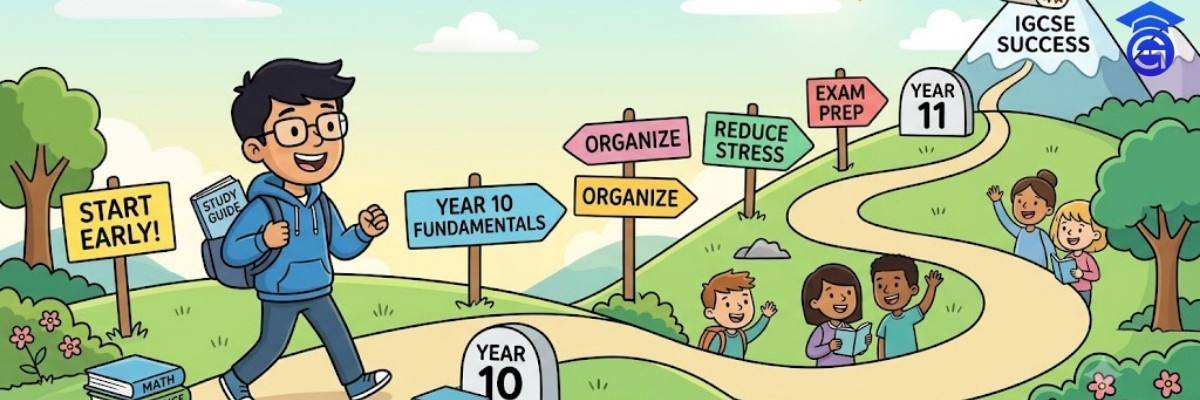
Ask most parents when their child should start preparing seriously for IGCSE and the answer is usually “Year 11.” Ask most students the same question and you’ll get a vague “soon” that means the same thing. The problem is that by Year 11, a lot of the useful preparation window has already closed. Not completely — there’s still plenty a student can do. But the easiest and most effective preparation happens earlier than almost anyone thinks.
What this covers
- The “Year 10 doesn’t count” assumption and why it’s wrong
- How IGCSE is actually structured across the two years
- What gaps look like when they compound over a year
- Why Maths and Sciences punish late preparation most
- What preparation in Year 10 actually means
- Why the summer between Year 10 and 11 is more important than it looks
- The case against early preparation — and why it doesn’t hold
- Questions parents and students ask
The “Year 10 Doesn’t Count” Assumption and Why It’s Wrong
There’s a version of this attitude that’s almost universal. Year 10 is the trial run. Year 11 is when it gets real. Get through Year 10, rest over summer, then buckle down for the exam year.
It’s understandable. IGCSE exams are sat in Year 11. The certificates say Year 11. The pressure arrives in Year 11. So the logic feels right even though it produces predictable problems, every year, for a large number of students.
Here’s what the assumption misses: IGCSE is a two-year course. Cambridge designs the Year 10 syllabus specifically as the foundation layer for Year 11. The topics covered in Year 10 aren’t standalone — they’re the prerequisites for what Year 11 teaches. Treating Year 10 as low-stakes because the exams come later is a bit like building the first floor of a building carelessly because nobody’s going to live on it. Everything above it sits on it regardless.
Students who arrive in Year 11 with solid Year 10 foundations have a genuinely different experience of the exam year than those who arrive with gaps. Not a slightly easier experience. A categorically different one. The Year 11 teacher doesn’t reteach Year 10. They assume it. A student who’s missing a foundation will feel it from the first few lessons, and catching up while keeping pace with new content is significantly harder than it sounds.
How IGCSE Is Actually Structured Across the Two Years
Most students and parents think of IGCSE as a Year 11 qualification. Technically that’s when the exams happen. But Cambridge explicitly designs the qualification as a two-year programme, with Year 10 as Year 1 and Year 11 as Year 2.
The Year 10 syllabus introduces the core concepts in each subject. Year 11 extends those concepts, applies them in more complex ways, and introduces the higher-level topics that the exam tests at harder grade boundaries. The relationship isn’t parallel — Year 11 depends on Year 10 in a chain of dependencies that differs by subject but exists in all of them.
In Maths, for example, the Cambridge IGCSE Mathematics (0580) syllabus covers number, algebra, geometry, statistics, and probability across both years. The Year 10 content on algebraic manipulation, basic functions, and coordinate geometry feeds directly into Year 11 quadratics, trigonometry, vectors, and more complex functions. You cannot comfortably handle Year 11 Maths without the Year 10 Maths being genuinely understood.
In Chemistry, the Year 10 introduction to atomic structure, bonding, and basic reactions is the conceptual scaffold for Year 11 topics in electrochemistry, organic chemistry, and rates of reaction. In Physics, the Year 10 work on forces, energy, and basic electricity reappears in more complex forms throughout Year 11. In Biology, Year 10 cell biology and basic biochemistry underpin Year 11 genetics, homeostasis, and ecosystems.
None of this is coincidence. It’s how the qualification is designed. Understanding that structure changes how sensible people think about Year 10.
A thought worth sitting with: Cambridge doesn’t design Year 10 as a warm-up. It designs it as Year 1 of a two-year qualification. The framing of “Year 11 is when IGCSE really starts” is a student cultural myth, not a reflection of how the curriculum is actually built.
What Gaps Look Like When They Compound Over a Year
A gap in Year 10 doesn’t stay the size it started. It grows. This is the part that’s hardest to communicate to students who are in Year 10 and not yet feeling any particular consequence from their shaky understanding of, say, indices in Maths or atomic structure in Chemistry.
Here’s a specific version of how it tends to play out. A student in Year 10 doesn’t fully grasp how to factorise quadratic expressions. It comes up mid-year, moves on, and the student mostly keeps up by following worked examples without understanding why the method works. They pass the relevant section of the internal test with 60%, which looks okay. Everyone moves on.
In Year 11, factorisation is assumed. The teacher uses it without comment while introducing completing the square. The student half-follows because they remember the shape of the earlier method but not the logic. Completing the square builds on factorisation, so now they’re shaky on both. When quadratic inequalities arrive the following week, built on completing the square, they’re lost. Three topics later, they’re sitting a mock paper and dropping marks on everything from the quadratics section onwards — not because Year 11 is too hard, but because a Year 10 gap compounded silently for twelve months.
The same pattern runs through Chemistry, Physics, Biology, and to varying degrees through the humanities and social sciences too. The specific gap differs by subject. The compounding mechanism is the same.
What makes this harder to catch: Year 10 assessments are set by schools, not Cambridge, and the difficulty often doesn’t reflect the standard the IGCSE exam will use. A student can perform reasonably well on school tests while still having foundational gaps, because the school tests don’t yet demand the same application and reasoning the actual IGCSE papers will. The gap isn’t always visible in Year 10 grades.
Why Maths and Sciences Punish Late Preparation Most
Not all subjects are equally sensitive to the timing of preparation. Some IGCSE subjects can be approached later with reasonable results — a student who starts serious preparation for IGCSE History or Economics relatively late in Year 11 can still cover the content, because these subjects don’t have the same chain of structural dependencies.
Maths and the Sciences are different. They’re cumulative in a way that makes late preparation genuinely punishing. You can’t understand organic chemistry without understanding atomic bonding. You can’t work with vectors without understanding basic geometry and coordinates. You can’t do the harder probability topics without the foundation of basic probability. These aren’t just helpful priors — they’re prerequisites in the strict sense that the later topic doesn’t function without them.
A student who decides in February of Year 11 that they need to get serious about IGCSE Maths faces a specific problem: they may need to go back to Year 10 content to rebuild foundations before they can make real progress on Year 11 content. That’s two things to do in a timeline that was already tight. Many students in this situation end up doing a shallow pass over everything and producing exam results that don’t reflect their actual ability — because they were capable of doing better, but the preparation window was too compressed for depth.
The student who arrives in Year 11 with solid Year 10 Maths foundations can spend the year deepening understanding and practising application. The student who arrives without them spends much of the year trying to establish what should already be established. Same exam, same teacher, same classroom. Very different experience of it.
What Preparation in Year 10 Actually Means
This needs to be said clearly because “start preparing early” is advice that sounds like “study more” or “do extra past papers from Year 10” — and it doesn’t mean either of those things. Both would be the wrong approach.
Preparation in Year 10 means genuinely understanding the content as it’s taught, rather than keeping pace with the class by memorising patterns and methods without grasping why they work. It means asking questions about the things that don’t quite make sense rather than nodding through them. It means being honest about which topics feel solid and which don’t, rather than assuming the shaky ones will sort themselves out.
It also means getting targeted support in subjects where gaps are forming, early enough that the gap is still small. A chemistry student who’s fuzzy on atomic structure in October of Year 10 can address that with a few focused sessions. The same student who is fuzzy on atomic structure in October of Year 11 — when bonding, reactions, and organic chemistry have built on top of it for a year — has a significantly larger problem to untangle in significantly less time.
The end of Year 10 and the summer that follows are the most important preparation window most students never use. By late Year 10, a student knows which subjects have gaps and which don’t. They can identify the specific topics that felt shaky rather than guessing. They have eight weeks of summer before Year 11 begins. That combination is genuinely useful, and most students treat it as simply the end of Year 10 rather than the start of something.
What “preparing early” is not: doing Year 11 content in Year 10. Trying to get ahead of the syllabus. Sitting past papers in Year 10 when the content hasn’t been taught yet. The right kind of early preparation is about securing the Year 10 foundation, not rushing into Year 11 material. That distinction matters because the wrong version is genuinely counterproductive.
Why the Summer Between Year 10 and Year 11 Is More Important Than It Looks
Two months of summer might be the single most underused opportunity in the IGCSE timeline. Here’s why it matters more than students tend to realise.
By the end of Year 10, all the Year 10 content has been taught. A student in June knows what they understand well and what they don’t — the honest version, not the school-test version. They have a complete map of their Year 10 knowledge. The summer is the moment to address what’s on that map before Year 11 starts building on it.
Once Year 11 begins, there’s no protected time to go back. The pace picks up, new content arrives constantly, and the space to revisit Year 10 foundations simply doesn’t exist in the same way. Every week that passes in Year 11 makes the cost of unaddressed Year 10 gaps slightly higher, because more new content has built on top of them.
Summer is also, logistically, the moment when students have the most time and the least competing pressure. No school assessments. No new content arriving daily. No homework from five subjects. It’s the lowest-stress environment in the IGCSE timeline to do the kind of reflective, targeted work that actually addresses gaps properly rather than patches them temporarily.
A student who spends even a few hours a week across July and August revisiting the Year 10 topics they know were shaky will arrive in September meaningfully better prepared than one who didn’t. Not dramatically better in terms of raw hours invested — the return on investment for targeted foundation work at this stage is high precisely because it’s addressing the right things at the right time.
For students who know self-directed summer work is unlikely to actually happen, Edugravity runs a dedicated Year 11 Head Start Programme across July and August — specifically designed around this window, this student group, and this purpose. It starts with a diagnostic in each subject so time goes toward the actual gaps rather than general revision.
The Case Against Early Preparation — and Why It Doesn’t Hold
It’s worth taking the opposing view seriously, because it has some surface logic to it. Year 10 students have a full academic workload. Piling on extra preparation for a year that hasn’t started seems premature. And burning students out before Year 11 even begins would be counterproductive.
All of that is true if “early preparation” means additional pressure on top of an already demanding Year 10. But that’s not what’s being argued here. The case for Year 10 preparation is the case for doing Year 10 properly — understanding the content as it’s taught, addressing gaps when they’re small, and not treating the year as a throwaway prelude to the exam year.
The burnout concern applies to students who are over-scheduled, under-rested, and pushed to perform beyond sustainable levels. It doesn’t apply to a student who understands their Year 10 Chemistry topic before it moves on, or who spends two hours in the summer consolidating something that was shaky. That’s not pressure. That’s just learning the course.
The deeper issue is that the argument against early preparation often rests on an implicit assumption that there’s plenty of time in Year 11 to catch up. There isn’t. Year 11 has its own content to get through. The exam is at the end of it. Teachers can’t slow Year 11 down to give students space to rebuild Year 10. That rebuild, if it happens at all, happens at cost to Year 11 progress.
Year 11 is already full. Year 10, and the summer after it, are the preparation window. Most students don’t use them as such. The ones who do tend to have a noticeably different experience of the exam year.
Finishing Year 10 and thinking about Year 11?
Edugravity’s Year 11 Head Start Programme runs across July and August for students making exactly this transition. A diagnostic in each subject to identify the right gaps, then two months of structured work to address them before Year 11 begins. AED 300 per subject. Small groups of maximum 6 students, in-person in Sharjah at 107 Al Reem Plaza, Corniche Street, or online across the UAE.
WhatsApp Us View the Head Start ProgrammeQuestions Parents and Students Ask
What This Actually Looks Like in Practice
There’s a student I think about when this topic comes up. Finished Year 10 with Bs and Cs across their subjects — not brilliant, not struggling, somewhere in the middle. Parents figured Year 11 would be when they’d get serious, so summer was a rest. September arrived and Year 11 started. Week 3, their Chemistry teacher introduced bonding and spent one lesson on it before moving to reactions. The student was lost, had a vague recollection of atomic structure from Year 10 but couldn’t quite access it under pressure. Asked a friend who also wasn’t sure. Didn’t ask the teacher. Reactions built on bonding they hadn’t secured. By November mock exams, Chemistry was their worst result by far.
This isn’t a story about a struggling student. It’s a story about a reasonably capable student who was underprepared for the specific way Year 11 works — and who would have had a completely different experience if atomic structure had been properly consolidated in the summer, or even properly understood when it was taught in Year 10.
That’s the version of this that plays out most often. Not dramatic failure. Just quiet underperformance relative to actual ability, because the foundations weren’t solid when Year 11 needed them to be.
The right response isn’t alarm — it’s early action. Year 10 is long. The summer after it is right there. These are the preparation windows that actually exist for IGCSE students, and most of them go unused because the exam year hasn’t started yet. By the time it has, the easiest preparation time is already gone.
If your child is currently in Year 10 or has just finished it, the most useful thing to understand is which subjects have gaps forming. Edugravity’s Year 11 Head Start Programme starts with a diagnostic in each subject for exactly this reason — so the preparation that follows goes toward the right places, not a general sweep of everything.
Key Takeaways
- IGCSE is a two-year qualification — Cambridge designs Year 10 as the foundation layer that Year 11 content builds on directly, not a trial run before the exam year
- Year 10 gaps don’t stay small: they compound silently as Year 11 content layers on top of them, which is why students often feel blindsided by how difficult Year 11 gets early in the year
- Maths and the Sciences are most sensitive to late preparation because of their strict cumulative structure — you genuinely cannot follow Year 11 Physics, Chemistry, or Maths comfortably without the Year 10 material being properly understood
- Preparation in Year 10 means genuine understanding, not extra workload — addressing gaps when they’re small, asking questions rather than nodding through confusion, and not treating the year as low-stakes
- The summer between Year 10 and Year 11 is the single most underused preparation window in the IGCSE timeline: two months, no competing pressure, and a complete picture of which Year 10 topics need attention