UAE School Mobile Phone Ban: What Parents and Students Need to Know in 2026



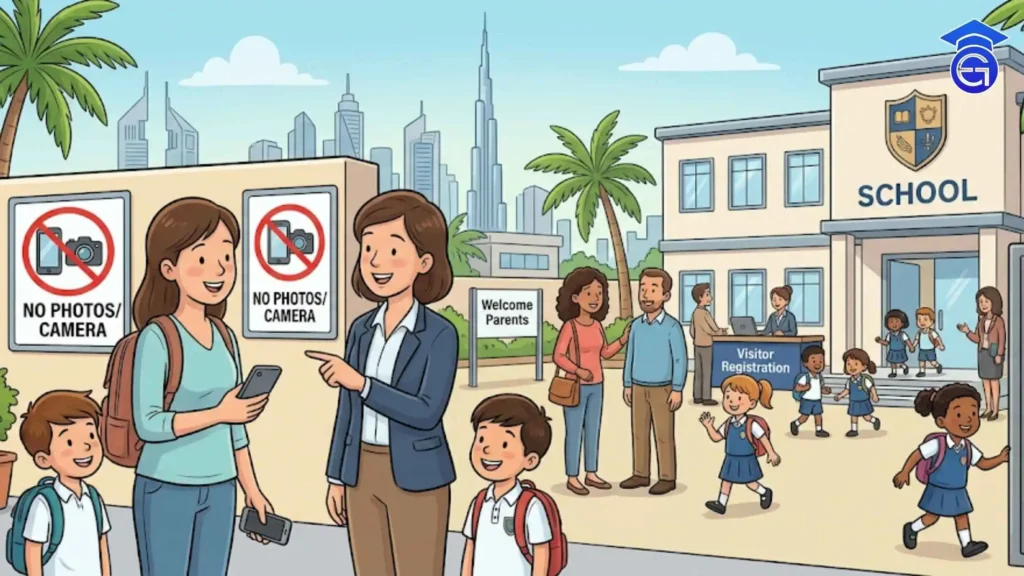
There’s a specific image that comes to mind every September first now, a line of students filing into homeroom and quietly dropping phones into a box or a pouch before the day even starts. That’s not new this year, the UAE’s school mobile phone ban has been in place since last year. What is new, as roughly 1.27 million students head back into classrooms this week, is how many schools are treating the ban as the start of a conversation rather than the end of one.
What this covers
- What the ban actually requires, and who it applies to
- Why schools are moving past simple confiscation
- What the France comparison actually teaches
- The distinction between personal phones and learning devices
- What this actually means for the hours outside school
- Questions people are actually asking right now
What the Ban Actually Requires, and Who It Applies To
Worth being precise about this, since it gets described loosely. A ministerial ruling introduced last year prohibits students from bringing mobile phones into public and private schools that follow the Ministry of Education curriculum, with penalties attached for violations. That’s a specific, defined scope, not a blanket rule covering every school in the country.
Private schools outside that curriculum don’t operate under one single uniform policy, since regulation for those runs through the individual emirate authorities rather than a single ministry directive. In practice, many have introduced their own version anyway, commonly requiring phones to be handed in at the start of the day or stored securely until dismissal. The shape of the policy varies by school, but the direction is broadly consistent.
Non-compliance carries real consequences at some schools. One school leader described phones being confiscated for the remainder of the academic year in cases of repeated non-compliance, which is a meaningfully longer consequence than a same-day return, and worth knowing if a family hasn’t yet had that conversation with their own school about exactly what the penalty structure looks like.
Why Schools Are Moving Past Simple Confiscation
Here’s the part that’s genuinely shifted this year, and it’s worth sitting with rather than skimming past. Educators quoted around this rollout have been unusually direct about the limits of a ban on its own. One school principal put it in terms that stuck with me: a policy that controls behaviour for seven hours a day doesn’t teach judgement for the other seventeen, and a student who hands in a phone in the morning and scrolls the moment they’re home hasn’t actually developed a different relationship with technology, just had a pause imposed on it.
That’s a genuinely useful reframe, and it’s clearly shaping how schools are approaching this term. Rather than treating the ban as the finished policy, several are building digital citizenship directly into the school day, conversations about screen habits, social media, online safety, attention span, and sleep, as ordinary parts of school life rather than a one-off assembly early in the term.
Worth noting: one school founder framed the goal explicitly as growing “digital maturity” over time, rather than simple compliance with a rule. That’s a different, longer measure of success than whether phones stay in their pouches, and it’s a more honest one.
What the France Comparison Actually Teaches
The timing here isn’t a coincidence. France’s parliament approved legislation in July banning social media access for under-15s and mobile phone use in high schools, and that rollout has become an unavoidable reference point for UAE schools thinking through their own approach, even though the UAE’s ban predates it by roughly a year.
The lesson being drawn from France isn’t that the underlying policy is flawed. French unions raising concerns ahead of implementation weren’t objecting to the principle of a ban, according to one UAE school leader’s reading of the situation, they were warning that many schools simply lacked the storage, staffing, and systems to deliver it properly on the timeline given. That’s a specific, practical failure mode, phone bans tend not to fail because the idea is wrong, they fail because the logistics get underestimated and enforcement gets left to individual teachers to improvise in the moment.
For UAE schools, that’s actually a reasonably favourable comparison. An existing regulatory framework and a year of practical experience already in place count for something here, provided schools treat that head start as a reason to refine the approach rather than assume the hard part is already finished.
The Distinction Between Personal Phones and Learning Devices
One detail worth understanding clearly, since it prevents a common misreading of what’s actually being restricted. This isn’t a rejection of technology in the classroom. Several schools continue running structured Bring Your Own Device programmes, often from the primary years upward, for teacher-supervised learning with safeguards built in.
The distinction schools are drawing is specifically between personal smartphones and school-managed learning devices, and it’s a meaningful one. A school-issued laptop or tablet, used for a defined learning task under supervision, is a genuinely different thing from a personal phone that imports social media, group chats, and a stream of notifications directly into the middle of the school day. One Abu Dhabi principal described this distinction as central to how the policy is being communicated to students and parents, precisely so the restriction reads as targeted rather than a blanket rejection of anything digital.
That framing matters for how families talk about this at home too. A blanket “no screens” message misses the actual point being made. The concern isn’t screens in general, it’s the specific category of personal device that brings the noise of the outside world into a space meant for focus.
If the phone ban has changed how your child studies at home too
A lot of families are noticing that less phone access during the school day shifts more of the distraction management burden onto homework and revision time at home. Edugravity’s small group sessions build in exactly the kind of structured, focused routine that carries that same discipline outside school hours.
WhatsApp Edugravity Book Free Trial ClassWhat This Actually Means for the Hours Outside School
If the honest critique of a ban is that it only covers seven hours, the honest follow-up question for any parent is what’s actually happening in the other seventeen. That’s not a rhetorical guilt trip, it’s a genuinely practical thing worth a few minutes of thought this week.
The schools getting this right seem to be extending the same logic home-side rather than leaving it as a school-only initiative: treating screen time as something to actively manage and talk about, not just restrict during defined hours and ignore the rest of the time. That includes fairly ordinary things, consistent routines around homework and sleep, open conversation about what a student is actually doing online rather than assuming, and parents modelling reasonable phone habits themselves, since kids notice the gap between a rule and the behaviour happening around them fast.
None of that is a dramatic overhaul. It’s mostly about treating the ban as a starting point for a conversation that continues at home, rather than a problem the school has now fully solved on its own.
Questions People Are Actually Asking Right Now
The One Thing Worth Sitting With This Week
A rule that only covers part of the day was always going to need something else alongside it, and it’s genuinely encouraging to see UAE schools naming that gap directly instead of treating a year-old ban as finished business. The honest measure of whether this is working isn’t whether phones stay in their pouches at 9am. It’s whether a student’s relationship with their phone looks any different by the time they’re using it unsupervised at home.
That second part isn’t really a school’s job to finish alone. It’s a genuinely shared one, and this week, with everyone back in routine, is a reasonable moment to actually have that conversation at home rather than assume the school policy is doing all the necessary work.
Settling back into term with a child who needs more structured focus?
Edugravity’s small group sessions build the same kind of focused, distraction-free routine schools are aiming for during the day, extended into homework and exam preparation. In-person in Sharjah at 107 Al Reem Plaza, Corniche Street, or online across the UAE.
WhatsApp Edugravity Book Free Trial ClassKey Takeaways
- The UAE’s school mobile phone ban has been in place since last year for public and MOE-curriculum private schools, with penalties for violations
- Schools are increasingly pairing the ban with digital citizenship lessons, since a ban only governs school hours, not the rest of the day
- France’s 2026 phone ban rollout offers a logistics warning, not a case against the policy itself: storage, staffing and enforcement systems matter
- Schools are distinguishing personal smartphones from school-managed learning devices, not rejecting technology outright
- The most effective response extends the same thinking home, treating screen time as something to actively manage rather than restrict only during school hours