
Signs Your Child May Need Extra Academic Support (And What to Do About It)
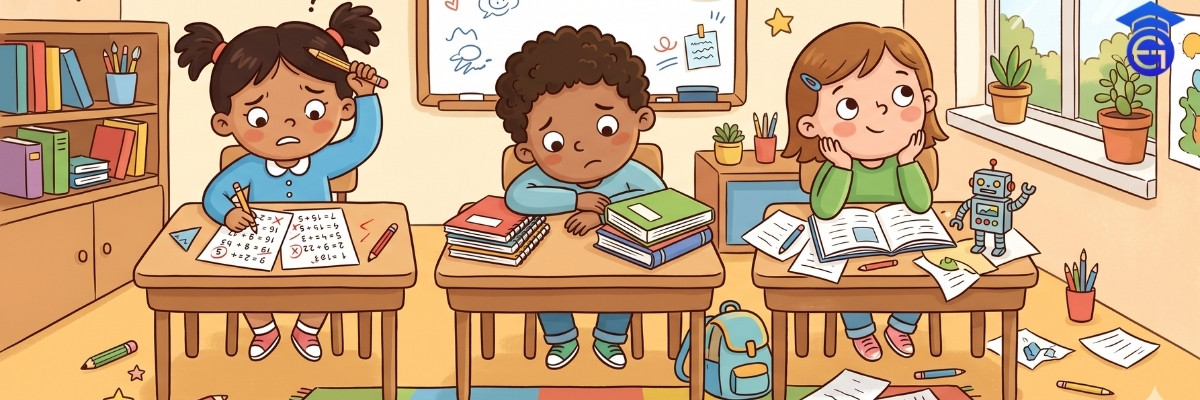
Most parents don’t notice something is wrong in one dramatic moment. It’s quieter than that. A grade that’s a bit lower than expected. Homework that seems to be taking longer. A subject your child used to talk about that they’ve gone silent on. You push it to the back of your mind because the school reports look okay, and your child says everything is fine. Then the term test comes back.
What this covers
- Why grades alone don’t tell the full story
- The behavioural signs parents often miss
- When it’s one subject and not the others
- The tricky case: your child says they understand everything
- What homework behaviour tells you
- The emotional signals that show up before grades do
- How to tell the difference between lazy and genuinely stuck
- What to actually do when you spot the signs
- Common questions from parents
Why Grades Alone Don’t Tell the Full Story
The instinct is to look at the report card and use that as the measure. And grades matter — they do. But they’re a lagging indicator. By the time grades drop significantly, a student has usually been struggling for weeks or months already.
There’s also the grade inflation problem. Schools vary enormously in how they mark internal work. A student who consistently gets 70% on school assignments might be doing brilliantly in a school with high standards, or floating comfortably below their actual potential in one with low ones. When that student sits a standardised exam or moves up a year group, the gap becomes suddenly visible.
So grades are data, but they’re not the whole picture. The real signals often show up in behaviour, in routine, in how a child talks about school, and sometimes in what they don’t say at all.
The Behavioural Signs Parents Often Miss
These are the ones that get dismissed as phases, personality, or just being a teenager. Sometimes they are those things. But in combination, they’re worth paying attention to.
A child who used to talk about school and now doesn’t. Not sullen silence in general — specifically about school, or a specific subject. When talking about what happened in class dries up, it’s sometimes because there’s nothing interesting to report. Sometimes it’s because the child is quietly overwhelmed and doesn’t know how to start that conversation.
Putting off homework until the last possible moment, but only for certain subjects. General procrastination is normal. Subject-specific avoidance is more specific. A student who drags their feet on Maths homework but gets English done promptly is probably telling you something about where the difficulty lies.
Coming home tired or flat after school on days that include a particular lesson. This sounds like a stretch, but parents who pay attention often notice it. A child who’s struggling in Chemistry doesn’t look forward to Chemistry days. That can show up as low energy or mood that correlates with the timetable more than with anything else.
Becoming defensive or dismissive when you ask about a particular subject. “It’s fine” said with the specific energy of someone who doesn’t want to talk about it is a different thing from “it’s fine” said easily. After enough conversations with students who are struggling, that distinction becomes fairly readable.
When It’s One Subject and Not the Others
Subject-specific difficulty is one of the clearest signals. A child who is performing well across most subjects but struggling in one usually has a real and addressable problem in that subject, not a general issue with work ethic or ability.
The most common pattern: a student was keeping up fine in a subject until a specific topic came along that didn’t click. They didn’t fully grasp it, didn’t ask for help at the time, and the class moved on. Every subsequent topic that builds on that missed concept becomes harder to follow. The gap compounds. By the time it shows up in grades, it can feel like a sudden collapse — but it was actually a slow accumulation of confusion starting from a single point.
This is why Maths and the sciences are particularly unforgiving. They’re cumulative in a way that some other subjects aren’t. You can not quite understand one chapter of a history course and still do reasonably well in the next. You cannot not quite understand how to factorise and then comfortably manage quadratic equations. The dependency is real.
Subject-specific difficulty also shows up in how a child talks about the teacher, which is worth separating out from the actual subject problem. “I hate Chemistry” is often code for “I feel lost in Chemistry and that makes me uncomfortable.” “I hate Mr. X” might mean there’s a genuine personality clash, or it might mean the student doesn’t feel safe asking questions in that class. Both are useful information, and neither means the subject is hopeless.
A realistic scenario: a Year 9 student starts struggling with Algebra. At home she says she’s fine; at school she doesn’t ask questions because she doesn’t want to look like she doesn’t understand. She copies what’s on the board and nods when the teacher checks. By the time mocks arrive in Year 11, she genuinely can’t do a significant portion of the paper — not because she’s incapable, but because the gap was never addressed. This is the most common version of this story I’ve seen, and it almost always starts with a missed concept and a reluctance to admit it.
The Tricky Case: Your Child Says They Understand Everything
This is the one parents find most confusing. Your child sits in front of you and tells you they understand the topic. They’re not lying, usually. They genuinely believe they understand it. And then they sit a test and don’t demonstrate that understanding on paper.
There’s a real cognitive phenomenon here. Reading through notes or following a teacher’s explanation can feel like understanding. You follow the logic. It makes sense in the moment. But that feeling of following someone else’s reasoning isn’t the same as being able to produce it yourself under exam conditions.
The test is the test. Specifically: can your child do the problem or write the answer without someone else’s scaffolding around them? If the answer is no consistently, then the understanding is shallower than it feels.
The way to check this at home isn’t to quiz them, which puts pressure on the conversation and usually triggers defensiveness. It’s to ask them to explain something to you as if you don’t know it. A student who really understands something can explain it in their own words, unprompted. A student who has only surface-level familiarity will either hesitate, or give back the exact phrases they memorised, or start the explanation and then trail off when they reach the edge of what they actually know.
That trailing off is the sign.
What Homework Behaviour Tells You
Time is one of the most useful signals. How long homework takes is often more informative than whether it gets done.
If Maths homework that should take 30 minutes is regularly taking 90 minutes, something is wrong. It might be distraction — phones, siblings, general reluctance. But it might also be that the child spends a lot of that time staring at questions they can’t do, attempting them, crossing them out, and trying again. That kind of extended struggle without progress is a different thing from simple procrastination, and it’s worth distinguishing between them.
Homework that gets done too quickly is the other version of this problem that people overlook. A child who races through their work and gets it done in ten minutes might be genuinely efficient. They might also be doing it carelessly, skipping questions they can’t answer, or copying from somewhere without actually engaging. Checking the quality of homework, not just whether it was completed, is worth doing occasionally.
The homework avoidance that ends in a breakdown — tears, frustration, slammed books, “I’m stupid” — is the most obvious signal. If that’s happening regularly in connection with a particular subject, that’s not just a bad evening. That’s a child who is genuinely distressed about something they don’t understand and don’t know how to fix.
Something to avoid: turning the homework battle into a nightly confrontation. If your child is struggling academically, adding parental pressure to the situation rarely helps the academic problem and reliably damages the relationship. The goal is to understand what’s happening, not to force compliance. Those are different objectives and they require different approaches.
The Emotional Signals That Show Up Before Grades Do
Academic stress has a physical and emotional signature that often precedes grade decline by weeks. Learning to read it earlier means you can respond earlier.
Increased anxiety around test days. Some pre-exam nerves are normal and healthy. Anxiety that significantly disrupts sleep, appetite, or general mood in the days before a test is not normal, and it’s worth taking seriously regardless of what the grades ultimately are. A child who is that anxious before tests is usually either not prepared enough, has had a bad experience in the past, or both.
Loss of interest in a subject that they previously found engaging. This one is subtle but meaningful. A child who loved science in Year 6 and now treats it with active dislike in Year 9 has probably hit a wall somewhere in those years. Subjects don’t become intrinsically less interesting — they become harder to enjoy when you’re not following what’s happening.
Comparing themselves unfavourably to classmates, particularly about academic performance. “Everyone else finds this easy” or “I’m the only one who doesn’t get it” are the kinds of phrases that should stop the conversation and prompt some gentle follow-up. They’re usually not accurate — they reflect how isolated a struggling student feels in a group where everyone else appears to be fine.
A general flatness that parents sometimes attribute to adolescence, which it might be, but which also tracks closely with periods of academic difficulty. It’s hard to tell these apart without paying close attention to whether it correlates with school rather than with everything else in their life.
How to Tell the Difference Between Lazy and Genuinely Stuck
This is the question parents ask most often, and it’s worth answering honestly. The distinction matters because the response is completely different.
A child who is genuinely lazy will avoid work broadly, across subjects, and their avoidance won’t follow a pattern related to difficulty. Their grades will be inconsistent in a way that tracks with effort, not with topic complexity. When motivated — by something they want, by a deadline that actually has consequences — they’ll produce. The capability is there when the incentive is strong enough.
A child who is genuinely struggling will often show selective effort. They work hard on things they can do and avoid things they can’t. They might even be high-effort, high-anxiety students who are getting poor results despite trying — which is the opposite of lazy. Their grades won’t improve when you add pressure because the problem isn’t motivational. It’s structural.
The clearest diagnostic is watching what happens when they try. A lazy student who sits down to do Maths homework with no distractions will usually get it done. A struggling student who sits down to do Maths homework with no distractions will still get stuck. That’s the difference.
Most parents, if they’re honest with themselves, can tell which category their child is in. The harder thing is admitting it, because “my child is struggling and needs help” is a more uncomfortable conclusion than “my child just needs to try harder.” One of them puts the problem in the child’s hands. The other puts some of it in yours.
What to Actually Do When You Spot the Signs
The first thing is a conversation with your child, not an interrogation. “I’ve noticed you seem frustrated with Maths lately — can you tell me what’s happening?” is different from “Why are your grades so bad?” The first opens something. The second closes it.
The second thing is a conversation with the school. Teachers have information you don’t. They see how your child operates in a classroom, which questions they ask, which ones they don’t, where they hesitate, how they compare to the general class performance. That context is genuinely useful for deciding what kind of support would help.
Third, be honest about the timeline. If your child has been struggling in Chemistry for six months and it’s two months before their IGCSE, the room to improve is real but it’s not unlimited. Getting support now is still worth doing, but expectations need to be calibrated to the time available. If they’ve been struggling and there are two years before the exam, the picture is much better.
External support — tuition — works best when it’s targeted. A student who needs help with organic chemistry doesn’t benefit from a generalist who goes through the whole syllabus again. They need someone who can identify the specific gap, address it at the foundational level, and build up from there. The difference in outcome between targeted support and general coverage can be significant.
Small group tuition, where a student is one of five or six rather than one of twenty, tends to produce better results for students who are struggling because it creates enough safety to actually ask the questions they’ve been sitting on for weeks. The embarrassment of not knowing something in a class of 30 is real. In a group of six, it’s manageable.
Not sure whether your child needs support, or what kind?
Edugravity offers a free diagnostic assessment that takes about an hour and gives you a clear picture of exactly where a student stands — what they know, what they don’t, and what kind of support would actually help. No pressure, no obligation. Just a clear picture. In-person in Sharjah at 107 Al Reem Plaza, Corniche Street, or online across the UAE.
WhatsApp Us Book Free DiagnosticCommon Questions From Parents
One Last Thing Worth Saying
Academic difficulty isn’t a character flaw. It’s not evidence that a child isn’t intelligent, isn’t trying, or won’t do well in life. It’s evidence that something in the way they’re currently learning isn’t working — and that’s a fixable problem.
The students who respond best to support are the ones who’ve been struggling quietly for long enough that having someone finally pinpoint the exact gap feels like relief. Not embarrassment. Relief. Because they’ve been blaming themselves for not understanding something that was never properly explained to them in the first place, or that built on something they never properly understood, and suddenly there’s a path forward.
That moment of relief is worth working toward. The earlier it arrives, the better.
If you’re reading this and something resonated, the next step doesn’t have to be a commitment to anything. Edugravity’s free diagnostic is designed to give you information, not to sign your child up for something. Come and get a clear picture. Then decide. Book the diagnostic here.
Key Takeaways
- Grades are a lagging indicator — behavioural and emotional signals almost always appear before the report card reflects a problem
- Subject-specific difficulty, especially in cumulative subjects like Maths and the sciences, usually traces back to a single missed concept that was never properly addressed
- A child who says they understand but consistently underperforms in tests has surface-level familiarity, not genuine understanding — and the distinction matters for how you help them
- The difference between lazy and struggling is most clearly visible when effort is present: a struggling student still hits walls even when they try
- The best time to act on the signs is before exam season closes the window for meaningful improvement