
How to Register for Cambridge or Edexcel IGCSE as a Private Candidate


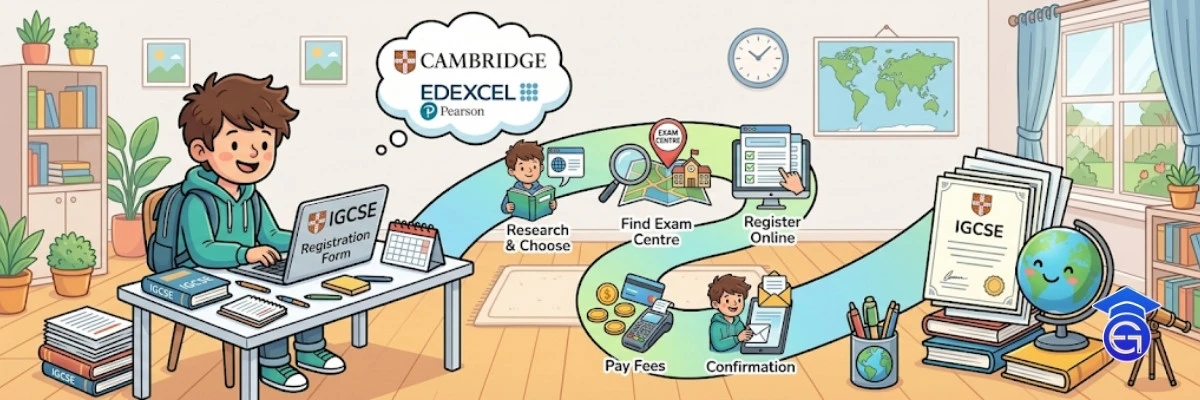
A parent messaged us a while back with a question that sounded simple but clearly wasn’t, at least not to her. Her daughter had left school mid-way through Year 10 for family reasons and was studying independently at home. “Can she still sit her IGCSEs somewhere,” she asked, “or has that door closed now that she’s not enrolled anywhere?” It hasn’t closed. It just isn’t advertised very clearly, and the process, registering as what both Cambridge and Pearson Edexcel call a private candidate, is a lot more doable than it first appears once you know the actual steps, whichever of the two boards ends up being the right fit.
What this covers
- What being a private candidate actually means
- Cambridge or Edexcel: which one should you choose?
- Step 1: Choosing your subjects
- Step 2: Finding an authorised exam centre
- Step 3: Registration deadlines, and why they’re earlier than you’d think
- Step 4: Documents, fees, and what to keep on file
- What’s genuinely not available to private candidates
- What actually trips people up
- Questions people are actually asking
What Being a Private Candidate Actually Means
In short, a private candidate is someone who sits IGCSE exams without being a full-time student at the school whose board they’re registering under. The qualification itself is identical to what a school candidate receives, same syllabus, same exam papers, same certificate. What’s different is entirely on the preparation and registration side, not the exam itself, and this applies whether you’re going through Cambridge International or Pearson Edexcel.
This route tends to come up for a handful of fairly specific reasons. Students who are homeschooled. Students resitting a subject after a disappointing result, without wanting to repeat a full year at school. Students whose school simply doesn’t offer a particular subject they need. Adult learners going back for a qualification they missed earlier. None of these situations are unusual, and both exam boards have built a real, functioning pathway for exactly this, even if it’s not something most schools go out of their way to mention.
Cambridge or Edexcel: Which One Should You Choose?
This is worth settling before anything else, because it shapes which centre you approach and how the rest of the registration goes. Cambridge International calls its qualification IGCSE. Pearson Edexcel calls its equivalent the International GCSE, often written informally as iGCSE too, which causes no end of confusion given how similar the names look on paper. They’re separate qualifications from separate boards, not two names for the same thing, and each has its own syllabus codes, exam papers, and grading.
Both are widely recognised by universities and accepted across British curriculum schools in the UAE, so neither is a “safer” choice in any general sense. The practical differences show up in the details. Edexcel runs an additional January exam session on top of May/June and October/November, which Cambridge doesn’t offer in most countries, useful if you want results sooner or need to resit a subject without waiting a full six months. Cambridge, on the other hand, has a broader international footprint in some subjects and a slightly different exam style that suits some students better than Edexcel’s, and vice versa for others.
It’s also worth knowing that you’re not locked into one board for every subject. It’s genuinely possible to sit some subjects under Cambridge and others under Edexcel, provided your chosen centre offers both, though most private candidates find it simpler to stick with one board unless there’s a specific reason not to, an Edexcel January resit alongside a set of Cambridge subjects sat in June, for instance.
Step 1: Choosing Your Subjects
This sounds obvious, but it’s worth doing properly before anything else, because subject choice determines almost everything that follows, which centre will take you, what the fees look like, and whether coursework becomes a problem. Both Cambridge IGCSE and Edexcel International GCSE cover a wide range of subjects, but not every one of them is realistic for a private candidate on either board, a point worth sitting with before falling in love with a subject list that later turns out to be unworkable.
A sensible approach is picking your subjects and your board first, then checking availability with a centre, rather than assuming any subject on the general Cambridge or Edexcel syllabus list will automatically be open to you. It’s a small ordering change, but it saves a lot of wasted planning.
Step 2: Finding an Authorised Exam Centre
Here’s the part that surprises people most: you can’t register directly with either board as an individual. Cambridge International and Pearson Edexcel both work through authorised exam centres, and in the UAE, the British Council is the main one accepting private candidates for both boards, with centres in Dubai and Abu Dhabi. That’s a genuinely useful overlap, since it often means one centre can handle your registration whichever board you land on. Pearson also maintains its own separate centre finder tool if you want to check for Edexcel-specific options beyond the British Council. Some Cambridge or Edexcel-registered private schools accept external candidates too, though this varies quite a bit school to school and genuinely needs a direct call or email to confirm, rather than assuming based on what a school’s website implies.
Once you’ve identified a centre, the actual registration is usually done online through that centre’s own system, sometimes called a School Registration System or a similar portal, rather than through any generic form from Cambridge or Edexcel directly. Contact the centre directly first. Confirm they’re accepting private candidates for the board and session you’re targeting, confirm your specific subjects are available, and only then start the formal registration.
Worth doing early: call or email your chosen centre before the registration window even opens. Centres sometimes cap how many private candidates they’ll take per session, and finding this out after the window has technically opened can mean you’ve already missed your spot.
Step 3: Registration Deadlines, and Why They’re Earlier Than You’d Think
This is genuinely the part that catches the most families off guard, and I’ve seen it happen more than once. Cambridge runs its main IGCSE sessions in May/June and October/November, with a more limited March session in some countries. Edexcel runs those same two main sessions plus an additional January series. But for either board, the registration deadline for each session falls well before the exams themselves, not the few weeks’ notice people instinctively expect.
| Exam series | Board | Typical registration deadline |
|---|---|---|
| January | Edexcel only | Around October/November of the previous year, though this varies by centre |
| May/June | Cambridge and Edexcel | Around February, though this varies by centre |
| October/November | Cambridge and Edexcel | Around August, though this varies by centre |
Those are rough guides, not fixed dates, since individual centres set their own exact deadlines within each board’s overall window. Late entry is usually still possible after the standard deadline closes, just with a noticeably higher fee attached, often a meaningful jump rather than a token surcharge. The honest, slightly frustrating truth is that “I’ll sort this out closer to the exam” is a plan that works far worse here than it does for most other things in life, whichever board you’ve chosen.
Step 4: Documents, Fees, and What to Keep on File
Once a centre confirms your place, the paperwork itself is fairly standard. Most centres will ask for a completed registration form, valid photo ID such as a passport, proof of date of birth, and a passport-sized photo. If you’re resitting a subject rather than sitting it for the first time, some centres also want proof of your previous entry or result.
Fees are paid directly to the centre, not to Cambridge or Edexcel themselves, and they’re charged per subject, sometimes per component within a subject. They vary meaningfully between centres, countries, and the two boards, so it’s worth getting an exact figure from your specific centre rather than budgeting off a number you saw somewhere online for a different country or board entirely. Once payment clears, you’ll typically receive a Statement of Entry confirming your subjects, board, and candidate details. Keep that. It’s the document you’ll need if anything about your registration ever needs checking later.
What’s Genuinely Not Available to Private Candidates
Worth being upfront about this rather than glossing over it, because it’s a real limitation with both boards, not a minor footnote. Subjects with school-assessed coursework or practical components, certain sciences, some creative and technical subjects, often aren’t available to private candidates at all, whether the syllabus sits under Cambridge or Edexcel. That’s not an arbitrary restriction. Coursework needs to be internally marked and moderated by teaching staff who’ve actually observed the student’s work over time, which a private candidate registration simply doesn’t provide for.
This is the genuine trade-off of the private candidate route, and it’s worth naming honestly rather than pretending the flexibility comes free. You get control over pace and subject choice, but you lose access to any subject built around ongoing internal assessment. For most core academic subjects, English, maths, the sciences in their non-coursework variants, humanities, this isn’t an issue. For a smaller handful of subjects, it genuinely rules the private candidate route out, and it’s far better to find that out early than after you’ve already committed to a study plan.
If working out which subjects are even viable feels like the hard part
Figuring out centre availability, deadlines, and which subjects actually work for a private candidate registration takes real digging, whether you’re leaning Cambridge, Edexcel, or still deciding, and getting it wrong costs a whole exam series. If this sounds like where you’re at, it might be worth having a quick chat with Edugravity’s team about what a guided private candidate plan could look like.
WhatsApp Edugravity Explore the Private Candidate ProgrammeWhat Actually Trips People Up
Beyond the deadlines, a few smaller things quietly derail private candidate registrations more often than the big obvious steps do.
- Assuming any centre will take any subject, then discovering late that a specific syllabus code isn’t offered that session, for either Cambridge or Edexcel
- Registering for a subject without confirming there’s no compulsory coursework component buried in the syllabus
- Mixing up Cambridge and Edexcel syllabus codes when comparing subject content, since the two boards number and structure their syllabuses differently even for similar subjects
- Waiting until close to the deadline to make first contact with a centre, only to find that session’s private candidate slots are already full
- Assuming exam preparation will look and feel like a normal school term, when in reality a private candidate is largely managing their own timetable, revision structure, and pacing
That last one is the quieter, more emotional part of this whole process, honestly. There’s a real sense of relief once registration is confirmed and the Statement of Entry lands in an inbox. But the discipline required to prepare well without a school’s built-in structure around you is a genuinely different demand, and it’s worth being honest with yourself, or your child, about whether that self-directed pace is realistic before committing to it.
Questions People Are Actually Asking
The One Thing Worth Remembering
Registering as a private candidate isn’t complicated once it’s broken into its actual steps, whether you end up with Cambridge, Edexcel, or a mix of both, but it is unforgiving of the assumption that there’s plenty of time. Deadlines fall months before the exam itself, not weeks, and subject availability needs confirming with a specific centre rather than assumed from a general syllabus list. Get those two things right early, and the rest of the process is genuinely manageable.
The calm next step is simple: pick your board and subjects, contact a centre before you need to, and confirm both availability and the deadline in writing.
Want help navigating the private candidate process end to end?
Edugravity’s Private Candidate Programme covers exam centre guidance, subject planning, and structured preparation, so nothing gets missed between registration and results day. In-person in Sharjah at 107 Al Reem Plaza, Corniche Street, or online across the UAE.
WhatsApp Edugravity Explore the Private Candidate ProgrammeKey Takeaways
- A private candidate sits the exact same exams as school students, on Cambridge IGCSE or Edexcel International GCSE, just without full-time school enrolment behind the preparation
- Registration must go through an authorised centre, mainly the British Council in the UAE for both boards, never directly with Cambridge International or Pearson Edexcel
- Edexcel offers an additional January exam session that Cambridge doesn’t, alongside the May/June and October/November series both boards share
- Deadlines typically fall around February for May/June exams and August for October/November, months earlier than most people expect, for either board
- Subjects with coursework or practical components are often unavailable to private candidates on either board, so confirming availability early avoids wasted planning
- Fees, exact deadlines, and subject lists vary by centre and board, so direct confirmation always beats assuming based on general information