
Cambridge May/June 2026 Exam Results Dates: What to Expect


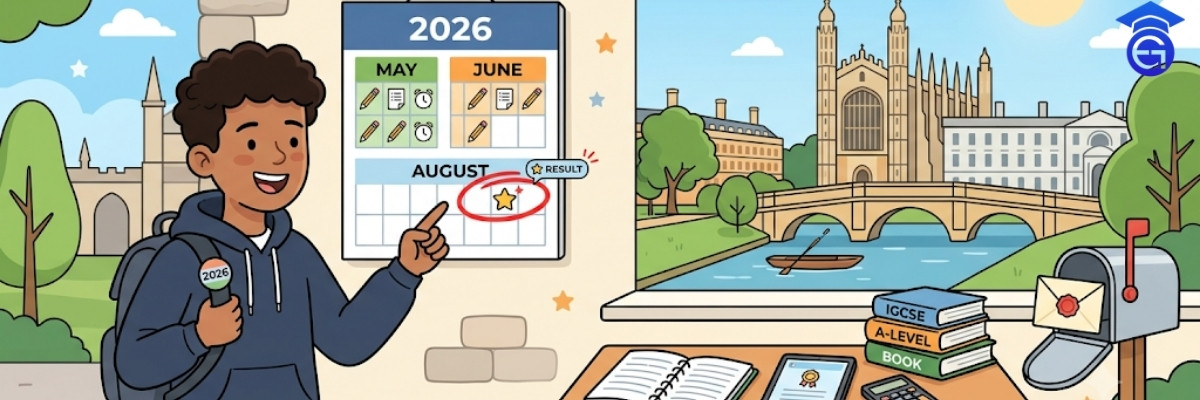
There’s a specific kind of quiet that settles over a house in the second week of August, once the exams themselves are long finished and all that’s left is waiting. This year that wait carries a bit more weight for a lot of families in the UAE, because the road to results looked different for thousands of Cambridge students this June. Here’s exactly when results land, how the release actually works, and what’s worth knowing if you sat your papers, or your portfolio, here in the Emirates.
What this covers
The June 2026 Results Dates in Full
Let’s start with the numbers, since that’s most likely why you clicked through.
| Qualification | Results Available to Schools |
|---|---|
| Cambridge International AS & A Level, AICE (Cambridge Advanced International Certificate of Education), Cambridge IPQ | 11 August 2026, 06:00 BST / UTC+1 |
| Cambridge IGCSE, Cambridge O Level, Cambridge ICE | 18 August 2026, 06:00 BST / UTC+1 |
Two dates, one week apart. 11 August covers AS and A Level, along with AICE and the IPQ. 18 August covers IGCSE, O Level and ICE. Both go live at 6am British Summer Time, which is 9am here in the UAE. Convert that to whatever time zone you’re actually in when the day arrives, because 6am BST has a habit of sneaking up on people abroad who forget the hour difference.
How Results Actually Reach You
This is the part that trips people up, especially if a family has friends sitting Pearson Edexcel or A Levels through a different board. Some exam boards publish two dates, a school release followed a day later by a student release. Cambridge doesn’t quite work that way.
What happens is this: Cambridge makes results available to schools through its Direct portal at 06:00 BST on the published date. From that point, it’s entirely up to your school how and when you actually see your grade. Some schools have students come in that morning to collect results in person, with staff on hand for anyone who wants to talk things through. Others issue a password so students can log in themselves to the secure results website and see their grades from home. I’ve seen both approaches work well, and I’ve also seen the timing of that release, even within the same morning, matter a great deal to how a student experiences the day. If your school hasn’t told you the plan yet, that’s a reasonable thing to ask about now rather than the night before.
Worth knowing: because your school controls the exact hour you see your results, “results day” for you might genuinely start later than 9am UAE time even though Cambridge has already released the data. Don’t assume something’s wrong if a friend at another school has their grade before you do.
So where do you actually go to find your result?
In practice, there are really only two routes, and your school will tell you which one applies to you.
- Your school collects it first. Schools and exam centres download results from Cambridge’s Direct portal, at direct.cie.org.uk, once it goes live at 06:00 BST. This is the school’s own login, not something students use directly.
- You check it yourself online. Many schools then set up individual access on Cambridge’s candidate results website, at myresults.cie.org.uk, and hand out a personal password so you can log in and see your own results from home, on your phone, wherever you happen to be that morning.
Some schools skip the online step entirely and simply have students come in to collect a printed statement of results in person, sometimes with a form teacher or head of year on hand. Either way, the password or the collection time isn’t something Cambridge sends you directly. It comes from your school, so if you’re not sure how you’ll be getting your result this year, that’s a question for your exams officer now rather than a guess on the morning itself.
Which Qualifications These Dates Cover
The 11 August date is the advanced qualifications day. Cambridge International AS and A Level sits at the centre of it, but it also covers the Advanced International Certificate of Education, known as AICE, and the Cambridge International Project Qualification. If any of those were part of your June entry, 11 August is your date, full stop.
The 18 August date covers everything at IGCSE level and its close relatives: Cambridge IGCSE itself, Cambridge O Level, and Cambridge International Certificate of Education, or ICE, which brings together results across a group of Cambridge IGCSE subjects. Students who sat a mix, say GCSE-equivalent subjects alongside an early A Level in Maths, are looking at two separate weeks of waiting rather than one. That’s a long month for anyone, and it’s fair to feel a bit frayed by the second date if the first one already brought its own nerves.
A Note for UAE Students After This Year’s Portfolio Route
This is probably the section that matters most if you’re reading from here in the Emirates, so it’s worth sitting with for a moment.
Cambridge International confirmed earlier this year that traditional exam hall sittings would not go ahead in UAE schools for the June 2026 series. Pearson Edexcel and OxfordAQA made similar calls around the same time, all citing the regional situation and student and staff safety as the reasoning. It’s estimated that around 120 schools across the UAE run the Cambridge curriculum, so this touched a genuinely large number of families, not a narrow edge case.
In place of sitting papers, Cambridge asked schools to move to a portfolio of evidence route. Rather than an exam hall, students submitted coursework and internal assessment evidence, generally structured around a small number of substantial pieces per subject, and Cambridge examiners marked and graded that evidence externally. It’s a genuinely different way of arriving at a grade, and there’s an honest trade-off in it: a portfolio can reflect a term or a year of sustained work in a way a single exam paper can’t, but it also depends heavily on how well the school selected and prepared that evidence on the student’s behalf, which is less within any individual student’s direct control than sitting their own paper would have been.
Here’s the reassuring part. The published results dates above still apply to students graded this way. 11 August for AS and A Level, 18 August for IGCSE and O Level. Your certificate won’t be marked differently or arrive later because of how the grade was reached. What will differ, potentially, is how much your school has told you about the process behind your specific result, and that’s worth asking about directly if you haven’t already had that conversation.
If you’re unsure how your result was determined: ask your school’s exams officer before results morning, not after. Understanding whether your subject was graded through banked results, a submitted portfolio, or some combination of the two means results day tells you something you can actually interpret, rather than a number that arrives with no context attached.
If this year’s disruption left gaps you want to close before the next series
Edugravity works with Cambridge and Edexcel students across the UAE on building genuine subject confidence back up, particularly for anyone whose preparation this year looked different from usual. It starts with a free diagnostic that shows exactly where the gaps sit, then a plan built around your board and your actual timetable. Worth a conversation before you decide on anything.
WhatsApp Edugravity Book Free DiagnosticIf a Result Isn’t What You Expected
Not every August ends the way a student hoped, and there’s no getting around that plainly. If a grade looks genuinely out of step with mock results, teacher predictions, or your own sense of how a subject went, Cambridge does offer an enquiries about results service for exactly this situation. It exists for cases where something may have gone wrong somewhere in marking or grading, and it’s your school, through your exams officer, that submits an enquiry on your behalf within the deadlines Cambridge sets.
It’s worth being honest that this route doesn’t guarantee a different outcome. What it does offer is an independent check, and in the cases where the original mark genuinely didn’t match the evidence on the paper, or in the portfolio, it can result in a change. The relief when that happens is real, and so is the frustration when it confirms the original grade. Both are fair reactions, and neither one means the process failed you.
There’s also a wider point worth holding onto here. A result that falls short of a university offer or a personal target doesn’t have to be the final word. Many universities run clearing-style processes for students who don’t meet their conditions, and UAE institutions typically have their own pathways for exactly this scenario. For subjects a student wants to strengthen or retake, Cambridge runs a November series in addition to the following June, so there’s usually more than one route forward, even when results day doesn’t feel that way in the moment.
What to Do in the Days After Results Land
The instinct on results morning is often to act fast on everything at once. Some decisions genuinely need speed. Others benefit from a slower head, and it’s worth knowing which is which before the day arrives rather than working it out under pressure.
If you’re applying to a UK university, Cambridge sends results to UCAS in time to meet standard deadlines, so most students don’t need to chase that themselves. If a university deadline is unusually tight, or you’re applying somewhere outside the standard UCAS timeline, Cambridge’s priority results service lets your school request a provisional statement of results sent directly to a chosen institution on the day results are published, which is worth flagging with your exams officer in advance if it applies to you.
For UAE university applicants, timelines tend to be a little more forgiving than the UK clearing rush, but confirming directly with the specific institutions you’re applying to beats assuming. And for anyone who received a portfolio-based grade this year and wants a more typical exam experience going forward, or simply wants to strengthen a subject, the preparation window for November starts almost immediately. Waiting until next summer isn’t the only option, and for some subjects it isn’t even the most sensible one.
A realistic timeline for the weeks after results day
On the day itself: read the result carefully, subject by subject, and note anything that looks inconsistent with your own expectations or your teachers’ predictions. If something looks off, speak to your exams officer that same week about the enquiries about results process and its deadlines. Within the first week: handle anything genuinely time sensitive, like a university offer that needs a response. Within the first month: if you’re considering the November series for a resit or an additional subject, start preparation now. The window is short, and a proper diagnostic of where the gaps are takes time to turn into useful revision.
Questions People Are Actually Asking Right Now
The Part Worth Sitting With Before the Date Arrives
A grade is a snapshot, not a sentence. It tells you where a subject stood at one particular point, under one particular set of circumstances, and this year those circumstances looked genuinely unusual for a lot of Cambridge students in the UAE. That doesn’t make the result less real. It just means it’s worth reading with a little more context than a normal August might have called for.
Whatever 11 or 18 August brings, give yourself the rest of that day before deciding what it means for what comes next. The options in front of you are almost always wider than results morning makes them feel.
If your household is also tracking a Pearson Edexcel results day alongside a Cambridge one this year, worth knowing the two boards don’t release on the same schedule or in quite the same way. We’ve laid out the Pearson Edexcel Summer 2026 results dates separately, so you’re not trying to track both from memory.
Whatever the result says, the next step gets clearer once you can see the actual gaps
Edugravity’s free diagnostic takes about an hour and shows exactly which topics and question types need work for your specific Cambridge subject and level. Useful whether you’re preparing for the November series or planning ahead for next June. In-person in Sharjah at 107 Al Reem Plaza, Corniche Street, or online across the UAE.
WhatsApp Edugravity Book Free DiagnosticKey Takeaways
- Cambridge AS & A Level, AICE and IPQ results reach schools on 11 August 2026, 06:00 BST
- Cambridge IGCSE, O Level and ICE results reach schools on 18 August 2026, 06:00 BST
- Cambridge doesn’t run a separate candidate release date. Your school decides how and when you see your grade after the 6am release
- UAE students affected by this year’s exam cancellations were assessed through a portfolio of evidence route, but the same results dates apply to them
- An enquiries about results service exists through your school’s exams officer if a grade looks inconsistent with expected performance