British Curriculum in the UAE: A Complete Guide for Parents


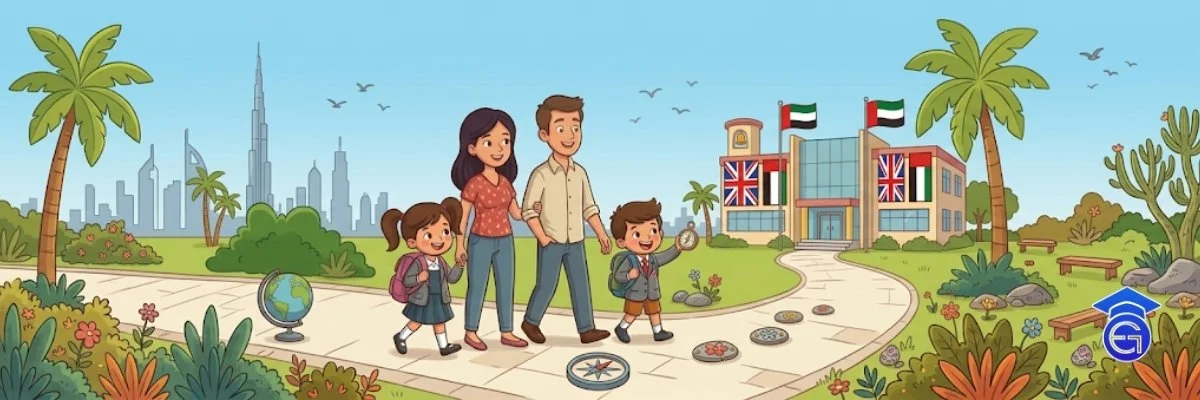
A friend of mine moved from London to Dubai a couple of years ago with two kids under ten, and the thing that surprised her most wasn’t the heat, it was how many school prospectuses used the phrase “British curriculum” while describing what sounded like fairly different schools. She’d assumed it meant one fixed thing, the way it more or less does back home. It doesn’t, not quite, and that gap between assumption and reality is where a lot of confused parents in the UAE end up.
What this covers
- What “British curriculum” actually means here
- The stage-by-stage structure, from EYFS to A-Level
- Who actually regulates these schools
- IGCSE versus GCSE, and which exam boards get used
- The private candidate route, and when it’s worth considering
- Why two “British curriculum” schools can feel completely different
- Is it actually the right fit for your child?
- Questions people are actually asking
What “British Curriculum” Actually Means Here
The short version: it’s the National Curriculum for England, but adapted to meet local requirements, and delivered by schools that have a fair amount of freedom in how they interpret it. In the UK itself, independent schools can choose to follow the national curriculum or design their own, so even there it’s not one single rigid script. Outside the UK, in the UAE included, schools build their own version around the same skeleton, EYFS, Key Stages, then IGCSEs and A-Levels, while adapting content, staffing, and pace to their own student body.
That’s not a criticism. It’s just worth knowing going in, because “British curriculum” on a school’s website is closer to a family resemblance than an exact copy. Two schools using that label can genuinely differ in subject breadth, teaching style, and how strictly they follow UK pacing.
The Stage-by-Stage Structure, From EYFS to A-Level
Laid out plainly, the progression looks like this across most British curriculum schools in the UAE.
| Stage | Ages / Years | What happens |
|---|---|---|
| EYFS (Early Years Foundation Stage) | Ages 3 to 5 | Play-based learning building early literacy, numeracy, and social skills |
| Key Stage 1 | Years 1 to 2 | Basic reading, writing, maths, and early scientific thinking |
| Key Stage 2 | Years 3 to 6 | Building independence and depth across core subjects |
| Key Stage 3 | Years 7 to 9 | Broader subject range, preparing for specialisation ahead |
| IGCSEs | Years 10 to 11 | Formal exams across a wide subject range, usually eight to ten subjects |
| A-Levels | Years 12 to 13 | Deep specialisation, typically three or four subjects, leading to university entry |
What stands out once it’s written down like this is how much narrowing happens near the end. A student studying eight or nine subjects at IGCSE drops to three or four at A-Level. That’s a deliberate feature of the system, not a flaw, but it does mean subject choice at 16 carries more weight than it might feel like at the time.
Who Actually Regulates These Schools
This is the part that genuinely reassures a lot of parents once they understand it, and honestly, it should. In Dubai, private schools including British curriculum ones are inspected by KHDA, the Knowledge and Human Development Authority. In Abu Dhabi, that role belongs to ADEK, the Department of Education and Knowledge. Both publish inspection reports rating schools on a scale that runs from Outstanding down to Weak, covering things like academic outcomes, teaching quality, leadership, and student wellbeing, not just exam results in isolation.
Some schools also opt into additional accreditation through the British Schools Overseas scheme, which is endorsed by the UK’s Department for Education. It’s voluntary, so its absence doesn’t automatically mean a school is worse, but its presence is a reasonable extra signal if you’re comparing two schools that otherwise look similar on paper.
Worth doing before you commit: read the school’s most recent KHDA or ADEK inspection report in full, not just the headline rating. The detailed sections on teaching quality and student progress often reveal more than the single-word overall grade does.
IGCSE Versus GCSE, and Which Exam Boards Get Used
Here’s a distinction that trips people up constantly, understandably so, since the names are almost identical. GCSEs proper are regulated by Ofqual, the UK’s exam regulator, and are mainly sat by students within the UK itself. IGCSEs, the international version, are what almost every British curriculum school outside the UK uses instead, accredited by either Cambridge International or Pearson Edexcel.
For A-Levels, schools in the UAE typically use AQA, Pearson Edexcel, or Cambridge International, and it’s genuinely common for a single school to mix boards across subjects, using whichever specification suits their teaching staff and student cohort best for that particular subject. None of these boards is universally “better.” A school choosing Edexcel maths and AQA sciences isn’t cutting corners, it’s usually just matching the board to the strongest available teaching resources.
The Private Candidate Route, and When It’s Worth Considering
Not every family needs to be enrolled full-time at a school to access IGCSEs and A-Levels, and this is the part of the British system a lot of parents don’t realise exists until they actually need it. A private candidate is a student who registers directly with an approved exam centre to sit IGCSE or A-Level exams, without being a full-time pupil there. The exams and certificates are exactly the same as they’d be for any enrolled student. What’s different is how the preparation happens.
This route tends to come up in fairly specific situations. A student who’s been homeschooled and wants a recognised qualification at the end of it. A student resitting one or two subjects after a disappointing result, without wanting to repeat an entire year at school for it. A student who’s moved from a different curriculum, IB or American, partway through secondary school and wants to add specific IGCSE or A-Level subjects rather than switching systems entirely. I’ve seen all three, and the private candidate route solved a genuine problem in each case that re-enrolling in a full school programme wouldn’t have.
It’s worth being honest about the trade-off here too, since it’s a real one. Private candidates get the flexibility to focus on exactly the subjects they need, on their own timeline, but they lose the built-in structure, teacher support, and classroom pace that comes with full-time enrolment. It suits a self-directed, disciplined student far better than one who needs regular external accountability to stay on track. There’s also a practical limitation worth knowing early: not every subject is realistically available to private candidates, since some, particularly sciences with lab practicals or subjects with school-assessed coursework, require facilities and internal moderation that most exam centres won’t extend to external candidates. Checking subject availability with the exam centre before committing saves a lot of wasted planning later.
Registration also tends to close earlier than most people expect, often several months before the exam series itself, and it has to go through a centre approved by the relevant exam board, not directly through the board itself. That’s a detail that catches families out more than it should, especially ones assuming they can register the way they would for a driving test, a few weeks ahead, whenever it’s convenient.
Why Two “British Curriculum” Schools Can Feel Completely Different
This is worth sitting with honestly, because it’s the source of most parent frustration around curriculum choice. The label describes a framework, not a guarantee of quality or fit. A school with an Outstanding KHDA rating and a school rated Acceptable can both legitimately call themselves British curriculum schools, and the actual day-to-day experience for a child can be worlds apart, class sizes, teacher retention, how much individual attention a struggling student actually gets.
There’s a genuine trade-off here worth naming rather than glossing over. A more established, highly rated British curriculum school often comes with larger class sizes and a more standardised pace, since it’s managing a bigger, more academically diverse cohort. A smaller or newer school might offer more individual attention but a shorter track record to judge by. Neither option is automatically the right call. It depends on what a particular child actually needs, which is a much more useful question than which school has the shinier prospectus.
If your child is enrolled but still struggling to keep pace
A well-rated school doesn’t automatically mean every subject clicks for every child, especially around the jump into IGCSE or A-Level. If that gap sounds familiar, it might be worth having a quick chat with Edugravity’s team about what a tailored plan could look like.
WhatsApp Edugravity Book Free DiagnosticIs It Actually the Right Fit for Your Child?
The British curriculum tends to suit students who like the idea of narrowing down early and going deep, since A-Levels mean serious specialisation in just three or four subjects by Year 12. A student who thrives on choice and enjoys keeping options broad for longer might feel more at home in the IB, which spreads study across six subject groups all the way to graduation. Neither is objectively better. It genuinely comes down to the individual student, and I’ve seen plenty of families agonise over this choice as though there’s a single correct answer waiting to be found. There usually isn’t.
What matters more in practice is consistency once a curriculum is chosen. Switching curricula mid-way through secondary school, from British to IB or American and back, is possible but genuinely disruptive, and it’s worth avoiding unless there’s a strong specific reason for it.
A relief a lot of parents report once they’ve actually chosen and settled in: the anxiety of the decision itself tends to fade quickly once a child is enrolled and progressing, far faster than the research phase would suggest it should.
Questions People Are Actually Asking
The One Thing Worth Remembering
“British curriculum” tells you the shape of the academic journey, EYFS through to A-Levels, but it doesn’t tell you much about the actual quality of a specific school, and treating the two as the same thing is where most of the confusion in this decision comes from. The inspection rating, the exam board choices, the class sizes, those are where the real differences live.
The calm next step isn’t finding the “correct” British curriculum school. It’s finding the specific one, regardless of label, that fits how your child actually learns.
Want an honest read on how your child is actually coping?
Whichever curriculum your child follows, Edugravity’s free diagnostic shows exactly where things stand, so support goes toward what’s genuinely needed. In-person in Sharjah at 107 Al Reem Plaza, Corniche Street, or online across the UAE.
WhatsApp Edugravity Book Free DiagnosticKey Takeaways
- “British curriculum” describes a framework, EYFS through A-Levels, not a fixed, identical experience across every school using the label
- IGCSEs, not GCSEs, are what British curriculum schools outside the UK actually use, accredited by Cambridge International or Pearson Edexcel
- KHDA (Dubai) and ADEK (Abu Dhabi) inspection ratings, from Outstanding to Weak, are a more reliable quality signal than the curriculum name alone
- A-Levels mean narrowing to three or four subjects by Year 12, a much bigger specialisation jump than IB’s broader spread
- Choosing between British, IB, or American curriculum depends on the individual child’s learning style, not one system being universally better
- The private candidate route lets a student sit IGCSEs or A-Levels without full-time school enrolment, useful for homeschoolers, resits, or curriculum switches, though not every subject is available this way