
UAE Schools Are Restricting Parent Photos on Campus: What the Rules Actually Say


Picture sports day. Your daughter’s in lane three, you’ve got your phone up, you catch the whole race, and she crosses the line grinning. It’s a lovely video. It also has nine other children in it, and by the time you’ve dropped it into the class WhatsApp group, a few dozen families have it on their phones. A week ago, that was just a normal Thursday. Now it’s the exact scenario a growing number of UAE schools are writing to parents about, and a Gulf News report on the legal side has a lot of parents asking whether they’re about to get in trouble for a race video. The short answer is calmer than the headlines, though not quite as relaxed as “don’t worry about it.”
What this covers
- What’s actually happening
- Where the rules apply, and the part that surprises people
- Can you still photograph your own child?
- The Dh500,000 figure: what it is and what it isn’t
- The WhatsApp group question
- Why schools are reinforcing this now
- The honest grey area
- What parents can do in practice
- Questions people are actually asking
What’s Actually Happening
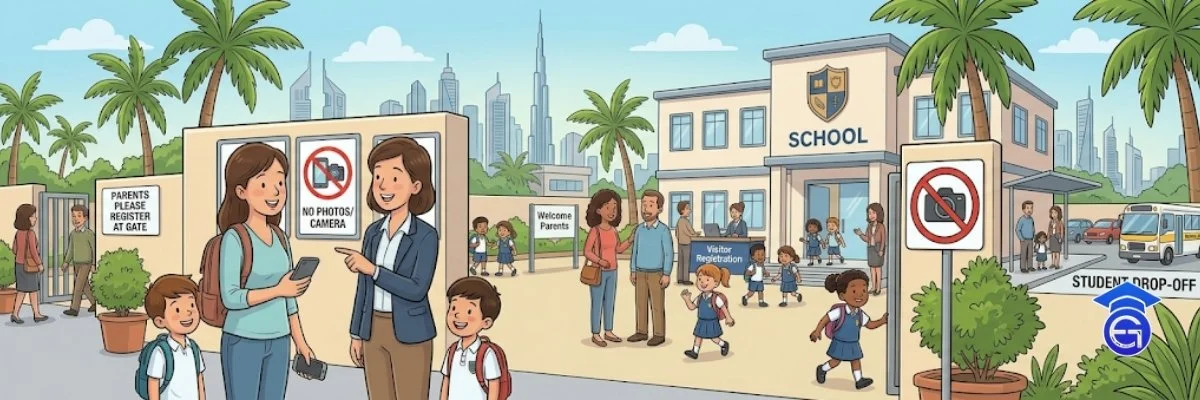
Schools in Dubai and Sharjah have been sending circulars to parents asking them and any visitors not to take photos or videos on school premises where other students or staff could end up in the frame without consent. The same notices ask parents not to share pictures or clips that show other children on WhatsApp groups, social media, or any other digital platform without appropriate consent.
One circular, as reported by Arabian Business, framed it as being in line with UAE privacy requirements and guidance that’s being reinforced across private schools. That wording matters. This isn’t a brand-new national law landing on one particular Monday. It’s schools tightening how they apply privacy and safeguarding expectations that already existed, and putting it in writing so nobody can say they weren’t told.
Where the Rules Apply, and the Part That Surprises People
You’d expect classrooms. You might expect assemblies. What catches parents off guard is how far the guidance reaches. Reports on the circulars say it covers corridors, playgrounds, assemblies, and also drop-off and pick-up areas.
That last one is the real change in habit. Plenty of parents have filmed a quick clip of their child walking through the gate, or snapped the morning chaos outside the school entrance, without a second thought. Other children walk through that same frame every single day. Nobody was doing anything sinister. But the point of the guidance is that good intentions don’t remove another family’s right to decide whether their child appears in someone else’s camera roll.
Can You Still Photograph Your Own Child?
Yes, and this is the part worth reading twice, because the coverage sometimes makes it sound like cameras are banned outright. They aren’t. Schools have said that photography may be allowed at designated events, with a clear condition attached: photograph or film your own child only, and avoid capturing or sharing images of other students. Official school photography carries on under the school’s existing consent and safeguarding procedures.
So the milestone photos are still possible. A concert, a sports day, a graduation. What’s changed is the expectation that you’ll frame it carefully and keep other people’s children out of what you share. In practice, that probably means fewer wide shots of the whole stage and a bit more attention to who’s standing behind your own kid.
Worth doing before the next event: look for the school’s specific photography instructions in the event notice itself. Rules for a concert can differ from rules for an ordinary school day, and some schools will designate a spot or a moment for photos.
The Dh500,000 Figure: What It Is and What It Isn’t
This is the number that went around, and it’s worth being precise about, because it’s easy to read it as “the school will fine you half a million dirhams for a photo.” That isn’t what the lawyers quoted by Gulf News said.
The figure is a potential penalty under Article 44 of the UAE Cybercrimes Law, which covers using electronic means to invade someone’s privacy without consent. According to the legal consultants quoted, a person found to have breached it could face at least six months in prison, a fine somewhere between Dh150,000 and Dh500,000, or both. Crucially, that comes into play where a complaint is raised with the authorities and the conduct is actually found to be an offence. It is not an automatic fine a school can hand out at the gate.
| Situation | What the lawyers quoted said |
|---|---|
| Photographing or sharing a child’s image in a way found to breach privacy | At least six months in prison, a fine of Dh150,000 to Dh500,000, or both, if a complaint is made and an offence is found |
| Digitally altering an image or recording to defame or offend someone | At least one year in prison, a fine of Dh250,000 to Dh500,000, or both |
| A school’s own response to a parent breaking its photo rules | Set by the school, typically a reminder or a conversation first rather than a legal step |
I’d add a plain caveat. I’m not a lawyer, and nothing here is legal advice. What I can say is that the range comes from legal professionals speaking to a national newspaper, and whether any particular situation counts as an offence would depend on the facts and on someone actually making a complaint. The sensible reading is that the law gives the school’s request real weight, not that every family with a camera is under threat.
The WhatsApp Group Question
This is the bit most parents assumed was fine. A closed group, only the parents from one class, everyone knows everyone. Surely that’s different from posting on Instagram.
According to the lawyers, not automatically. Article 44 is worded broadly enough to cover taking a photograph, and also transferring, disclosing, copying, or keeping electronic images. One of the legal consultants pointed out that a private group isn’t exempt just because it’s private. The same coverage noted that you don’t need to post something publicly for it to raise a privacy issue.
My honest read is that the realistic chance of anyone being prosecuted over a class group photo is low, and the practical lesson is a lot simpler than the legal one. If another family’s child is clearly identifiable in an image, ask first, or crop them out, or don’t send it. That’s good manners as much as good law, and it’s the habit the schools are really trying to build.
Why Schools Are Reinforcing This Now
The legal commentary points to a few layers. The UAE Child Rights Law, known as Wadeema’s Law, establishes a child’s right to privacy, and the lawyers stressed that a child’s dignity and privacy have to be respected in all circumstances. The Personal Data Protection Law adds that personal information generally can’t be collected or used without consent, except where the law allows. Schools, for their part, carry their own safeguarding obligations under Dubai’s private school regulatory framework.
There’s also an ordinary, human reason that a school can’t see from the outside. Some families have good reasons for a child not to appear online at all, and a teacher can’t tell which ones. The simplest way to protect those children is a rule that applies to everyone, which is exactly what a circular does, even when it feels a bit blunt.
The Honest Grey Area
It would be too neat to say the rule is obviously right and move on. There’s a real tension here, and it’s worth admitting. School events matter to families. A first performance, a medal, a leaving assembly, these are moments parents don’t get back, and a rule that makes people nervous about lifting a phone can feel cold, especially for a parent who was simply trying to catch their own child.
Against that, a school has no way of knowing which families have agreed to what, and it can’t police every frame at every event. So it asks for a blanket standard and relies on parents to use judgment inside it. Neither side is being unreasonable. The practical middle ground, own child only, designated moments, nothing shared that includes other children, is probably as good as it gets, and I’d rather parents hear that straight than be told it’s all a fuss over nothing.
If the new term already feels like a pile of circulars and changes
New rules about photos, uniforms, food and timings are one more thing to keep track of alongside actual schoolwork. If the academic side is the part you’d like a clearer read on, it might be worth having a quick chat with Edugravity’s team about what a tailored plan could look like for your child.
WhatsApp Edugravity Book Free DiagnosticWhat Parents Can Do in Practice
None of this needs a big overhaul. A few habits cover most situations.
- Read the school’s circular and any event notice properly, since photography rules can differ between an ordinary day and a designated event
- Frame your own child only, and notice who’s in the background before you hit record
- Keep photos that include other children out of WhatsApp groups and social media unless you’ve asked and been told yes
- Leave the drop-off and pick-up areas as camera-free as you can, since other families walk through that space constantly
- Use the school’s official photos and galleries for the group shots, since those go through the consent process
If your child is old enough to have their own phone, it’s worth a quick conversation with them too. The rules apply to anyone holding a camera on campus, and a teenager filming friends in a corridor is in the same territory as a parent filming a sports day.
Questions People Are Actually Asking
The One Thing Worth Remembering
The photo was never really the problem. The audience you can’t see is. Once an image of someone else’s child leaves your phone, you don’t control where it goes, and that family never got a say. The new circulars are a fairly blunt way of putting that into words, and the law sits behind them more firmly than most parents realised.
The calm next step is small: read your school’s latest notice, decide how you’ll handle the next event, and keep other people’s children out of what you share.
Want one thing about the school year to feel clear?
Edugravity’s free diagnostic gives an honest read on where your child stands academically right now, so the term ahead starts with a plan rather than a guess. In-person in Sharjah at 107 Al Reem Plaza, Corniche Street, or online across the UAE.
WhatsApp Edugravity Book Free DiagnosticKey Takeaways
- Schools in Dubai and Sharjah are asking parents not to photograph or share images of other children on campus without consent, including on WhatsApp
- The guidance reaches beyond events to corridors, playgrounds, assemblies, and drop-off and pick-up areas
- Photographing your own child at designated events is generally still allowed, as long as other students stay out of the frame and out of what you share
- The Dh500,000 figure is a potential penalty under the Cybercrimes Law if a complaint is made and an offence is found, not an automatic school fine
- A closed WhatsApp group isn’t automatically exempt, so the safest habit is asking first or cropping other children out