Dubai’s FutuReady Framework: What KHDA’s New Career Guidance Rules Actually Mean for Your Child


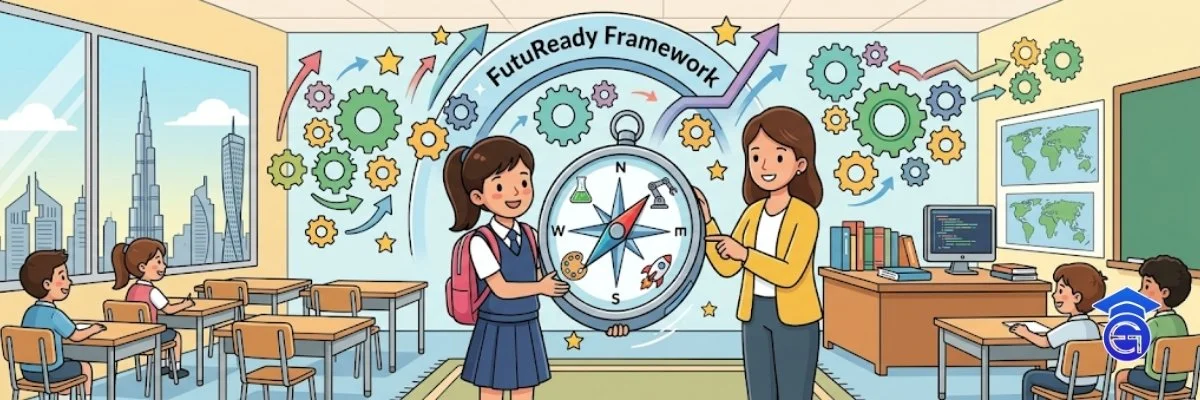
A parent I spoke to a while back put it better than most guidance counsellors ever have. Her son, fourteen at the time, told her he wanted to work in something like AI ethics, a field that barely has a settled job title yet, let alone a clear path into it from a Dubai secondary school. She didn’t know whether to encourage that or gently steer him toward something more provable on paper. That exact conversation is happening in a lot of households right now, and it’s a big part of why KHDA just rolled out something called the FutuReady Framework.
What this covers
What Is the FutuReady Framework, Actually?
In short, it’s a new rulebook. Dubai’s Knowledge and Human Development Authority has published a document with the rather formal title of “The FutuReady Framework: The Dubai Standards for Academic Guidance and Career Readiness in Educational Institutions,” and it sets nine standards that private schools and higher education institutions across the emirate now have to work toward.
What it’s not is a new subject on the timetable, or a single workshop students sit through once in Grade 11. It’s meant to reshape how academic and career guidance works from the early years all the way through to graduation, which is a much bigger scope than the careers fair and one-off aptitude test most of us remember from school.
Dr. Amna Almaazmi, who leads growth and human development at KHDA, framed the reasoning behind it fairly directly: many of the jobs today’s students will eventually do don’t exist yet. That’s not a throwaway line either. It’s the whole premise the framework is built on.
Why This Is Happening Now
I’ve sat in enough parent-teacher conversations over the years to notice a pattern, and it’s shifted. Ten years ago, the anxious question was usually about which subjects would keep university options open. Now it’s more likely to be something like “how do I know what to prepare him for when the field itself might not exist by the time he graduates university.” That’s a genuinely harder question, and the honest answer is that nobody has a perfect one.
The old model of career guidance assumed something reasonably stable underneath it, that a student picks subjects, then a course, then enters a profession that looks roughly the same for the next thirty years. Automation and AI have made that assumption shakier than it used to be, and KHDA’s framework is essentially an admission of that, tied to Dubai’s own economic planning. It sits alongside the Dubai Economic Agenda, known as D33, and the Education 33 strategy, both of which are focused on building the kind of adaptable, future-facing workforce the emirate wants to see coming out of its schools.
So this isn’t guidance for guidance’s sake. It’s guidance built with a specific, fairly ambitious goal in mind: producing students who can navigate a job market that keeps changing shape, rather than students who were well prepared for a version of the economy that’s already moving on.
The Nine Standards, in Plain Language
The full document is written the way official standards documents tend to be written, dense, and understandably so, since it needs to hold up as a compliance framework across hundreds of schools. Stripped down to what actually matters for a parent reading this at home, the nine areas cover roughly the following ground.
- Structured guidance that starts early, not just something that kicks in during the final two years of school
- Building future-facing skills like adaptability, digital literacy, and critical thinking, alongside academic content
- Proper professional capacity, meaning trained staff handling guidance rather than it being bolted onto a homeroom teacher’s existing workload
- Real exposure through experiential learning, things like internships, work shadowing, and project-based learning tied to actual industries
- Guidance that’s grounded in genuine labour market insight, not just tradition or whichever careers happen to be well known locally
- Active family and community involvement, recognising that a lot of career influence happens at the dinner table, not the careers office
- Digital and AI-enabled guidance tools, used to support counsellors rather than replace the human judgement behind them
- Inclusive, student-centred support that explicitly covers students of determination, not guidance built around one “typical” learner
None of these are radical on their own. What’s different is that they’re now written down as expected practice across the board, with indicators schools are meant to be measured against, rather than being left entirely to whichever approach an individual school happened to land on.
What Actually Changes for Your Child
For a student currently in, say, Year 8, this probably means career and academic guidance conversations start showing up earlier and more regularly than they might have for an older sibling. Instead of one big decision point around subject selection, the idea is a series of smaller, ongoing touchpoints, building an understanding of strengths and interests well before any exam board or university application enters the picture.
For a student closer to graduation, the shift is more about depth than timing. Guidance is meant to be tied to actual labour market information and genuine work exposure, rather than a generic list of “popular” careers that hasn’t been updated to reflect what’s actually growing in the region.
Worth knowing: the framework applies to guidance provision as a whole, not to a single exam board or curriculum. Whether your child is in an IB school, a British curriculum school, or something else entirely, the same nine standards apply to how that school structures its guidance.
Where the Grey Areas Are
It would be easy to write this up as an unqualified win, and in a lot of ways it is a genuine step forward. But there’s a trade-off worth naming honestly. Standards on paper don’t automatically translate into the same experience for every student, and Dubai’s private schools are starting from very different places. Some already run structured guidance programmes with dedicated, trained counsellors. Others have historically treated it as an extra duty for whichever teacher had a free period, which is a much bigger gap to close than a single academic year allows for.
That’s presumably why KHDA has given schools three years to implement or build on their existing provision, rather than expecting full compliance overnight. Handbooks have been published for schools and higher education institutions separately, and KHDA plans to run workshops for education leaders to walk through what’s actually expected. Three years sounds generous until you consider how much has to change underneath it, staff training, new guidance structures, partnerships with employers for real work exposure. None of that happens by September of next year just because a document says it should.
There’s also a quieter, more personal grey area here. A better framework at school doesn’t remove the anxiety a parent feels watching their child choose a direction in a world that keeps shifting under everyone’s feet. It helps. It’s genuinely useful structure. But it’s not a complete answer on its own, and pretending otherwise wouldn’t be honest.
If the guidance gap is the part that worries you most
Waiting three years for a school-wide rollout isn’t much comfort if your child needs support figuring out strengths and direction now. If this sounds like where things stand for your family, it might be worth having a quick chat with Edugravity’s team about what a tailored plan could look like in the meantime.
WhatsApp Edugravity Book Free DiagnosticWhat Parents Can Do While Schools Catch Up
A few things genuinely help here, and none of them require waiting for the three-year rollout to finish.
- Ask the school directly what their current guidance provision looks like, and roughly where they are against the nine standards
- Talk about skills at home rather than job titles, since the skill (problem-solving, communication, working with data) tends to outlast any specific role built around it
- Look for real exposure outside the classroom, an internship, a short volunteering stint, shadowing someone in a field your child’s curious about
- Treat career guidance as an ongoing conversation rather than a single decision to get right in one sitting
None of this is dramatic advice, and honestly, that’s the point. Big structural change at the KHDA level moves slowly by design. What a family does at home doesn’t have to wait for that timeline at all.
Questions People Are Actually Asking
The One Thing Worth Remembering
The FutuReady Framework won’t remove the uncertainty of guiding a child through a job market that keeps reinventing itself. Nothing really can. What it does is give Dubai schools a shared, fairly detailed standard to work toward, instead of leaving the quality of that guidance almost entirely to chance depending on which school a family happens to choose.
For parents, the honest takeaway isn’t “relax, the school has it handled now.” It’s closer to “there’s now a real structure worth asking about,” and asking is still very much on you.
Want a clearer picture of where your child actually stands?
Edugravity’s free diagnostic looks at real strengths and gaps rather than guesswork, so any conversation about subjects or direction is grounded in something concrete. In-person in Sharjah at 107 Al Reem Plaza, Corniche Street, or online across the UAE.
WhatsApp Edugravity Book Free DiagnosticKey Takeaways
- KHDA’s FutuReady Framework sets nine standards for academic and career guidance in Dubai schools, from early years through graduation
- It responds to a real shift, many future jobs don’t exist yet, so guidance now leans on transferable skills over a single career choice
- Private schools have three years to implement the standards, so the rollout will be gradual and uneven across schools
- The framework ties into Dubai’s D33 Economic Agenda and Education 33 Strategy, aiming students toward the emirate’s future workforce needs
- Better standards don’t remove parental uncertainty entirely, real exposure and honest conversations at home still matter alongside anything the school provides