
How to Prepare for AS & A Level Exams in the Final 6 Weeks


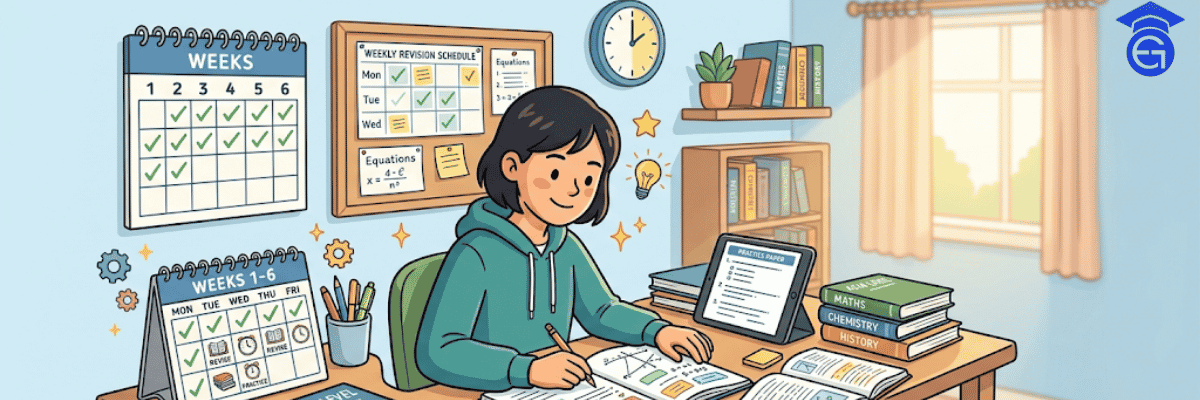
Six weeks sounds like either plenty of time or barely any, depending on the day you ask. On a good day it feels like a real runway. On a bad one, after a mock that didn’t go the way you hoped, it feels like nowhere near enough. The honest answer sits somewhere in between, and it depends far more on what those six weeks actually get spent on than on the number itself. If you’re heading into the October/November series for Cambridge or Edexcel, here’s a plan that fits the time you’ve genuinely got.
What this covers
- What six weeks can realistically achieve
- Start with a diagnostic, not a re-read
- Deciding what to prioritise when you can’t cover everything
- Past paper technique under real timing
- Where Cambridge and Edexcel actually differ in this window
- When a structured crash course is worth it
- The final two weeks specifically
- Questions people are actually asking right now
What Six Weeks Can Realistically Achieve
Let’s be straightforward about this, because vague reassurance isn’t useful this close to an exam. Six weeks is genuinely enough time to move a grade when the underlying issue is technique, timing, or a defined set of shaky topics. It’s a much tighter fit when whole units were never properly learned the first time, especially across more than one subject.
The honest first step is figuring out which situation you’re actually in, rather than assuming. A student retaking AS Maths after a near-miss grade is usually in a very different position to a student sitting A2 units for the first time who’s behind on content because of a difficult term. Both can use six weeks well. Neither should use the same plan.
I’ve watched students do genuinely impressive things with six weeks when the plan matched their actual starting point, and I’ve also watched students burn the same six weeks re-reading notes on topics they already knew reasonably well, because it felt safer than confronting the topics they didn’t. The second pattern is more common than people admit.
Start With a Diagnostic, Not a Re-Read
If there’s one piece of advice worth taking seriously in week one, it’s this: sit a genuine timed past paper before doing anything else, for every subject you’re preparing. Mark it properly, against the actual scheme, not against a rough sense of whether the answers look right.
Reading through notes feels productive in a way that’s slightly misleading. Recognising a concept and being able to apply it under timed exam conditions are different skills, and the gap between them is exactly what a diagnostic paper reveals. I’ve seen students who could explain a topic clearly out loud lose real marks on that same topic in a past paper, purely because the question was phrased in a way they hadn’t practiced responding to.
That one paper, done honestly in week one, tells you three separate things: which topics are genuinely weak, which are fine, and whether the real issue is timing rather than knowledge at all. Those three problems need different fixes, and there’s no way to tell which one you’re dealing with without sitting a real paper first.
Worth doing this week: if you haven’t sat a full timed paper recently, do one before reading any further study advice, including this article. Everything that follows is more useful once you know where you actually stand.
Deciding What to Prioritise When You Can’t Cover Everything
Six weeks means honest triage, and this is the part that tends to make people uncomfortable, because it means accepting you probably won’t get to everything.
Here’s a genuinely useful way to think about it. Topics that are shaky but not entirely unfamiliar tend to offer the best return on a focused push, since the underlying understanding is already partly there and needs consolidating rather than building from nothing. A topic that’s completely new with six weeks left is a different calculation. Sometimes it’s worth the investment, especially if it’s heavily weighted in the exam. Often, though, it’s more efficient to treat it as a contained, acceptable loss and spend that time securing marks elsewhere instead. That’s not a comfortable thing to say out loud to a parent expecting full coverage, but it’s the honest maths of a short window.
There’s a trade-off here worth naming plainly. Chasing full syllabus coverage in six weeks usually means shallow coverage of everything, which under exam pressure tends to produce partial marks across the board rather than full marks anywhere. Prioritising a smaller set of topics deeply, backed by past paper practice, tends to produce a more reliable outcome, even though it means consciously walking past some content.
Past Paper Technique Under Real Timing
Once the diagnostic and the priority list are in place, the bulk of the remaining weeks should be built around timed past papers, not passive review. This is where a lot of six-week plans quietly go wrong. Students do practice questions, but untimed, in a quiet room, with notes nearby, which bears very little resemblance to what the actual exam demands.
Timed practice does two things notes can’t. It builds a genuine sense of pacing, since running out of time on the final question of a paper is a completely avoidable, and common, way to lose marks that have nothing to do with subject knowledge. And it surfaces exactly how marks are awarded, which for AS and A Level papers often comes down to method marks and structured working, not just a correct final answer. Reviewing a paper against the actual mark scheme afterward, not just checking whether the number matches, is where a lot of the real learning happens in this window.
A reasonable rhythm for the middle stretch of the six weeks is two to three timed papers per subject per week, spaced rather than crammed together, each one followed by proper mark scheme review before moving to the next.
Where Cambridge and Edexcel Actually Differ in This Window
Worth a note here, since the two boards don’t run on quite the same calendar or structure, and mixing them up can genuinely cost preparation time.
Cambridge’s AS and A Level October/November series runs from 28 September to 13 November 2026, with results on 7 January 2027. Edexcel International A Level runs its own separate October series, with exams beginning 8 October 2026 and results on 20 to 21 January 2027. If you’re sitting Edexcel IAL, standard entries typically closed in late August, so if you’re only starting to think about this now, it’s worth confirming your entry status with your exams officer directly rather than assuming.
Beyond dates, the papers themselves reward slightly different things. Cambridge’s structured “show that” questions expect a specific proof style. Edexcel’s papers tend to lean on command word precision and structured extended responses. Neither is harder than the other, but preparing generically for “AS Level” without accounting for which board you’re actually sitting is a real way to waste some of a short six weeks on the wrong kind of practice.
If you’re on Edexcel IAL and haven’t confirmed your entry: check with your school this week specifically, since the standard entry window for the October series has likely already closed, and late entry, where available, comes with its own tighter deadline.
When a Structured Crash Course Is Worth It
I’ll be honest about this rather than turning it into a pitch, since that’s not useful to anyone reading this with six weeks on the clock. A crash course is worth it when it’s built around diagnosis and targeted practice, not an attempt to re-teach the full syllabus at speed. There genuinely isn’t time in six weeks to cover a full year’s content at the same depth a first pass would, and a course pretending otherwise is setting up an unrealistic expectation.
What actually helps in a short window is precision: identifying the specific topics and question types costing a particular student marks, then spending the available hours almost entirely there, with timed past paper practice built in throughout rather than saved for the final days. That’s the structure behind Edugravity’s October/November AS & A Level Crash Course, and it’s why it starts with an actual diagnostic rather than a generic content walkthrough. Six weeks spent precisely on the right topics moves a grade further than six weeks spent thinly covering everything.
If six weeks feels tight and you want a plan built around your actual gaps
Edugravity’s October/November Crash Course starts with a real diagnostic for each subject, then builds a focused, board-specific programme around exactly what’s costing marks. Cambridge and Edexcel, in Sharjah or online across the UAE.
WhatsApp Edugravity Explore the Crash CourseThe Final Two Weeks Specifically
The instinct in the last fortnight is almost always to push harder, longer days, more subjects squeezed in, less sleep. I’ve seen this backfire more times than it’s helped. Exhausted recall genuinely is worse recall, and a student running on four hours of sleep after a late cramming session tends to underperform relative to what they actually know, not because the knowledge isn’t there, but because it’s harder to access under pressure when the brain hasn’t rested.
What tends to work better here is narrower and calmer: a smaller number of timed papers done at proper exam pace, genuine mark scheme review after each one, and enough sleep that what’s already been learned can actually be retrieved on the day. It’s a less dramatic final stretch than a marathon push, and it’s also the one that tends to hold up better under real exam pressure.
A rough shape for the six weeks
Week one: a genuine timed diagnostic per subject, marked properly, to see exactly where marks are being lost. Weeks two to four: focused work on the priority topics the diagnostic revealed, with timed past papers woven in two to three times a week per subject. Weeks five to six: full timed papers under real exam conditions, spaced out rather than crammed, mark scheme review after each. The final few days: lighter review, proper sleep, and confirming exam logistics, times, materials, room location, rather than pushing new content.
Questions People Are Actually Asking Right Now
The One Thing Worth Holding Onto This Week
Six weeks isn’t a lot of time, and it’s also not as little as it feels on a bad day. What actually determines the outcome isn’t the number of weeks, it’s whether that time goes toward the right topics, tested under real conditions, rather than toward whatever feels most comfortable to revisit. That’s a sharper discipline than a longer revision schedule allows for, not a lesser one.
If you’re starting this week, the single most useful thing you can do today isn’t another read-through of notes. It’s one timed past paper, marked honestly. Everything else follows from what that paper actually shows.
Six weeks goes further with a plan built around your actual gaps
Edugravity’s October/November Crash Course starts with a real diagnostic, not a generic syllabus recap, so the limited weeks go where they’ll actually move the grade. In-person in Sharjah at 107 Al Reem Plaza, Corniche Street, or online across the UAE.
WhatsApp Edugravity Explore the Crash CourseKey Takeaways
- A genuine timed diagnostic in week one shows exactly where marks are being lost, more usefully than re-reading notes
- Six weeks can meaningfully improve a grade for technique or specific weak topics, less reliably for entire unlearned units
- Prioritise shaky-but-familiar topics over entirely new ones when the syllabus can’t all be covered in time
- Cambridge’s AS/A Level series runs 28 Sept to 13 Nov 2026 with results 7 Jan 2027; Edexcel IAL exams begin 8 Oct 2026 with results 20 to 21 Jan 2027
- The final fortnight works better with fewer, calmer timed papers and proper rest than with longer cramming sessions