
Pros and Cons of Registering as a Private Candidate for IGCSE: What Nobody Tells You
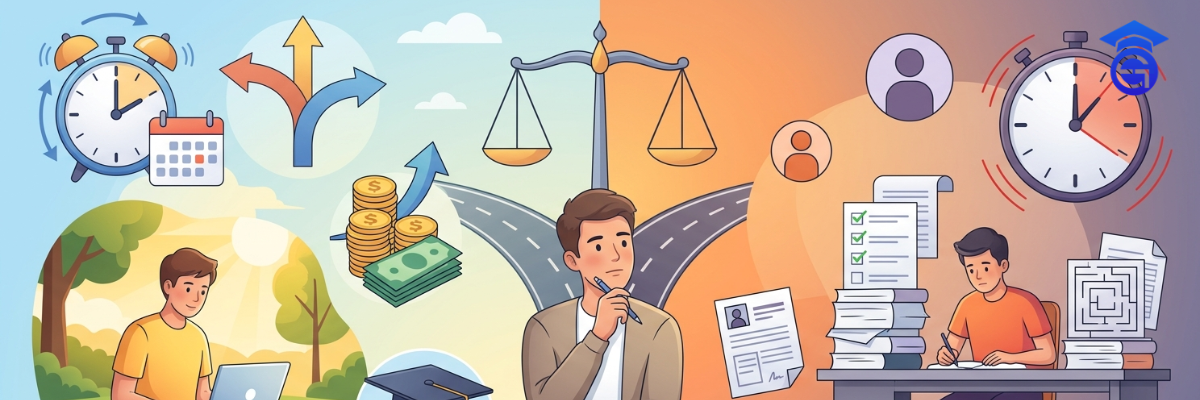
A parent asked me recently whether their daughter should register as a private candidate for IGCSE, and I could tell they’d read all the official guidance but still weren’t sure. Because the official guidance tells you what’s possible, not whether it’s actually a good idea for your specific situation. That’s what this is for. The pros are real. So are the cons. And neither list means much unless you understand what they actually mean in practice.
What’s covered in this guide
What Being a Private Candidate Actually Means
Before we get into pros and cons, let’s be clear about what this path involves. A private candidate is someone who sits IGCSE exams without being enrolled in a school that teaches the Cambridge or Edexcel curriculum.
You’re responsible for your own learning. That might mean homeschooling with a parent, hiring private tutors, using online courses, teaching yourself from textbooks, or some combination. The school bit, the daily classes and teacher support, that’s not part of the package.
When exam time comes, you register through an exam center, usually the British Council in the UAE, and sit the same papers as school students. The certificate you receive is identical. Universities can’t tell the difference. Employers can’t tell the difference.
That’s the structural reality. Now let’s talk about what it’s actually like.
Quick clarification: Private candidate status is about how you study, not where you live or what your situation is. Homeschooled students, students at schools that don’t offer IGCSE, adults returning to education, students who want subjects their school doesn’t teach, they all use this route. It’s more common than people realize.
The Advantages That Actually Matter
Let’s start with what works well about the private candidate route, because there are genuine advantages here.
Complete schedule flexibility
This is the big one. You study when it suits you. Morning person who thinks clearly at 6 AM? Great, that’s your study time. Teenager who can’t focus before 10 AM? Also fine, study in the afternoon. You’re not locked into a school timetable that might not match how you actually work.
For students with other commitments, this flexibility is transformative. Athletes training intensively. Students involved in serious creative pursuits. Kids whose families travel frequently. The ability to structure learning around life rather than life around a school schedule is worth a lot.
Personalized pace
You can spend three months on the Maths topics you find difficult and race through Biology in six weeks if that’s your strength. No waiting for classmates to catch up. No being left behind because the teacher’s moved on and you’re still confused about the last chapter.
For genuinely bright students who find school frustratingly slow, this accelerates everything. For students who need more time on certain topics, it removes the stress of keeping up with an arbitrary pace.
Subject choice freedom
Schools have timetable constraints. If French and History both run period 3 on Tuesday, you pick one. As a private candidate, you pick whichever subjects you want without worrying about scheduling conflicts.
You can also take fewer or more subjects than a typical school student. Want to focus deeply on four subjects instead of the standard eight or nine? Fine. Want to take twelve because you’re ambitious and capable? Also possible.
Significant cost savings, sometimes
This one needs explaining properly because it’s not straightforward. Exam fees for private candidates run around £100 to £200 per subject, call it AED 500 to 1000. Taking eight subjects means roughly AED 4,000 to 8,000 in exam fees total.
Compare that to two years of international school fees, which in the UAE can run AED 40,000 to 100,000 annually depending on the school. If you’re homeschooling or using affordable online resources, the savings are enormous.
But, and this is important, most students need support. Tutoring costs add up. Quality online courses aren’t free. By the time you’ve paid for proper teaching across eight subjects, you might be spending significant money anyway. The cost advantage exists, but it’s not automatic.
Less social pressure and distraction
For some students, the social environment of school is exhausting or actively harmful. Anxiety, bullying, peer pressure to underachieve, constant social comparison. Removing that environment lets certain students focus on learning without the emotional overhead.
This benefit is student-specific. Some kids thrive socially at school and would miss it terribly. Others genuinely do better learning independently.
Something I’ve seen work well: Students taking most subjects through school but registering as private candidates for one or two additional subjects their school doesn’t offer. You get the structure and support of school for your main subjects plus the flexibility to pursue interests outside that curriculum. Best of both approaches.
The Disadvantages Nobody Emphasizes Enough
Now let’s talk about what makes the private candidate route difficult, because these challenges are real and they derail students who aren’t prepared for them.
You’re entirely responsible for everything
Schools handle registration, deadlines, exam timetables, statement of entry checking, all the administrative pieces. As a private candidate, that’s on you. Miss a registration deadline? Nobody’s reminding you. Exam clash because you didn’t check the timetable carefully? Your problem to solve.
This sounds minor until you’re actually managing it. The Cambridge exam system has specific procedures, strict deadlines, and particular requirements. Getting it wrong can mean missing exams entirely.
Finding exam centers is harder than it sounds
Not all exam centers accept private candidates. Some that do have limited spaces. In the UAE, the British Council is the main option, but their centers can fill up, especially for popular subjects and sessions.
You need to confirm space, understand their specific requirements, pay on time, and coordinate with them for special accommodations if needed. It’s manageable, but it’s work.
Self-discipline is non-negotiable
There’s no teacher checking if you’ve done your homework. No one’s testing you weekly to make sure you’re actually learning the material. No classmates to study with or compare notes. You have to manage your own learning, and that requires a level of self-motivation that not all 15- and 16-year-olds possess.
I’ve watched bright, capable students fail as private candidates not because they couldn’t understand the material, but because they couldn’t sustain the discipline to study consistently without external structure. It’s a real issue.
Isolation and lack of peer learning
You don’t realize how much you learn from classmates until you don’t have any. Hearing someone ask a question you hadn’t thought of. Seeing how others approach problems. Group discussions that deepen understanding. Collaborative study sessions before exams.
Private candidates miss all of that. You can join online forums or study groups, but it’s not quite the same as daily classroom interaction.
Teacher support is limited or absent
When you’re confused about a concept in school, you ask the teacher. They explain it again a different way. They give you extra practice problems. They check your understanding and adjust their teaching.
Private candidates don’t have that. You can hire tutors, and many successful private candidates do exactly that. But tutors are expensive, they’re not available 24/7, and finding good ones takes effort.
Resource hunting takes time
Schools provide textbooks, practice materials, past papers, study guides. Private candidates have to find all of this themselves. Some of it’s free online. Some of it’s not. Some of it’s good quality. Much of it isn’t.
Figuring out which resources actually help, which textbooks align with the syllabus, which online courses are worth paying for, that’s time and energy that school students don’t have to spend.
Real scenario that happens often: Student registers as private candidate to save money. Struggles with self-study. Family hires tutors for most subjects to compensate. End up spending nearly as much as school fees would have been, but without the structured environment and social benefits of school. This isn’t failure, it’s just the reality that independent study requires support for most students.
The Real Cost Comparison
Let’s be specific about money because this is often the deciding factor for families.
School route for two years of IGCSE at an international school in Sharjah or Dubai runs somewhere between AED 80,000 and 200,000 total, depending on which school. That includes teaching, resources, facilities, exam fees, everything.
Private candidate exam fees only, assuming eight subjects, roughly AED 4,000 to 8,000 total. Massive savings, right?
But now add the actual cost of learning those eight subjects. If you’re using quality online courses, that’s AED 500 to 1,500 per subject. Call it AED 8,000 for eight subjects. If you’re hiring tutors for weekly sessions across the two years, you’re looking at AED 200 to 400 per hour depending on the tutor. Eight subjects, two hours per week per subject, that adds up fast.
Textbooks, revision guides, practice materials, another AED 2,000 to 3,000. Travel to exam centers for the actual exams. Time spent by parents coordinating everything.
By the time you’ve paid for proper support, you might be spending AED 30,000 to 60,000 over two years. Still cheaper than school, but not the dramatic difference the exam fees alone suggest.
The genuine savings exist when students can largely self-study using free or low-cost resources, supplemented with targeted tutoring only for specific weak areas. That works for some students. Not for most.
Who Actually Succeeds as a Private Candidate
After watching many students go through this route, there are patterns in who does well.
Self-motivated students who don’t need external pressure to work consistently. They set their own deadlines, stick to study schedules, and genuinely enjoy learning. These students thrive with the freedom and often outperform what they would have achieved in school.
Students with strong parental support where at least one parent can oversee the process, help with planning, provide accountability, and arrange necessary resources. The parent doesn’t need to teach the subjects, but they do need to manage the overall process.
Students with specific needs that schools don’t accommodate well. Severe anxiety in group settings. Learning styles that don’t fit classroom teaching. Physical or mental health issues requiring flexibility. Geographic situations requiring frequent movement. For these students, private candidacy isn’t about preference, it’s about necessity, and necessity often drives success.
Students already attending school who register as private candidates for one or two additional subjects. They get structure from school while pursuing extra interests independently. This hybrid approach works surprisingly well.
Who struggles? Students who need external structure to stay on track. Students without adequate support systems. Students underestimating how much work independent study actually requires. Students who thought they were self-motivated but discovered they’re actually not once nobody’s checking.
The Coursework Problem You Need to Know About
Here’s something that catches families off guard. Some IGCSE subjects include coursework or practical components that need teacher assessment.
Art, for example. Drama. Design and Technology. Certain Science practicals. These subjects have components where a qualified teacher needs to observe your work, assess it according to specific criteria, and submit marks to Cambridge.
If you don’t have access to a teacher who can do this, you can’t take those subjects in their standard format. Cambridge offers alternative papers for some subjects that replace coursework with additional exams, but not for all subjects.
This limits subject choice for private candidates in ways that aren’t immediately obvious. You need to check carefully which subjects have coursework requirements and whether alternatives exist before planning your subject combination.
For the core academic subjects, Maths, English, Sciences, Humanities, Economics, Business, this isn’t an issue. They’re assessed entirely through exams. But if your student is interested in creative or practical subjects, the coursework requirement becomes a real constraint.
How to Decide If This Is Right for You
Looking at everything we’ve covered, here’s how to think through this decision properly.
Start by being brutally honest about your student’s self-motivation. Not “they’re capable of it in theory.” Do they actually, consistently, do work without being told? Do they set goals and follow through? Do they recover from setbacks without external encouragement? If the answer is genuinely yes, private candidacy is viable. If you’re hoping they’ll develop these traits through the process, that’s risky.
Consider your support capacity as a family. Can someone oversee the process, manage deadlines, arrange resources, provide accountability? This doesn’t mean teaching the subjects, but it does mean project managing the whole endeavor. If both parents work full-time and nobody has bandwidth for this, the administrative burden might be too much.
Look at the actual cost including support, not just exam fees. If you’ll need extensive tutoring to make this work, calculate what that costs and compare it honestly to school fees. The financial advantage might be smaller than you think.
Think about what your student gains and loses socially. Some students don’t need or want the social environment of school. Others do, even if they don’t realize it yet. Consider whether you can provide social interaction through other channels if removing school from the equation.
Check subject requirements carefully. If your student wants to take subjects with coursework components, confirm alternatives exist or that you have access to qualified assessment.
Consider starting small. Take one or two subjects as a private candidate while continuing school, or try it for one exam session before committing to the full IGCSE program. This tests whether the reality matches expectations without putting everything on the line.
Considering the private candidate route for IGCSE in Sharjah?
Edugravity supports private candidates across the UAE with structured tuition that bridges the gap between independent study and school learning. We provide the teaching expertise, exam preparation, and accountability that private candidates need, while maintaining the flexibility that makes this route attractive. Whether you need support for all subjects or targeted help in specific areas, we’ve helped private candidates achieve the same results as school students.
WhatsApp Us Book Free ConsultationThe Bottom Line
Being a private candidate for IGCSE works brilliantly for some students and fails miserably for others. The difference isn’t intelligence or capability. It’s fit.
The advantages are genuine: flexibility, personalized pacing, subject freedom, potential cost savings, reduced social pressure. These matter tremendously if they solve problems your student actually has.
The disadvantages are also genuine: complete responsibility for administration, self-discipline requirements, isolation, limited teacher support, resource hunting. These matter if your student needs structure and support to thrive.
The certificate is the same either way. What differs is the journey to get there. For the right student in the right situation with adequate support, private candidacy is an excellent choice. For students who need external structure or for families without bandwidth to manage the process, school remains the better option even if it’s more expensive.
Don’t choose based on what sounds appealing in theory. Choose based on honest assessment of your student’s work habits, your family’s capacity to support the process, and whether the advantages actually solve problems you’re facing.
Our private candidate students typically maintain study schedules of 10-15 hours per week per subject over 12-18 months. That’s the reality of what proper preparation requires. We help structure that time effectively, provide expert teaching, and keep students accountable to their goals. Learn more about our support for private candidates.
Key Takeaways
- Main advantages: complete schedule flexibility, personalized learning pace, subject choice freedom, potential cost savings (AED 4,000-8,000 vs AED 80,000-200,000 for school), reduced social pressure for students who need that.
- Main disadvantages: complete responsibility for administration and deadlines, requires exceptional self-discipline, isolation from peer learning, limited teacher support unless you hire tutors, time spent finding quality resources, exam center availability constraints.
- Real costs including necessary support often reach AED 30,000-60,000 over two years when tutoring is factored in. Still cheaper than school but not the dramatic difference exam fees alone suggest.
- Success depends on student’s genuine self-motivation, strong parental oversight, adequate support systems, and honest assessment of needs rather than hopeful assumptions about developing discipline through the process.
- Coursework requirements in subjects like Art, Drama, and certain Sciences limit subject choice for private candidates unless alternatives are available. Always check subject-specific requirements before planning.
- Hybrid approach works well: attend school for most subjects while registering as private candidate for one or two additional subjects the school doesn’t offer.