
Offline vs Online Tuition in Sharjah: What Really Works Best for IGCSE & AS-Level Students in 2026?
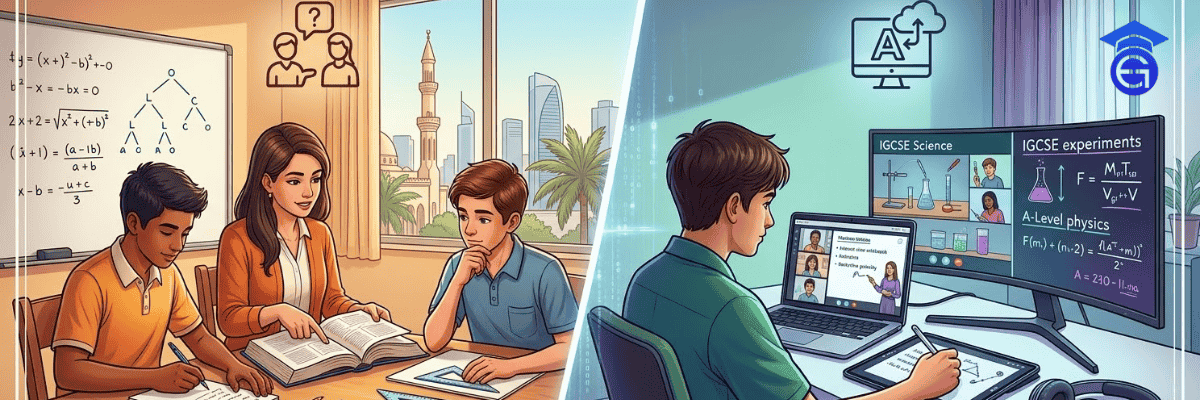
Parents keep asking me this, and it’s almost always phrased the same way: should we do offline or online tuition for our daughter’s IGCSEs? And I get it. It feels like a significant decision. But here’s what I’ve noticed after watching hundreds of students go through both formats. The question itself is usually missing the point. Whether tuition happens in a room or on a screen matters far less than whether it’s actually good tuition. Still, the format does make a difference. Just not always in the ways people expect.
What’s covered in this guide
- What’s changed about this question in 2026
- The reality of offline tuition in Sharjah
- The reality of online tuition in 2026
- Why the focus problem isn’t what you think
- Sharjah-specific factors that actually matter
- When subject type affects the decision
- What actually determines results
- How to make this decision for your situation
What’s Changed About This Question in 2026
Five years ago, this was a different conversation. Online tuition was emergency remote teaching, hastily set up during lockdowns with teachers who’d never taught on a screen before. The technology was clunky. Students were exhausted by Zoom fatigue. Parents were rightfully skeptical.
2026 is not that. Online tuition has evolved into something genuinely different from those early pandemic attempts. The platforms are smoother. Tutors who work online now do it because they’re good at it, not because they have to. The interactive whiteboards, shared documents, and screen annotation tools actually work reliably.
More importantly, students themselves have changed. IGCSE and AS-Level students in 2026 were in primary school during the pandemic. They don’t remember a time when learning through screens seemed strange. That comfort level matters.
At the same time, offline tuition has also improved. The best tutoring centers in Sharjah learned from watching what worked online. They’ve incorporated some of those tools. Digital resources alongside face-to-face teaching. Better use of practice platforms. More flexible scheduling.
So the question isn’t really “online versus offline” anymore. It’s “which type of tuition, delivered in which format, works best for this specific student’s needs?”
Something worth knowing: The research on online versus offline learning effectiveness has converged. When properly implemented with qualified teachers, both formats produce equivalent academic outcomes. The difference shows up in convenience, cost, and fit with the student’s learning style, not in the grades themselves.
The Reality of Offline Tuition in Sharjah
Let’s start with what offline tuition actually looks like for IGCSE and AS-Level students in Sharjah in 2026.
Most offline tuition happens in one of three settings. There are the established tutoring centers, usually located in Al Majaz, Al Nahda, or Al Khan. Then there are private tutors who come to your home. And finally, small group classes run from someone’s villa or apartment.
The tutoring centers offer structure. Set class times, dedicated learning spaces, administrative support for registration and payment. If your student thrives on routine and benefits from physically separating “school” from “home,” this matters. Walking into a space that’s specifically for studying creates a psychological shift that some students need.
The quality of instruction at these centers varies wildly. Some employ experienced British curriculum teachers who really know the IGCSE and A-Level specifications inside out. Others hire recent graduates who are teaching subjects they only just passed themselves. You can’t assume quality based on the glossy brochure or the rent they’re paying on their premises.
The Sharjah traffic reality
Here’s something parents don’t always factor in properly. Getting to offline tuition in Sharjah involves actual travel time. If your student is attending classes in Al Majaz but you live in Muwaileh or Al Warqaa, that’s 25 to 40 minutes each direction depending on traffic. Twice a week adds up to two to three hours of car time weekly.
That’s time not spent studying, sleeping, or doing anything else productive. For students already juggling school, homework, and exam prep, three hours a week sitting in traffic is a meaningful cost. It might be worth it if the tuition is exceptional. But it needs to be genuinely better than online alternatives to justify that time investment.
The group size question
Offline tutoring centers often advertise “small group classes.” In practice, “small” can mean anything from four students to fifteen. I’ve watched parents pay for what they thought was personalized tuition and then discover their child is in a class of twelve students, some working on different subjects simultaneously.
For IGCSE and AS-Level, class size matters more than at younger ages. These are exam-focused years. Students have specific weak points that need addressing. A tutor managing eight students can’t give individualized attention to weak areas. They end up teaching to the middle of the group, which helps nobody particularly well.
If you’re considering offline tuition, nail down the exact class size and whether all students in that class are studying the same subject at the same level. If the answer is vague or evasive, that tells you something.
Real scenario I’ve seen multiple times: Student attends expensive offline tuition center for Maths IGCSE. Parent assumes it’s working because the student goes twice a week and comes home with worksheets. Two months before exams, they do a practice paper and realize nothing has actually improved. The classes were too large and the teaching was generic. By then, it’s late to course-correct.
The Reality of Online Tuition in 2026
Online tuition has come a long way, but it’s not magic. It’s just teaching that happens through a screen instead of in person. That shift creates some advantages and some disadvantages.
The technology itself is no longer the barrier it once was. Most families in Sharjah have reliable internet. The platforms used for online tutoring, Zoom, Google Meet, specialized education software, work smoothly. Interactive whiteboards let tutors and students write simultaneously. Screen sharing makes working through exam questions straightforward. Session recordings mean students can review lessons later, which is genuinely useful before exams.
What online tuition offers most clearly is access and flexibility. Your student can work with a tutor based anywhere. That British Maths teacher who’s excellent at A-Level Further Maths but lives in Dubai? Not a problem. The former IGCSE examiner who tutors from the UK? Completely feasible. You’re not limited to whoever happens to live near you in Sharjah.
Scheduling also becomes more manageable. No commute time means a 6 PM session is actually a 6 PM session, not “leave home at 5:30, get back at 7:15.” Students can fit sessions around their actual school schedule more easily. That matters when you’re trying to balance tuition with homework, revision, and the need to occasionally sleep.
The focus myth
Parents worry that students won’t focus during online lessons. They imagine their kid half-watching the tutor while scrolling Instagram on another tab. It’s a reasonable concern. It also doesn’t match what actually happens in well-run online tuition.
One-on-one online tuition is remarkably hard to zone out of. The tutor can see exactly what you’re looking at on screen. They’re asking you direct questions constantly. There’s nowhere to hide. Compare that to a group class, whether offline or online, where you can mentally check out for ten minutes and nobody notices.
The students who struggle with focus online are usually the same students who struggle with focus offline. The format isn’t the issue. What they need is a tutor skilled at maintaining engagement, which is a teaching quality, not a delivery method.
What online tuition requires from students
Online tuition does require students to be somewhat self-directed. They need to log in on time, have their materials ready, be willing to speak up when confused. For younger students, this can be a challenge. For IGCSE and AS-Level students, who are 15 to 18 years old, it’s generally not an issue unless there are other factors involved.
What doesn’t work well online is the kind of passive learning where students just sit and listen to someone talk at them for an hour. But that doesn’t work well offline either. Good teaching, regardless of format, involves active engagement, questions, problem-solving, and practice.
Why the Focus Problem Isn’t What You Think
Let me address this directly because it comes up in almost every conversation about online tuition.
Yes, it’s easier for a student to get distracted when they’re at home on their laptop. They could open another tab. They could have their phone next to them. There’s no physical tutor in the room keeping them accountable.
But here’s what I’ve observed: students who are genuinely engaged with learning don’t want to waste their tuition time scrolling social media. The distraction problem shows up when students are enrolled in tuition they don’t see the point of, taught by tutors who aren’t engaging them effectively.
The real focus issue isn’t online versus offline. It’s whether the tuition is actually teaching the student something useful in a way that holds their attention. Boring, ineffective tuition is boring and ineffective whether it’s delivered in person or through a screen.
I’ve watched students sit through hour-long offline classes barely paying attention, mentally present but not actually learning anything. And I’ve watched the same students be completely focused during a 45-minute online session because the tutor was addressing their actual weak points and keeping them actively involved.
If your student is getting distracted during online tuition, the question isn’t “should we switch to offline?” It’s “is this tutor actually good at teaching?”
Sharjah-Specific Factors That Actually Matter
There are some realities specific to Sharjah that affect this decision in ways they wouldn’t elsewhere.
The commute factor
I mentioned this earlier, but it bears repeating. Sharjah’s geography and traffic patterns make commuting to offline tuition more time-consuming than in more compact cities. If you live in one emirate and the tutoring center is in another, you’re looking at significant travel time.
For families with multiple children or parents who work full-time, coordinating drop-offs and pickups becomes genuinely complicated. Online tuition eliminates this entire category of logistical stress.
Heat and summer months
Summer in Sharjah is brutal. June through September, temperatures regularly hit 45 degrees Celsius. Getting students to commute to offline tuition during these months is not fun. They arrive hot, uncomfortable, and less ready to focus than they would be starting from their air-conditioned home.
Online tuition during summer makes vastly more sense from a pure comfort and practicality standpoint. This matters especially for students doing summer intensive revision before retakes or preparing ahead for the next academic year.
The tutor pool in Sharjah
Sharjah has good tutors. It also has far fewer experienced British curriculum specialists than Dubai does, simply because of population size and where international schools are concentrated. This means if you limit yourself to offline tutors based in Sharjah, you’re working from a smaller pool.
Online tuition opens up access to tutors based anywhere. You’re not limited by geography. For specialized subjects or very high-level content like A-Level Further Maths or specific Science options, this can make the difference between finding someone qualified and settling for whoever’s available locally.
Comparing Both Formats: What You Actually Get
Let’s be clear about what each format offers and what it doesn’t. No spin, just the practical reality.
Offline tuition: the advantages
Face-to-face interaction lets tutors read body language and facial expressions. When a student is confused but not saying anything, you can see it. That immediate feedback helps tutors adjust their approach before the student falls too far behind.
Classroom dynamics create peer learning that’s hard to replicate online. Students hear questions from classmates they hadn’t thought to ask. They see how others approach problems. There’s spontaneous collaboration when someone explains a concept to the person next to them in a way that clicks better than the tutor’s explanation did.
Physical presence creates focus for many students. Going to a specific place for studying establishes a mental separation between “study time” and “home time.” For students who struggle with self-discipline, this environmental cue matters.
Whiteboards and working space let multiple students display their work simultaneously. The tutor can glance across and see three different approaches to the same problem, then use that to teach everyone. That’s harder to manage when everyone’s on separate screens.
Direct material exchange is simpler. Handing over a marked practice paper or a resource sheet takes two seconds. No scanning, no file sharing, no technical friction.
Offline tuition: the disadvantages
Commute time is real time lost. In Sharjah, getting to and from tuition can easily add two to three hours per week. That’s time not spent studying, sleeping, or doing anything else productive. For students already stretched thin, that’s a significant cost.
Geographic limitations restrict your tutor options. You’re choosing from whoever happens to teach near you. For common subjects that’s fine. For specialized A-Level options or students who need specific teaching styles, the pool gets small quickly.
Weather affects attendance. Summer in Sharjah means 45-degree heat. Students arriving hot and uncomfortable aren’t in ideal learning condition. During sandstorms or heavy rain, getting to tuition becomes genuinely difficult.
Schedule rigidity is built in. If the tuition center runs Maths on Tuesday and Thursday evenings, that’s when you go. No flexibility for when your school schedule shifts or when you have competing commitments.
Cost is typically higher because centers have facility overhead. Rent in Al Majaz or Al Khan isn’t cheap, and that gets passed to parents through fees.
Online tuition: the advantages
Zero commute time means more efficient use of everyone’s time. A one-hour session is actually one hour, not 90 minutes once you factor in travel.
Access to specialist tutors anywhere expands your options dramatically. That former IGCSE examiner in the UK? The A-Level Further Maths specialist in Dubai? Both available to you without geographic constraints.
Scheduling flexibility is substantially better. Sessions can happen early morning, late evening, weekends. Easier to work around school commitments and family schedules.
Session recordings let students review difficult concepts later. Before exams, being able to rewatch an explanation of a tricky topic is genuinely useful.
Digital resources integrate seamlessly. Past papers, mark schemes, interactive simulations, all can be shared and displayed instantly without printing or physical materials.
Cost is often lower because there’s no facility rent to cover. Not always, but frequently enough to matter.
Online tuition: the disadvantages
Technical issues happen. Internet drops. Audio cuts out. Screen sharing freezes. These are rare with good connections and platforms, but they’re still more common than the lights going out in an offline classroom.
Peer interaction feels different through screens. Students can collaborate, but the spontaneous “lean over and look at your neighbor’s work” moment doesn’t translate. Breakout rooms help, but they’re not quite the same.
Home distractions are real for some students. Siblings, parents, pets, the comfort of being in their own space. For students who struggle with focus, removing these distractions by going to a dedicated study space helps.
Screen fatigue is real after a full day of school on computers. Adding more screen time in the evening isn’t ideal, though for most students it’s manageable.
Body language cues are reduced. Tutors can see faces but miss smaller physical signals. It’s not impossible to gauge understanding, just slightly harder.
The Case for Offline Tuition
After comparing both formats, there’s a reason we at Edugravity primarily encourage offline tuition for IGCSE and AS-Level students when it’s feasible. The classroom interaction simply works differently, and for most students, it works better.
When students are physically in the same room, the quality of peer-to-peer learning changes. They can see each other’s working on whiteboards. They overhear questions from other students that they hadn’t thought to ask themselves. There’s a natural back-and-forth that happens spontaneously in a physical classroom that’s harder to replicate through screens.
The tutor can also read the room differently. Body language matters. You can see when a student is genuinely confused versus just temporarily stuck. You notice when someone’s getting frustrated before they say anything. That immediate feedback loop helps tutors adjust their pace and approach in real-time.
There’s also something about physically going to a place specifically for studying that creates better focus for many students. It’s a mental shift. Home is for relaxing. The tutoring center is for working. That separation helps, especially for students who struggle with self-discipline.
Small offline groups, the kind we run with maximum six students, create a learning environment where students push each other. They see their classmates solving problems and think “if they can do it, I can too.” There’s healthy competition. There’s collaborative problem-solving. That energy is hard to manufacture online.
None of this means online tuition doesn’t work. It does. But when we’re honest about what produces the best learning environment for exam-focused students, offline tuition with proper classroom interaction has the edge.
Experience the difference of offline tuition in Sharjah
At Edugravity’s Sharjah center, we keep our classes small (maximum 6 students) specifically to maximize classroom interaction. Students learn from each other, tutors can read the room and adjust in real-time, and the focused learning environment makes a real difference. We also offer online tuition for students who need that flexibility, but we’ve found offline works best for most IGCSE and AS-Level students.
WhatsApp Us Visit Our CenterHow to Make This Decision for Your Student
Looking at everything we’ve covered, here’s how to think through this for your specific situation.
If your student can reasonably get to offline tuition without excessive commute time, that’s what we’d recommend. The classroom interaction, peer learning, and focused environment genuinely make a difference for most IGCSE and AS-Level students. It’s not that online doesn’t work. It’s that offline works better when it’s practical.
The students who benefit most from offline tuition are those who thrive on face-to-face interaction, learn well from seeing how their peers approach problems, and need the structure of physically going somewhere to study. If that sounds like your student, the commute time is worth it.
Online tuition makes more sense when commuting adds more than an hour weekly of travel time, when you need access to specialist tutors not available locally, or when schedule flexibility is essential because of other commitments. It’s also the better choice during Sharjah’s summer months when the heat makes traveling genuinely unpleasant.
Some students also genuinely work better online. They’re comfortable with the technology, they focus well at home, and they like the efficiency of no commute. If your student has been doing online tutoring successfully, there’s no compelling reason to switch just for the sake of being offline.
The mistake to avoid is choosing based on what sounds better in theory rather than what fits your practical reality. Offline tuition that your student can barely get to because of schedule conflicts or traffic won’t work well. Online tuition in a house full of distractions with poor internet won’t work well either.
Visit our Sharjah center(Location) if you’re considering offline tuition. See the classroom setup, talk to tutors, understand exactly what the experience will be like. For online tuition, request a trial session to confirm the technology works smoothly and your student responds well to the format.
At Edugravity, we offer both options because we know different families have different constraints. But we’re honest about where we see the best results: small offline groups where students can interact, collaborate, and learn from each other under expert guidance. That’s the model that consistently produces the grade improvements parents are looking for.
Our offline students average one to two grade levels of improvement within a term. The classroom interaction, peer learning, and focused environment make that difference. We also support online students effectively, but when logistics allow, we encourage families to choose offline tuition. Visit us to see the difference yourself.
Key Takeaways
- Offline tuition offers better classroom interaction, peer learning dynamics, and environmental focus that benefits most IGCSE and AS-Level students when logistically feasible.
- Main offline advantages: face-to-face interaction, spontaneous peer collaboration, physical learning environment, better body language reading by tutors. Main disadvantages: commute time (2-3 hours weekly in Sharjah), geographic tutor limitations, weather impacts, less schedule flexibility.
- Main online advantages: zero commute, access to specialist tutors anywhere, superior scheduling flexibility, session recordings, lower cost. Main disadvantages: reduced peer interaction quality, potential home distractions, screen fatigue, occasional technical issues.
- Edugravity primarily recommends offline tuition for better classroom dynamics but offers online options for students with schedule constraints, excessive commute distances, or specific preferences for digital learning.
- The decision should be based on practical factors: commute time feasibility, student’s learning style preferences, subject specialist availability, and family schedule constraints, not abstract ideas about which format is “better.”
- Both formats work when delivered by qualified tutors in small groups (maximum 6 students) with exam-focused teaching. Quality of instruction matters more than delivery medium, but offline interaction creates advantages when logistics allow.