
KHDA’s Distance Learning Guide for Parents: What It Actually Says and What It Means for You
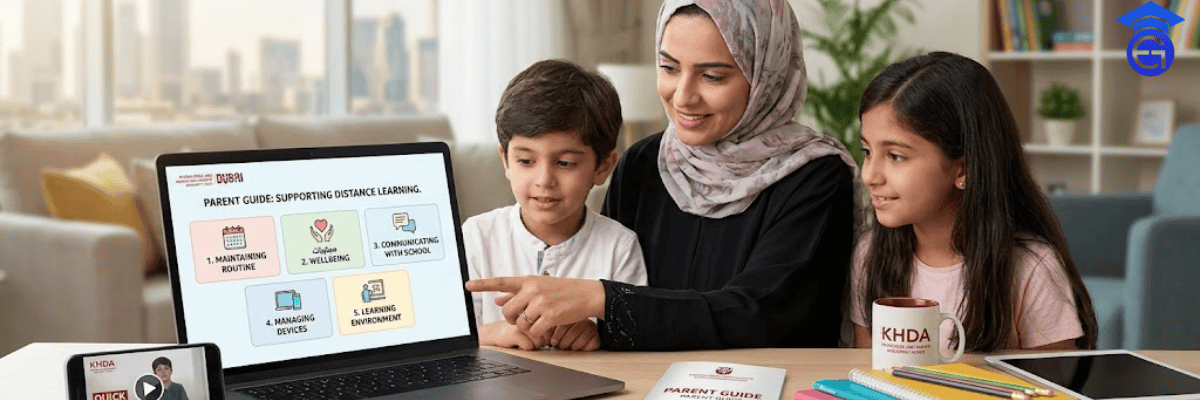
If you’ve spent the last few weeks half-supervising your child’s online classes while simultaneously trying to do your own job from the same table, you’ll appreciate what KHDA said on Tuesday: you are not expected to be the teacher. Dubai’s education regulator published a parent guide for distance learning on 7 April 2026 — and the most useful thing in it isn’t a checklist. It’s that line.
What’s in this guide
- Why KHDA published this now
- The one thing most parents are getting wrong
- The five things KHDA actually wants parents to focus on
- Why “communicate early” is the most repeated piece of advice
- What to do when devices, time or space are limited
- What the guide says for different age groups
- Screen time, stress and the wellbeing section
- Students who need extra support
- Frequently asked questions
Why KHDA Published This Now
Schools in Dubai have been on distance learning since mid-March 2026, with the UAE Ministry of Education reviewing the arrangement weekly. As of the date of this article, remote learning is confirmed until at least April 17. That’s weeks, not days. And unlike a brief disruption where everyone muddles through, an extended period of distance learning requires something more deliberate from everyone involved — schools, teachers, and yes, parents too.
KHDA had already published a separate framework for schools, setting out quality expectations for how they should be delivering lessons and supporting students remotely. This new parent guide is the other half of that conversation. It’s addressed directly to families, and it’s notable for being realistic rather than aspirational.
Fatma Belrehif, CEO of the Quality Assurance and Compliance Agency at KHDA, described the guide as a way of reinforcing the partnership between schools and families — not asking parents to compensate for what schools aren’t doing, but to play a specific and bounded role in helping learning happen at home.
Important context: Distance learning in Dubai also sits alongside a broader moment for exam-year students. If you have a child in Year 11 or Year 13 whose IGCSE or A-Level exams have been cancelled, the questions about portfolio assessment and alternative grading are separate from — but related to — what the KHDA guide covers. Read our exam cancellations guide here.
The One Thing Most Parents Are Getting Wrong
I’ll say this plainly because I think it’s the most valuable thing in the whole document.
A lot of parents — particularly those with younger children, or those who are very invested in their child’s performance — have spent the past few weeks trying to be a second teacher. Re-explaining concepts. Sitting through every online lesson. Correcting homework as if they marked it themselves. Feeling guilty when they can’t keep up, and doubling down when they can.
KHDA’s guide says, clearly: stop. That’s not your job.
The guide is explicit that schools remain responsible for planning and delivering lessons, monitoring student progress, and providing academic support. Parents are there to make the environment work, not to replicate what the school does. The distinction matters because parents who blur that line end up exhausted, their children end up confused about who’s actually in charge of their learning, and the school loses visibility into what’s actually going on.
Supporting your child’s learning is not the same as teaching it. That’s worth reading twice.
The Five Things KHDA Wants Parents to Focus On
The guide organises its parent-facing advice around five priorities. They’re not complicated, but they’re deliberately narrow — which is the point. The message is: do these things well, not everything badly.
Stay connected to the school
Help your child follow the school’s timetable, read messages, and keep up with learning activities. This sounds obvious, but in households with multiple children, working parents, or unreliable internet, it’s the first thing that slips. Staying connected means knowing what’s expected each day, not just checking in when something feels wrong.
Support participation — but don’t force it
Encourage your child to join lessons, complete assigned work, and engage with what’s being asked of them. The guide doesn’t say “make sure they attend every session perfectly.” It says encourage. That’s a realistic calibration for what distance learning actually looks like across weeks, not days.
Keep the day structured
Routine matters more during disruption, not less. KHDA’s guide asks parents to help make the day predictable: time for learning, time for breaks, meals, movement, and rest. Children — especially younger ones — don’t regulate this well on their own. Structure from the home side helps them stay anchored even when the school day feels different.
Watch the wellbeing signals, not just the work
The guide explicitly says: pay attention to your child’s mood, energy, stress, and motivation — not only whether they’ve completed their assignments. That’s a meaningful shift in emphasis. A child who is logging in, ticking boxes, and visibly fraying is not doing well, even if their attendance record looks fine. Spotting the fraying early is the job here.
Communicate early when something’s wrong
If something is affecting your child’s learning — anything at all — tell the school promptly. Not after two weeks of managing it yourself. Not after your child has missed a week of lessons. Early. The guide is unusually direct about this, and it’s worth understanding why.
Why “Communicate Early” Is the Most Repeated Piece of Advice
It comes up in almost every section of the guide, which suggests KHDA is trying to fix a specific pattern they’re seeing. Parents who wait. Who assume the school knows. Who handle things quietly at home and only reach out when the situation is already complicated.
The reality is that schools operating remotely have far less visibility into what’s happening for individual students than they do in person. A teacher who would normally notice a child looking withdrawn, or sitting at the back not engaging, or struggling with a concept — that teacher now only sees a username on a screen, maybe a camera off, maybe a missed submission. They can’t see what you can see.
So when KHDA says communicate early, they mean: if your child is having a hard morning, say something. If your internet went down for two hours and they missed a lesson, let the school know. If a family situation is making it hard for your child to focus, the school can only accommodate what it knows about.
“If your family is outside the UAE or your temporary living arrangements have changed, but your child remains enrolled in school, inform them early so that suitable allowances can be made.”
KHDA Parent Guide to Supporting Your Child During Distance Learning, April 2026That line about being outside the UAE is worth noting specifically. A number of families left Dubai in the weeks after regional tensions escalated. If your child is technically enrolled but learning from a different time zone or a different country, the school needs to know that. Timezone differences, spotty connectivity, or different household circumstances all affect what the school can reasonably expect — but only if they know the situation.
What to Do When Devices, Time, or Space Are Limited
This is one of the more practical sections in the guide, and one I think a lot of families will actually use. It directly addresses the reality that not every home has a spare desk, reliable broadband, and an adult free to supervise learning all day.
KHDA says: if you’re in a household with multiple children, shared devices, limited internet, working parents, or just general pressure — prioritise what matters most and tell the school the rest. Specifically, the guide suggests identifying which child needs the most direct support at any given time, and aiming for a manageable routine rather than a perfect one.
“Manageable routine, not perfect supervision” is the exact kind of phrasing that makes a parent guide useful. It acknowledges that perfection isn’t on the table for most families right now.
If access is genuinely limited: Tell the school early. Don’t wait until your child has missed multiple sessions and the school is chasing attendance. A simple message — “we have one device between three children, here’s our plan” — gives the school information it can actually work with. Silence doesn’t.
What the Guide Says for Different Age Groups
The guide is broken down by school stage, which is useful because the right approach looks very different depending on whether your child is five or fifteen.
Early years and lower primary (roughly Ages 4 to 8)
For young children, parents will need to do a lot more hands-on support than the guide asks of parents with older kids. That means preparing devices, helping them log in, guiding them through short activities, and being nearby during sessions. It also explicitly encourages offline activities — reading together, drawing, counting, singing, play-based learning. Young children learn through doing, not just watching a screen. The guide acknowledges this and doesn’t pretend that sitting a five-year-old in front of a laptop for three hours is workable.
Upper primary and lower secondary (roughly Ages 9 to 14)
At this stage, KHDA says parents should look beyond the surface level. It’s not enough to ask whether your child logged in — check whether they understood the lesson, engaged with it, and completed what was asked. This age group is capable of appearing to participate while not really being present. They’re also old enough to feel genuine stress about school performance but not always old enough to say so clearly. The guide asks parents to keep an eye on the signs, not just the output.
Senior students (roughly Ages 15 and above)
Older students are more independent, but KHDA’s guidance for this group is actually quite assertive. It recommends helping them structure their week with planners or checklists, watching actively for signs of stress or overwhelm, and stepping in early if workload starts building in ways they can’t manage alone. This matters especially for exam-year students right now, whose situation is already complicated by cancelled exams and portfolio assessment processes. Independent doesn’t mean unsupported.
Screen Time, Stress, and the Wellbeing Section
The guide has a dedicated wellbeing thread running through almost every section, and it addresses screen time with more nuance than the usual “limit it to X hours” advice.
KHDA acknowledges that distance learning means more screen time by definition, particularly for younger children. Rather than giving a hard number, it asks parents to balance online lessons with breaks, movement, rest, and offline activities — and to speak to the school if screen-based learning is causing fatigue, headaches, or disengagement. That’s a practical framing: the screen time is partly unavoidable, but its effects are manageable if you’re paying attention.
On stress specifically, the guide says to watch for signs that might not look like stress at first glance: tiredness, frustration, withdrawal, or a child who’s suddenly resistant to learning. These are all common presentations of a child who’s overwhelmed and doesn’t have the words for it yet. The advice is to check in regularly, keep routines calm and predictable, and offer reassurance rather than additional pressure when learning feels hard.
One pattern worth flagging: Parents sometimes respond to a stressed child by adding more structure, more monitoring, more questions about whether work is done. For some children that helps. For others it makes things worse. The guide’s emphasis on reassurance over pressure is deliberate. If your child is disengaged and miserable, the answer probably isn’t another check-in about their assignment. It might just be a break and a conversation about something else entirely.
Students Who Need Extra Support
KHDA devotes a specific section to students who may find distance learning harder than most: children of determination, younger children, and those dealing with anxiety, family pressures, or barriers to connectivity. The advice here is not to manage these situations alone.
The guide suggests speaking with the school and, where relevant, the school’s Head of Inclusion about what alternative arrangements might look like: shorter tasks, extra breaks, a different pace, specialist therapy support where it applies. Schools can make adjustments, but only if the conversation happens. This circles back to the “communicate early” theme — it applies most urgently for children who are already finding things difficult.
The guide also addresses cameras and online conduct, advising parents to follow school guidance, protect children’s personal information, and flag any inappropriate behaviour or privacy concerns early. For younger children it recommends keeping devices in communal spaces and staying nearby during sessions where possible.
What This Guide Is Really Saying
Reading the KHDA parent guide as a whole, the core message is something like: we know this is hard, we know your circumstances vary, and we’re not asking you to be perfect. We’re asking you to stay connected, keep routines, watch your child’s wellbeing, and talk to the school when things are off.
That’s actually a pretty reasonable ask. It’s narrower than what a lot of parents have been trying to do since schools shifted online. And sometimes narrower is more useful than comprehensive — because comprehensive can feel like an accusation when you’re already stretched thin.
The guide doesn’t resolve everything. It doesn’t tell you what to do when your child refuses to engage with a lesson, or how to handle the sibling who always seems to need something exactly when the online class starts, or what to do with the guilt of knowing your child’s education is happening through a screen while you’re three meters away on a work call. There’s no document that solves all of that.
But it does give parents a clear lane. And right now, a clear lane is more useful than a wider road.
Distance learning is harder without structure behind it.
At Edugravity, we work with students across Sharjah, Dubai, and Ajman — IGCSE, A-Level, and exam-year students who need more than just a link to a lesson. Small groups, maximum 6 students. Subject tutors who know the UAE curriculum and what students are actually going through right now. If your child is struggling to stay on track during distance learning, or if you’re worried about how the portfolio assessment process will affect their grades, let’s talk.
WhatsApp Us Book Free DemoFrequently Asked Questions
What does the KHDA distance learning guide say parents should do?
KHDA’s guide outlines five priorities for parents: stay connected to the school, support your child’s participation in lessons, maintain a daily routine, protect your child’s wellbeing, and communicate early when problems arise. The guide explicitly says parents are not expected to teach — that’s the school’s job.
Are UAE parents expected to teach their children during distance learning?
No. KHDA’s guide is clear on this point: parents are not expected to perform the role of teachers. Schools remain responsible for planning and delivering lessons, monitoring progress, and supporting students academically. Parents are responsible for supporting the home environment and keeping routines manageable.
How long will distance learning continue in Dubai schools?
As of 7 April 2026, distance learning is confirmed until at least April 17. The Ministry of Education reviews the directive weekly, so the situation can change. Follow your school’s official communications rather than relying on news reports for the latest status.
What should I do if my child is struggling during distance learning?
Contact the school early. KHDA’s guide places heavy emphasis on early communication rather than waiting for problems to escalate. Tell the school about any barriers — connectivity, shared devices, stress, absence, or a change in living circumstances — and they can make appropriate allowances. Schools operating remotely have far less visibility into individual student situations than they do in person, so they can only respond to what you tell them.
What does the KHDA guide say about screen time during distance learning?
The guide acknowledges that distance learning increases screen time, especially for younger children, and recommends balancing online sessions with breaks, movement, rest, and offline activities. If your child is showing signs of screen fatigue, headaches, or reduced engagement, contact the school. It doesn’t set a fixed daily screen time limit — instead it focuses on monitoring the effects and adjusting accordingly.
My child has additional learning needs. Is there specific guidance?
Yes. KHDA’s guide has a section on students who may need extra support, including students of determination, younger children, and those facing anxiety, family pressures, or access barriers. The recommendation is to speak with the school and, where relevant, the Head of Inclusion about alternative arrangements such as shorter tasks, extra breaks, a different pace, or specialist support. Don’t wait — these conversations are easier to have early.
My family is temporarily outside the UAE. What should we do?
Tell the school as soon as possible. KHDA’s guide specifically mentions families who are outside the UAE or in changed living circumstances, and it asks them to inform the school early so suitable allowances can be made. Time zone differences, connectivity issues, and different circumstances all affect what the school can reasonably expect from your child — but only if they know the situation.
Key Takeaways
- KHDA published a parent guide for distance learning on 7 April 2026, covering all school stages from early years through senior school.
- The most important message in the guide: parents are not expected to teach. Schools remain responsible for lessons, progress monitoring, and academic support.
- The five parent priorities are: stay connected, support participation, maintain routine, protect wellbeing, and communicate early.
- KHDA emphasises early communication repeatedly throughout the guide — flag issues before they escalate, not after.
- Advice varies by age group: younger children need more hands-on support, while older students need structure and someone watching for stress signals.
- Distance learning is confirmed until at least April 17, reviewed weekly by the Ministry of Education.
Related reading on Edugravity: If your child is in an exam year and you’re navigating both distance learning and the cancelled IGCSE or A-Level exams, our guides cover exactly what each board is doing instead. UAE Exam Cancellations 2026: Complete Guide | Cambridge June 2026 | Pearson Edexcel May/June 2026 | IB NECM Guide