Cambridge Cancels IGCSE, O Level, AS & A Level and IPQ June 2026 Exams in UAE: Everything Students Need to Know
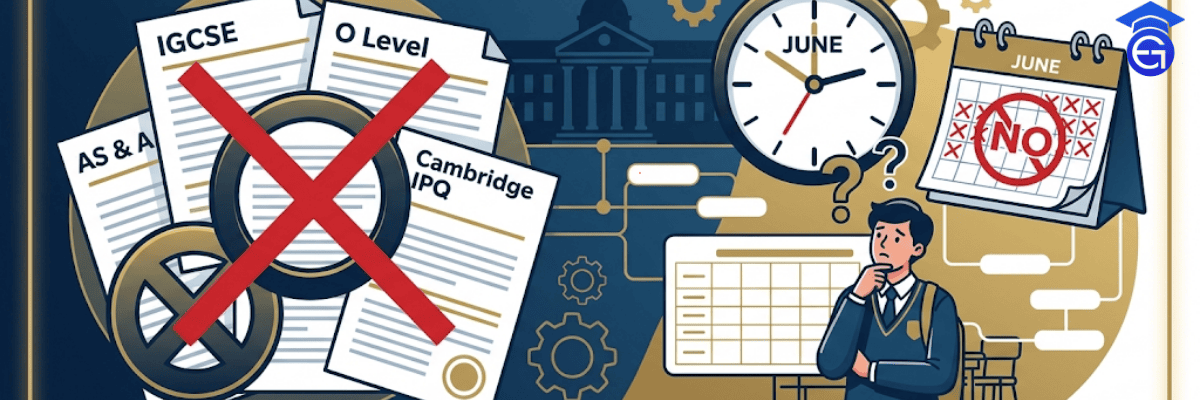
If your child sits Cambridge exams, you probably already felt this coming. After weeks of distance learning and a wave of cancellations across other boards, Cambridge International Education confirmed on 2 April 2026 that the June 2026 exam series will not go ahead in the UAE. No written papers. No exam halls. Instead, something called a “portfolio of evidence.” Here’s what that actually means and what families should do now.
What’s covered in this article
What Cambridge Actually Confirmed
On 2 April 2026, Cambridge International Education sent a circular to schools in the UAE making the situation clear: there will be no return to traditional written exams in the June 2026 series. That sentence, “We will not move back to running exams in your country in the June 2026 series,” is as definitive as official communications get.
The circular was sent by Marion Tucker, Cambridge’s Director of Customer Support, and its contents were seen and reported by Gulf News. The decision was made in coordination with the UAE Ministry of Education, which matters because it means this isn’t Cambridge acting unilaterally. It’s coordinated, considered, and final.
Schools will now prepare and submit portfolios of student work on behalf of their candidates. Cambridge has committed to updating schools at least once a week until the process is complete, with the first follow-up expected to cover exam administration next steps, Cambridge Checkpoint, withdrawal policy, and details of a free webinar for exams officers on submitting portfolios.
The short version: Cambridge IGCSE, O Level, AS Level, A Level, and IPQ written exams will not take place in the UAE in June 2026. Grades will be awarded through a portfolio of evidence route, coordinated by schools on behalf of students.
Which Qualifications Are Affected?
This covers the full Cambridge suite for the June 2026 series in the UAE. That means:
- Cambridge IGCSE (International General Certificate of Secondary Education)
- Cambridge O Level
- Cambridge International AS Level
- Cambridge International A Level
- Cambridge IPQ (International Project Qualification)
Cambridge is the most widely offered international curriculum in the UAE. It’s estimated that over 120 schools across the country run Cambridge programmes. So the scale of students affected here is significant. We’re not talking about a small number of private candidates. This is the mainstream British curriculum pathway for a huge proportion of UAE school students.
If your child’s school follows the CAIE syllabus and they were due to sit exams this June, this announcement applies to them directly.
Note for parents of Cambridge Checkpoint students: Cambridge has indicated that Checkpoint will be addressed in its next communication to schools. The June 2026 cancellation announcement as confirmed so far specifically refers to IGCSE, O Level, AS & A Level, and IPQ. Watch your school’s communications for Checkpoint-specific guidance.
What Is the Portfolio of Evidence Route?
This is the question most parents are asking, and it’s a fair one. “Portfolio of evidence” is Cambridge’s established contingency process for situations where traditional exams can’t go ahead. It’s not new. Cambridge has used this system before in regions affected by conflict or disruption.
In simple terms, instead of a student sitting a timed paper in an exam hall, the school compiles a body of work that represents what that student has actually done and learned throughout the year. This goes to Cambridge, who use it to determine a final grade.
What typically goes into a portfolio?
Cambridge’s guidance on what qualifies as evidence varies by subject, but generally it includes some combination of: coursework completed during the academic year, mock exam papers and results, formal internal school assessments, class tests and topic assessments, and teacher commentary or professional judgment.
The specifics of what Cambridge will accept for June 2026, and the weighting given to each type of evidence, will come from Cambridge’s own published guidance. Schools have been directed to Cambridge’s public website for the full portfolio process documentation. If you’re a parent, your school’s exams officer is the right person to ask about subject-specific details.
Worth knowing: Cambridge has been clear that “your candidates can receive certification for their work and progress with their education.” The certification pathway is intact. Students will still receive Cambridge qualifications. The route to getting them has changed, not the destination.
How Will Final Grades Be Worked Out?
This is where honest uncertainty comes in, and I think it’s worth saying that plainly rather than dressing it up. The exact grading methodology for each subject, across each level, will come from Cambridge in its detailed guidance to schools. That hasn’t all been published yet.
What we do know is how Cambridge’s portfolio process has worked historically. Schools gather and submit evidence. Cambridge’s examiners review that evidence and apply their marking frameworks to arrive at a grade. It’s a professional, structured process, not a free-for-all where teachers just decide grades themselves.
The key thing here is that a student’s grade will reflect the body of work they’ve actually produced this year. That means mock exams done properly, coursework submitted to a high standard, and solid internal assessments all carry real weight now. If a student has been consistent and diligent throughout the year, the portfolio process should represent them fairly.
What about subjects with practical components?
Sciences, art, drama, physical education and other subjects with practical or coursework components already have existing marks and assessments on record. These will form a natural part of the portfolio submission. In some ways, students who have been thoroughly assessed throughout the year are actually well positioned for this.
The students who might find this process harder to navigate are those who relied heavily on performing well in the final exam to compensate for weaker coursework or internal assessments. That’s worth acknowledging.
For students still finishing coursework: Complete it properly. Don’t assume that because exams are cancelled, coursework doesn’t matter anymore. It matters more now. Everything submitted as part of the portfolio goes toward your final grade.
Will Universities Still Accept These Results?
Yes. And I want to be clear about this because I’ve already seen students and parents spiral into worry about this specific question.
UK universities are familiar with alternative grading scenarios. They dealt with calculated grades in 2020 and again in 2021 across the entire UK. Cambridge qualifications awarded through a portfolio route are still Cambridge qualifications. The grade on the certificate is what universities see. They don’t receive a note saying “this was awarded via portfolio.”
UCAS will manage the process from the university side, as they did during COVID disruption. Universities have frameworks for conditional offers when grades come through alternative assessment routes. This will not derail applications for students with strong academic records.
For students applying to universities in the US, Australia, Canada, or elsewhere, the situation is broadly similar. International universities are aware of the regional situation affecting the UAE. Context, where needed, can be provided through applications and counselor recommendations. Most international universities are experienced in evaluating Cambridge qualifications from a range of global contexts.
There’s a real question worth sitting with about grade consistency and whether alternative grades will, over time, be treated identically to traditionally examined grades by some highly selective institutions. Nobody can answer that with complete certainty right now. But for the vast majority of students and the vast majority of universities, this distinction won’t be the deciding factor.
What Schools Are Being Asked to Do
Schools are carrying a significant administrative load right now. Cambridge has given schools the job of preparing and submitting portfolios for every candidate across every Cambridge subject. That’s a substantial amount of work, especially for schools running multiple cohorts across IGCSE and A Level simultaneously.
Cambridge has pledged weekly updates and a dedicated free webinar for exams officers to walk through the collection and submission process. Schools with specific questions are encouraged to reach out directly at info@cambridgeinternational.org.
If you’re a parent, the most useful thing you can do is make contact with your school’s exams officer or Head of Year and ask specifically what they need from students right now. Every school will be at a slightly different stage of understanding the process and gathering evidence. Clear, calm communication with school goes a long way.
A note on school communication: Schools are receiving new guidance regularly. The information they have today may be updated next week. Try to get information from official school channels rather than parent WhatsApp groups, which, through no fault of anyone’s, tend to mix confirmed information with speculation.
What Students Should Actually Do Right Now
Stop. Breathe. Then do these things.
Don’t abandon your revision. This is the instinct a lot of students have when they hear exams are cancelled, and it’s the wrong one. Understanding your subjects still matters, both for the integrity of your portfolio and for your ability to perform in whatever comes next, whether that’s sixth form, university, or further study. The knowledge doesn’t stop being useful just because there’s no exam paper.
Finish your coursework. Any outstanding coursework, internal assessments, or project work should be completed and submitted to the best of your ability. This is now front and centre in terms of how your grade gets determined. Don’t rush it and don’t cut corners.
Talk to your teachers. They are your best source of subject-specific information right now. They’ll know what evidence Cambridge needs for their subject, what’s already on record, and whether anything additional needs to be done before submission deadlines.
Year 13 students: communicate with your universities. If you have conditional offers, contact the admissions teams or ask your school counselor to do so on your behalf. Universities are generally aware of the situation in the UAE, but proactive communication puts you in a stronger position than waiting to see how everything unfolds.
Don’t panic about your grade. Students who have worked consistently throughout Year 10 and 11, or throughout the sixth form, have built up a body of evidence. That evidence exists. The portfolio process is about surfacing it and presenting it properly. You’re not starting from nothing.
An Honest Take on All of This
I’ve been around enough exam cycles to know that these moments feel more catastrophic in the middle of them than they turn out to be in retrospect. That doesn’t mean this isn’t genuinely hard. It is. Year 13 students who spent months preparing for A Levels are now facing a completely different finishing line. Year 11 students dealing with their first major qualification cycle are doing so in deeply unusual circumstances.
What I keep coming back to is this: the Cambridge qualification at the end of this process is still a Cambridge qualification. The grade still means something. The universities on the other side of this are experienced institutions that have dealt with disrupted exam cycles before. They’re not going to dismiss an entire cohort.
The students I’d be more concerned about are those who’ve struggled to stay engaged through distance learning and haven’t built much of an evidence base this year. For them, the portfolio route is genuinely harder to navigate than a traditional exam might have been. If that’s your situation, the most important thing you can do is be honest with your school about it and ask what you can still do to strengthen your portfolio before submission deadlines.
For everyone else, trust the process, stay engaged, and let your schools do the work they’re being asked to do on your behalf. Cambridge has long-standing systems for this. It’s not perfect. Nothing about this year has been. But it’s workable.
Worried about your Cambridge portfolio or need help catching up?
At Edugravity in Sharjah, we work with British curriculum students across IGCSE and A Level subjects every day. Whether you need help completing coursework, strengthening your understanding before portfolio submission, or just want someone to talk through your options with, we’re here. Small groups, real attention, no generic prep.
WhatsApp Us Book Free DemoFree assessment available. Not sure where your child stands ahead of portfolio submission? We offer a free diagnostic session to identify gaps and help students put their strongest work forward. Book yours here.
Key Takeaways
- Cambridge International has cancelled all IGCSE, O Level, AS & A Level, and IPQ June 2026 exams in the UAE. This decision was made in coordination with the UAE Ministry of Education and is final for this series
- Grades will be awarded through a portfolio of evidence route, where schools compile and submit student work to Cambridge for marking and grading
- Over 120 UAE schools offer Cambridge programmes, making this one of the largest exam disruptions the British curriculum community here has faced
- Cambridge qualifications awarded through this route remain valid and will be recognised by universities in the UK and internationally
- Students should continue completing coursework, stay in contact with teachers, and let their school manage the submission process on their behalf
- Cambridge has committed to weekly updates for schools and will host a free webinar for exams officers on portfolio collection and submission
- Schools and exams officers can contact Cambridge directly at info@cambridgeinternational.org with specific questions