
Are IGCSE, A-Level, and IB Exams Still On This Year? What UAE Parents Need to Know
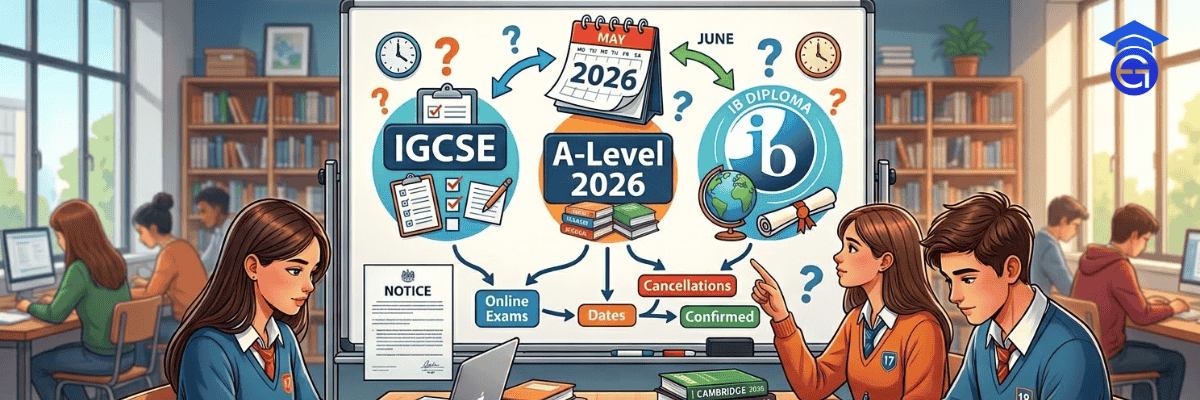
I’ve had this conversation about five times in the past week. Parent calls, slightly stressed, asking if their child’s IGCSE or A-Level exams are actually happening this year given everything going on. And I get it. When schools switch to distance learning and news keeps talking about regional disruption, it’s reasonable to wonder whether May exams will go ahead as planned. So here’s the straightforward answer: yes, at the time of writing, IGCSE, A-Level, and IB exams are still scheduled to proceed in the UAE in 2026. But there’s context worth understanding.
What’s covered in this guide
The Current Status of Exams
As of late March 2026, Cambridge IGCSE, Edexcel IGCSE, A-Levels, and IB Diploma exams are all proceeding as scheduled in the UAE. No exam boards have announced cancellations for these qualifications.
This is different from what happened with some other curricula. The Council for the Indian School Certificate Examinations (CISCE) cancelled ICSE and ISC board exams for UAE students in mid-March. CBSE also made changes affecting their students. But British curriculum qualifications and the IB have not followed suit.
Why the difference? Partly timing. The Indian curriculum exams were scheduled for mid-March, exactly when schools were dealing with the most immediate disruption. IGCSE and A-Level exams don’t start until late April and early May. IB exams begin in late April. That extra time matters.
Partly it’s structural. Cambridge, Edexcel, and the IB are used to dealing with disruption across different countries simultaneously. They’ve got established frameworks for handling these situations, refined over years of managing exams across conflict zones, natural disasters, and yes, pandemics.
What this means in practice: Schools are continuing to prepare students for exams as scheduled. Teachers are teaching exam content. Mock exams are happening or planned. Revision timetables are being finalized. Unless you hear otherwise from your school or directly from an exam board, assume exams are proceeding.
Key Dates for IGCSE, A-Level, and IB
Here’s when exams actually happen, because knowing the timeline helps understand why boards are confident they can proceed.
Cambridge IGCSE and A-Level
Cambridge exams run from late April through June 2026. The exact dates vary by subject, but the exam window is substantial. For most UAE students, this means first exams in the final week of April, with the bulk happening throughout May and early June.
Edexcel IGCSE and International A-Level
Edexcel exams typically start in early May and run through mid-June. Again, specific dates depend on which subjects students are taking, but the May to June window is standard.
IB Diploma Programme
IB exams run from April 24 to May 20, 2026. This is a tighter window than IGCSE and A-Levels, but it’s also a globally standardized schedule. IB results are due July 6, 2026.
Results dates
A-Level results come out August 13, 2026. IGCSE results follow on August 20, 2026. IB results arrive earlier, on July 6, 2026. These dates matter for university applications, particularly for students applying through UCAS or to international universities.
| Qualification | Exam Period | Results Date |
|---|---|---|
| Cambridge IGCSE | Late April – June 2026 | August 20, 2026 |
| Edexcel IGCSE | Early May – June 2026 | August 20, 2026 |
| Cambridge A-Level | Late April – June 2026 | August 13, 2026 |
| Edexcel A-Level | May – June 2026 | August 13, 2026 |
| IB Diploma | April 24 – May 20, 2026 | July 6, 2026 |
What Has Changed and What Hasn’t
While exam dates remain the same, some adjustments have been made to support schools dealing with disruption.
What hasn’t changed
The exam timetable itself. Your child’s exams are on the same dates they were always going to be on. The content being tested hasn’t changed. The grade boundaries, the marking standards, the requirements for each subject, all of that remains identical to what was planned.
For most students, this means preparation continues exactly as it would in a normal year. If your child was revising for Maths on a particular schedule, that schedule still makes sense. If mock exams identified weak areas, those still need addressing. The exam itself hasn’t moved or changed in any way that requires adjusting preparation.
What has changed for IB students
The IB made specific accommodations for schools across the Middle East, including the UAE. The coursework submission deadline moved from March 15 to April 15, 2026. That extra month gives students and teachers more time to complete and refine coursework despite disruption.
The IB also confirmed that students can transfer to another IB World School, defer to a later exam session, or withdraw with a full refund if circumstances require it. These are safety nets for extreme situations, not changes affecting most students.
Additionally, Inclusive Access Arrangements are available for students whose learning or performance has been significantly affected. Schools apply for these on behalf of students who need them.
What schools are doing
Behind the scenes, school associations across the Middle East are in active communication with exam boards. They’re ensuring that boards understand the scale of disruption and are prepared to act if situations deteriorate.
Your school’s exams officer is the person managing all of this. They’re monitoring announcements from Cambridge, Edexcel, or the IB. They’re coordinating with other schools. They’re prepared to apply for special consideration if needed. Trust that this is being managed, even if you’re not seeing all the work happening in the background.
IB’s Additional Flexibility Measures
The IB’s response has been more proactive than Cambridge or Edexcel’s, partly because the IB operates as a single global organization while Cambridge and Edexcel are exam boards that schools can choose to use.
The coursework deadline extension applies automatically. Schools don’t need to request it. If your child is an IB student with coursework due, they now have until April 15 instead of March 15. That’s already in place.
The transfer, deferral, and withdrawal options exist for families facing extreme circumstances. Moving countries due to safety concerns. Serious illness. Family emergencies. These aren’t for students who’ve had a few weeks of distance learning. They’re genuine emergency provisions.
The Inclusive Access Arrangements cover situations where a student’s ability to prepare for or sit exams has been materially affected by disruption. Prolonged school closure. Loss of access to facilities or resources. Significant personal impact from regional events. Again, schools apply for these, and they’re assessed case by case.
What Happens If There’s Serious Disruption
The question parents are really asking is: what if things get worse? What if schools can’t open properly before exams? What if exam centers can’t operate safely?
Exam boards have contingency plans. They’ve dealt with this before in various countries. The most likely scenario, if disruption continues significantly, is special consideration being applied broadly rather than exams being cancelled outright.
Special consideration means adjusting grades to account for circumstances beyond students’ control. It doesn’t mean everyone gets higher grades automatically. It means the disruption is factored into how results are determined, based on evidence of what students have achieved.
For that to work, schools need to maintain records. Mock exam results. Coursework. Teacher assessments. Classroom performance. All of this becomes evidence of a student’s actual ability if the exam can’t be the only measure.
This is why it’s crucial that students keep engaging with schoolwork even during distance learning. Those assignments, those online lessons, those practice tests, they’re not just busywork. They’re building a record of achievement that matters if special consideration becomes necessary.
Something worth understanding: Cancelling exams entirely is a last resort. It causes enormous complications for university admissions, particularly for students applying internationally. Exam boards and schools will do almost anything to make exams happen safely before resorting to cancellation. The bar for that decision is very high.
What Parents and Students Should Do Now
Here’s the practical advice for families trying to navigate this.
Keep preparing as normal
Your child’s revision schedule should proceed as planned. Exams are happening unless you hear otherwise, and scrambling to catch up if you’ve stopped preparing is much harder than maintaining momentum.
If your child was doing past papers twice a week, keep doing past papers twice a week. If they were working with a tutor, continue those sessions. If they had a revision timetable mapped out, stick to it. Uncertainty about whether exams might be affected is not a reason to stop preparing for exams that are currently scheduled.
Stay in touch with your school
Your school is your primary source of accurate information. They’ll know before you do if anything changes. They’re receiving updates directly from exam boards. They’re coordinating with other schools.
If you have specific concerns, talk to your child’s head of year or the exams officer. Don’t rely on WhatsApp groups or social media for updates. Those are where rumors spread faster than facts.
Document everything, just in case
If there’s been disruption affecting your child’s preparation, keep records. Dates when school was closed. Assignments that couldn’t be completed. Resources that were unavailable. This matters if special consideration needs to be applied later.
Take screenshots of communications from school about closures or changes. Save emails. Keep a simple log if needed. You probably won’t need this, but having it doesn’t hurt.
Support your child’s wellbeing
Uncertainty is stressful. Your child is probably worried about exams anyway, and adding “will they even happen?” to that worry doesn’t help.
Reassure them that exams are still on, that adults are managing the logistics, and that their job is just to keep preparing. Frame it as: nothing’s changed about what you need to know or do, we just need to stay flexible about the details.
If your child is genuinely struggling with anxiety about this, talk to their school counselor. They’re seeing this across multiple students and can provide perspective and support.
Need focused exam preparation during uncertain times?
At Edugravity in Sharjah, we’re continuing structured IGCSE, A-Level, and IB tuition regardless of school disruption. Whether your child’s school is doing distance learning or has returned to campus, we provide consistent, expert teaching and exam-focused support. Small groups (maximum 6 students), experienced tutors, and clear preparation plans so your child stays on track.
WhatsApp Us Book Free ConsultationThe Bottom Line
Exams are on. That’s the current situation. Could it change? Theoretically yes, but it would require circumstances significantly worse than what we’re seeing now.
Exam boards have experience managing disruption. They’ve got contingency plans. They’re monitoring the situation. School associations are representing students’ interests. There are formal processes for special consideration if needed.
What that means for parents and students is simple: keep preparing. Stay in communication with your school. Trust that the adults managing this know what they’re doing. And remember that uncertainty about logistics doesn’t change what your child needs to know to perform well on their exams.
The students who’ll do best, regardless of what happens with exam administration, are the ones who keep working consistently through the uncertainty. That consistency, that discipline to keep preparing even when things feel unstable, that’s what produces results.
Our students are maintaining their revision schedules and staying on track for May/June exams. We’re providing the structured support and consistency they need during this period. Whether you need help with specific subjects or comprehensive exam preparation across your child’s full timetable, we’re here. Get in touch to discuss your child’s needs.
Key Takeaways
- IGCSE, A-Level, and IB exams are currently scheduled to proceed as planned in UAE in 2026, with exam periods running from late April through June.
- IB has extended coursework deadlines to April 15 (from March 15) and offers transfer, deferral, or withdrawal options for extreme circumstances, but exam dates remain unchanged.
- Cambridge and Edexcel have not announced changes to exam timetables. Schools are preparing students as normal and will apply for special consideration if serious disruption affects student performance.
- Students should continue revision schedules as planned. Uncertainty about potential changes is not a reason to stop preparing for currently scheduled exams.
- Schools’ exams officers are monitoring situation closely and are primary source for accurate updates. Rely on official school communications, not social media or WhatsApp groups.
- Document any significant disruption affecting your child’s preparation. Keep records of school closures, missed assignments, or unavailable resources in case special consideration becomes relevant later.