Dubai’s Education 33 Strategy Explained: What It Means for Students and Parents
If you’ve seen the term “Education 33” floating around and wondered what it actually means for your child, their school, or the broader direction of education in Dubai, this is the breakdown you’re looking for. Not the press release version. The version that translates government strategy into something a parent sitting at the kitchen table can actually use.
What this covers
- What Education 33 actually is
- Why Dubai is doing this now
- The five strategic goals, decoded
- What the 28 Game Changer initiatives mean in practice
- The specific targets by 2033
- What E33 means for non-Emirati families
- An honest look at what this will actually change
- Questions people are asking about E33
What Education 33 Actually Is
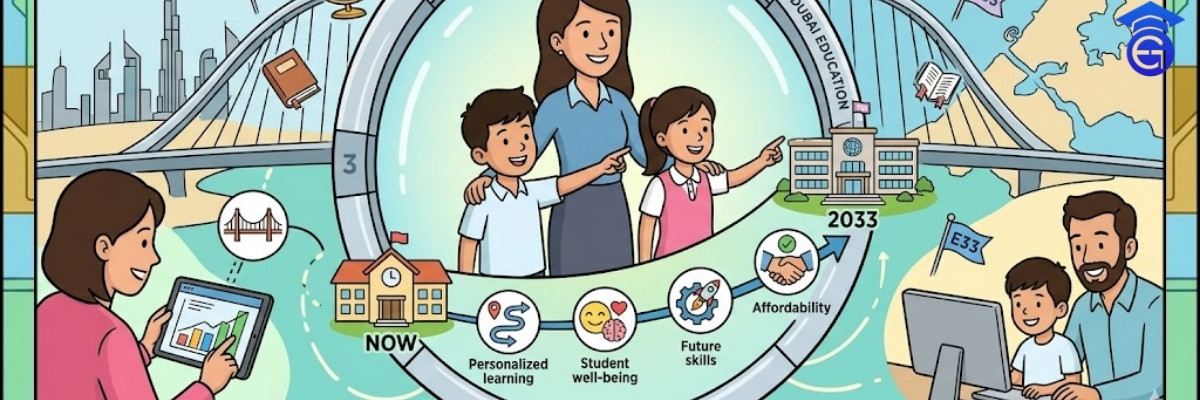
Education 33, or E33, is Dubai’s long-term education strategy running from now until 2033. It was first announced by His Highness Sheikh Hamdan bin Mohammed bin Rashid Al Maktoum in October 2024, with KHDA — the Knowledge and Human Development Authority — responsible for implementation and oversight.
The name connects it to a broader cluster of Dubai 2033 initiatives. The Dubai Economic Agenda is D33. The Dubai Social Agenda is also 33-aligned. Education 33 sits alongside these as the education pillar of Dubai’s decade-long development plan.
The core idea is a shift from what KHDA describes as a traditional, institution-centric model to a learner-centric one. That phrase gets used a lot in official communications. What it actually means is that the system is supposed to stop treating every student identically and start adapting to individual needs, learning styles, and life goals. Whether every school in Dubai manages to execute that in practice is a different question, but that’s the direction the strategy is pushing.
E33 covers the full education journey, from early childhood through to higher education and lifelong learning beyond formal study. It’s not only about schools. Vocational training, university education, and professional development are all within its scope.
Quick context: E33 was developed through more than 50 engagement sessions involving over 290 educational institutions, including early childhood centres, schools, universities and training institutes. It’s not a top-down document written without consultation — though how meaningfully the feedback shaped the final strategy is harder to verify.
Why Dubai Is Doing This Now
Dubai already has one of the most diverse education landscapes in the world. Students from over 190 nationalities attend schools across the emirate, following curricula from the UK, US, India, IB, and more. KHDA inspects and rates private schools regularly. On paper, the system works reasonably well.
So why a new strategy? A few honest reasons.
First, the job market is changing faster than education systems typically respond. Roles that will exist in 2033 don’t fully exist yet. A curriculum designed to produce graduates in 2015 may not be producing the skills Dubai’s economy actually needs in 2030. E33 is an attempt to close that gap before it gets wider.
Second, affordability has been a genuine pressure point. Dubai has excellent schools at the top end and a growing number of options across the middle range. But for many families, particularly those on lower incomes, finding quality education at an affordable price has been difficult. E33 explicitly targets that gap with a commitment to 49,000 new seats in affordable schools by 2033.
Third, there’s the ambition to position Dubai as a global education hub in its own right, competitive with established centres like London, Singapore, and New York. That’s a significant goal that requires more than good individual schools. It requires a coherent system with international recognition, prestigious institutions, and the infrastructure to attract students from around the world.
And fourth, the Emirati workforce question. Private sector employment of UAE nationals has been a policy priority for years. Investing in Emirati teachers specifically — the strategy targets 3,000 new Emirati educators in private education by 2033 — is part of a longer effort to build a local professional workforce that can sustain Dubai’s growth independently of expatriate labour over the long term.
The Five Strategic Goals, Decoded
E33 is built around five goals. The official language around them is fairly polished, so here’s what they mean stripped back to what actually matters.
1. Productive Emiratis empowered with high-quality education
This goal focuses specifically on Emirati students: improving their educational outcomes, embedding Emirati values and Arabic language into the learning experience, and preparing Emirati youth to lead in the country’s future. It includes the push to increase Emirati teachers in private schools, and initiatives around promoting Arabic as a language of active use rather than a compliance checkbox.
2. Equitable and accessible education for diverse learners
This one covers everyone else. The explicit commitment here is that E33 benefits learners across all fee levels, not just those whose families can afford premium schools. The 49,000 new seats in affordable schools is the headline target. More broadly, this goal is about making sure the quality gap between the most expensive and least expensive school options in Dubai narrows meaningfully over the decade.
3. Engaged educators and parents that nurture lifelong learning
Two things here. First, bringing more Emirati educators into the system and investing in teacher quality. Second, genuinely involving parents in their children’s education journey rather than treating them as passive recipients of school reports. Parent engagement as an active policy priority is more interesting than it sounds: the research on student outcomes consistently shows that what happens at home alongside school matters as much as what happens in the classroom.
4. World-class learning destination for all learners
This is the international ambition goal. Dubai already attracts students and educators from across the world, but E33 wants to formalize and dramatically scale that. The target of a tenfold increase in education tourism by 2033 is ambitious. Attracting prestigious international universities to open campuses in Dubai is part of this too. If it works, Dubai becomes not just a place people live and send their children to local schools, but a destination students actively choose for their education.
5. Innovative ecosystem that creates impact and activates growth
The fifth goal is about research, technology, and connecting education to industry. The idea is that schools and universities shouldn’t exist in isolation from the economy. Students should have direct exposure to real industries, internship pathways, and problem-solving opportunities that prepare them for actual jobs rather than ideal versions of jobs that might not exist by the time they graduate.
Something worth holding onto: these five goals aren’t sequential or isolated. A student whose school improves in teaching quality (goal 2), who has a parent more actively involved in their learning (goal 3), and who gets industry exposure in their final years (goal 5) is experiencing E33 as a connected system. The strategy only works if multiple goals move simultaneously. Ambitious in the right way, but that coordination is genuinely hard to deliver.
What the 28 Game Changer Initiatives Mean in Practice
Beneath the five goals sit 28 specific initiatives, which KHDA calls Game Changers. They’re being rolled out in phases over the decade, and each one has specific KPIs attached. These aren’t aspirations. They’re tracked targets with accountability built in.
Some of the Game Changer areas that are most relevant for families include personalised learning journeys for all students, embedding Emirati culture and values more deeply across curricula, growing the number of Emirati teachers in private institutions, positioning Dubai among the best places in the world to work as an educator, elevating the quality standards of vocational and training institutes, and empowering Emirati parents specifically to take a more active role in their children’s education.
The personalised learning initiative is probably the most far-reaching for students across all backgrounds. The premise is that every student has different needs, different learning speeds, and different career aspirations, and that the education system should be flexible enough to accommodate that rather than requiring every student to fit the same mould. In practice this will look different in different schools, but the regulatory push from KHDA is toward more adaptive teaching and less one-size-fits-all instruction.
The vocational and training quality improvements are often overlooked in conversations about education strategy but they matter a lot. Not every student is heading to university. Not every student should be. A strategy that invests in quality pathways for students pursuing technical, creative, or vocational careers is fairer and ultimately more economically useful than one that treats university as the only legitimate destination.
The Specific Targets by 2033
Unlike a lot of education strategies that stay comfortably vague, E33 published specific measurable targets. That’s worth acknowledging. Targets can be missed, but at least they exist and can be tracked.
The headline KPIs include a 90% satisfaction rate among parents regarding the education options available to them in Dubai. Minimum 49,000 new seats in affordable schools. 3,000 Emirati teachers added to the private education workforce. A tenfold increase in education tourism by 2033. Attraction of prestigious international universities to Dubai. And the broader goal of placing Dubai in the top 10 cities in the world for education by 2033, aligned with the Dubai Social Agenda.
The 90% parent satisfaction target is interesting to sit with. Dubai’s current parent satisfaction levels are reasonably high already — KHDA surveys consistently show positive sentiment — but reaching 90% across all fee levels, including families at the lower end of the income range, is genuinely ambitious. It requires improvements not just in elite schools but in mid-range and affordable schools where the gaps are larger.
The 49,000 new affordable seats target is the most concrete housing the equity commitment in hard numbers. Whether the schools that emerge to provide those seats meet the quality threshold parents actually want is a separate question that E33’s quality oversight mechanisms will need to answer over time.
The honest caveat: large-scale education strategies everywhere — not just in Dubai — consistently struggle with the gap between policy ambition and classroom reality. The five goals and 28 initiatives are well-designed on paper. The implementation depends on thousands of individual schools, teachers, and administrators responding to the policy signals over a decade. History suggests this is hard. That doesn’t mean it won’t happen. It means the monitoring and accountability mechanisms that KHDA operates will be crucial in determining whether E33 delivers what it promises.
What E33 Means for Non-Emirati Families
Some parents reading about E33 assume it’s primarily about Emirati students and that their family, as expatriates, sits outside its scope. That’s not quite right.
E33 explicitly frames its equity goal around “learners across all fee levels.” The affordable school seat expansion applies across the board. The parent satisfaction target doesn’t distinguish by nationality. And the ambition to attract international universities and grow education tourism is specifically about welcoming more international students and families, not fewer.
What E33 does do differently for Emirati students is maintain a specific strand around Emirati values, the Arabic language, and Emirati cultural identity within the curriculum. This is relevant for non-Emirati students indirectly — it means schools across Dubai will likely embed more content around UAE culture and Arabic language as active subjects. For families from other countries, this is mostly a positive: understanding the cultural context of the country your child is growing up in has value. But it’s worth being aware that it’s part of the direction schools will be moving.
For families specifically considering the UAE as an education destination from outside — international students choosing where to study — E33 is directly relevant. The strategy is explicitly trying to make Dubai attractive for that decision. More prestigious international university campuses, higher-quality standards across institutions, and a recognised regulatory framework through KHDA are all part of making that pitch convincing.
An Honest Look at What This Will Actually Change
Education strategies are announced, and then the hard work of making them real begins. The honest assessment of what E33 will actually change for a family in Dubai over the next decade involves some nuance.
What will likely change: school quality standards will continue to be driven upward by KHDA oversight, which is already happening and will accelerate. Affordable school options will expand, which genuinely matters for families on tighter budgets. There will be more emphasis on student wellbeing, personalised learning, and career-connected education in how schools operate and how they’re inspected.
What will take longer: genuine personalisation of learning at scale is one of the hardest things to deliver in education. It requires teacher training, smaller class sizes, better diagnostic tools, and institutional willingness to move away from a standardised delivery model. That’s a ten-year process at minimum, and some schools will move faster than others.
What’s genuinely uncertain: whether a tenfold increase in education tourism is achievable in that timeframe, and whether the prestigious international university campuses materialise in the numbers and quality the strategy envisions. These depend on factors beyond KHDA’s direct control, including global market conditions and the decisions of universities based in other countries.
For a parent whose child is at school in Dubai right now, the most immediate relevance of E33 is probably in how KHDA inspections and school ratings evolve over the next few years. Schools responding to the new strategic direction will be investing in learning quality, teacher development, and parent engagement. Those are the areas where the strategy will show up first in practical terms.
Questions People Are Asking About E33
What This Means If You’re Thinking About Your Child’s Education Right Now
Strategies announced at a government level take years to filter through to individual classrooms. That’s not a criticism of E33 specifically — it’s how education policy works everywhere. But there are a few things worth taking from it if you’re actively thinking about your child’s education in Dubai or the broader UAE.
The direction of travel is clear. Dubai is investing in making its education system better — more personalised, more affordable, more connected to industry, more internationally prestigious. That’s a positive backdrop for any family choosing to educate their children here.
The quality gap between schools will narrow over time, but it hasn’t closed yet. If you’re choosing a school now, KHDA inspection ratings remain the most reliable indicator of what’s actually happening inside a school. The E33 ambitions are the destination; the inspection reports tell you where a school is today.
And for students who find that their school isn’t yet delivering the personalised, adaptive education that E33 describes, good external support still matters. The gap between what schools aim to do and what individual students need doesn’t close automatically, and it certainly won’t close by 2033 for a student sitting exams next year. That’s where targeted tuition and small-group learning continue to be genuinely useful regardless of what the broader strategy promises.
Supporting students across the UAE through every stage of their education journey
Edugravity works with IGCSE, A-Level and IB students in Sharjah and across the UAE, offering small-group tuition in Maths, Sciences, English, Economics, Business Studies and Accounting. While Dubai’s education system evolves toward E33’s vision, we’re here to bridge the gap between what schools deliver and what individual students need. In-person in Sharjah or online across the UAE.
WhatsApp Us Book Free DemoFor more on how to choose the right academic support for your child in the UAE, read our guide on what to look for in an IGCSE tuition centre in Sharjah.
Key Takeaways
- Education 33 (E33) is Dubai’s ten-year education strategy to 2033, built around five goals and 28 Game Changer initiatives, overseen by KHDA
- The core shift is from an institution-centric to a learner-centric education model — personalised, flexible, and connected to real-world skills and industry
- Specific KPIs include 49,000 new affordable school seats, 3,000 new Emirati teachers in private education, 90% parent satisfaction, and a tenfold increase in education tourism
- E33 covers all learners in Dubai, not only Emirati students — the equity and accessibility goals apply across all fee levels and nationalities
- Policy ambition takes years to reach individual classrooms — KHDA school inspection ratings remain the most reliable current measure of school quality for families making decisions now