How to Choose the Best Science Tuition in the UAE: Physics, Chemistry and Biology
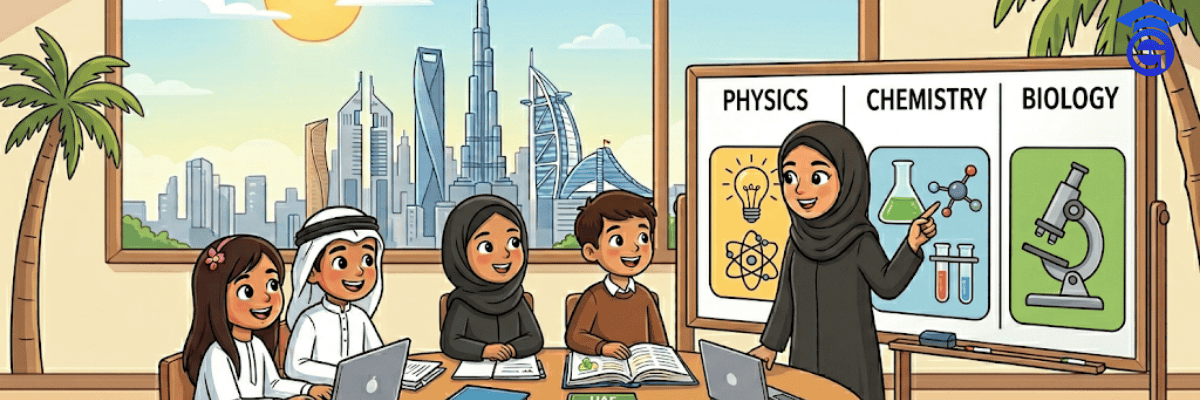
Science subjects have a way of going from fine to urgent very quickly. A student who seemed to be keeping up in September is suddenly staring at a past paper in January with no idea where to start. It happens across all three sciences, but for different reasons in each one. If you’re trying to find the right tuition support for Physics, Chemistry or Biology in the UAE, here’s what to actually look for, and what most centres won’t tell you upfront.
What this covers
- Why each science needs different support
- What makes Physics the hardest science to tutor well
- Chemistry: the subject where one weak topic derails everything
- Biology’s problem isn’t difficulty — it’s volume
- What to actually ask before booking science tuition
- How Edugravity approaches all three sciences
- Why the IGCSE-to-A-Level jump hits science students hardest
- Questions parents ask most often
Why Each Science Needs Different Support
There’s a version of science tuition that treats all three subjects as interchangeable. Show up, go through the syllabus, do some past papers, done. That approach produces modest results at best, because Physics, Chemistry and Biology are genuinely different disciplines with different failure modes.
Physics fails students who can’t bridge the gap between concept and calculation. Chemistry fails students who hit one topic they didn’t properly understand and then watch subsequent topics stop making sense. Biology fails students who underestimate how much detail the mark scheme actually requires. These are three distinct problems. A tutor who doesn’t recognise which one a specific student is facing is going to deliver generic instruction that doesn’t move the needle.
I’ve seen students sit with a science tutor for three months and gain almost nothing, not because the tutor was incompetent, but because the sessions kept covering content the student already understood while the actual problem, a specific conceptual gap or a technique issue, went unaddressed. The diagnostic step matters enormously in science. More so than in almost any other subject area.
So before you look at tuition centres, it helps to understand what each science actually demands.
What Makes Physics the Hardest Science to Tutor Well
Physics at IGCSE and A-Level sits at the intersection of mathematics and conceptual reasoning. That double demand is what trips most students up. You can understand that force equals mass times acceleration in an abstract sense and still consistently get calculation questions wrong because the mathematical setup is shaky. Conversely, a student who’s strong at maths but doesn’t genuinely grasp why circuits behave the way they do will solve standard questions mechanically, then freeze when one is framed slightly differently.
Good Physics tuition has to address both simultaneously. Concept without calculation leaves students exposed in the applied questions. Calculation without concept produces students who can’t adapt when the question is unfamiliar.
The topics where this gap shows up most often: electricity and circuits, which require students to visualise what’s actually happening in a system rather than just plug numbers into formulas. Waves and optics, where the diagrams need to be understood directionally. At A-Level, fields and quantum physics, where the concepts are genuinely counterintuitive and a tutor who just teaches the equations without building the mental model is wasting the student’s time.
Something worth checking: ask any prospective Physics tutor how they explain electromagnetic induction. It’s a topic most A-Level students struggle with and it requires a tutor who can draw it, describe it physically, and connect it to the mathematical relationship. If the explanation stays abstract or purely formula-based, the sessions won’t help with the parts of the exam that matter most.
At IGCSE, Cambridge Physics (0625) and Edexcel Physics (4PH1) both test graph interpretation and practical skills alongside theory. Students who’ve only been drilled on factual recall consistently underperform on the applied questions. The tuition has to include those skills explicitly, not assume they’ll develop on their own through content exposure.
IB Physics HL is a significant step up from almost anything at IGCSE. The Internal Assessment requires genuine experimental design and data analysis. Students who arrive at the IA without having thought carefully about methodology face a stressful revision process. Getting support early in the IB cycle, rather than when the IA deadline is approaching, makes a measurable difference.
Chemistry: The Subject Where One Weak Topic Derails Everything
Chemistry has a cumulative structure that’s unforgiving in a very specific way. Topics build on each other in a sequence that’s hard to skip around. If a student doesn’t properly understand atomic structure and bonding, they’ll struggle with energetics. If energetics is shaky, reaction kinetics becomes harder to follow. If kinetics isn’t solid, equilibrium feels arbitrary. By the time organic chemistry arrives in the second year of A-Level, a student with gaps from earlier in the course is essentially trying to navigate a complex map without the foundation it’s drawn on.
This is why Chemistry tuition has to start with a genuine diagnostic rather than just picking up where the school is currently teaching. The gap is usually not in the current topic. It’s two or three units back, and nothing is going to resolve properly until that earlier gap is addressed.
Mole calculations are the classic sticking point at IGCSE. Students who don’t develop real fluency with moles in Year 10 carry that uncertainty into every subsequent quantitative question, and there are a lot of quantitative questions in IGCSE Chemistry. A tutor who spots that early and addresses it directly rather than pressing on with new content is doing their job. One who doesn’t notice, or notices but moves on anyway because the syllabus schedule says so, is going to produce a student who improves on easy marks and stays stuck on the questions that matter.
A pattern I’ve seen more times than I’d like: a student gets B grades on internal tests, the school reports they’re keeping up, and the parents assume things are fine. Then the first major mock arrives and there’s a C or D on the paper. What happened is that the internal tests covered topics in isolation, and the mock drew on multiple topics together, exposing gaps that never got fixed. Chemistry compounds, in every sense of the word.
At A-Level, organic chemistry becomes the dominant challenge for most students. The reaction mechanisms, especially nucleophilic substitution and elimination in Cambridge and Edexcel syllabuses, require a very specific kind of visual thinking about electron movement that most students haven’t been explicitly taught. They’ve seen the reactions written out but haven’t been shown how to reason through them independently. A tutor who can build that reasoning, rather than just presenting more examples to memorise, is genuinely valuable at this stage.
For IB Chemistry, the internal assessment and the data-based questions in Paper 3 are areas where students consistently lose marks they didn’t have to lose. Both require skills that sit alongside content knowledge, scientific methodology, data interpretation, graph analysis, and the IB’s specific command terms. These aren’t instinctive. They’re taught.
Biology’s Problem Isn’t Difficulty — It’s Volume
Biology is sometimes labelled the easiest of the three sciences, which is unfair and also unhelpful to the students who struggle with it. It’s not particularly mathematically demanding at IGCSE, that’s true. But the sheer volume of precise, specific information required is significant, and the mark scheme is unforgiving about vague answers.
The classic Biology mistake: a student understands what osmosis is, can explain it in plain language, but writes an answer that’s just slightly imprecise in the wrong place and loses the mark. The examiner wants specific terminology in a specific sequence. “Water moves from a region of high water potential to low water potential across a partially permeable membrane” scores. “Water moves from where there’s more water to where there’s less” doesn’t, even though both say the same thing. That gap between genuine understanding and exam-ready language is exactly where Biology tuition needs to work.
The topics with the highest mark-loss rate at IGCSE Biology tend to be: genetics and inheritance, where students understand the concept but make diagram errors or use terminology incorrectly under pressure. Respiration and photosynthesis, which are detailed enough that students who’ve half-learned them get caught out when questions probe specific stages. The nervous system and hormones, where the processes need to be described in a precise sequence to get full marks.
At A-Level, the content volume becomes genuinely large. Protein synthesis, cell signalling, the immune system in detail, ecology with quantitative methods, genetics with much more complex inheritance patterns than IGCSE. Students who developed a habit of surface-level learning at IGCSE hit a wall at A-Level Biology. The approach that got them a C at IGCSE won’t get them a B at A-Level, let alone an A.
For IB Biology specifically: the experimental skills tested through the Internal Assessment and Paper 3 are distinct from the content in Papers 1 and 2. Students often prepare extensively for content questions and then lose marks on the data analysis sections because they haven’t practised interpreting graphs, evaluating methodology, or applying the specific scientific vocabulary that IB examiners reward. Good IB Biology tuition addresses all of these, not just the easier-to-teach content side.
What to Actually Ask Before Booking Science Tuition
Most parents ask the right general questions and the wrong specific ones. “Are the tutors qualified?” is a reasonable starting point but tells you very little on its own. “Is the tutor experienced with the Cambridge IGCSE Chemistry syllabus specifically?” is a much better question. The difference between a Chemistry tutor who knows Edexcel well and one who knows Cambridge well is not trivial. The assessments, the mark scheme language, the practical components, the style of questions — these differ meaningfully between boards.
Four questions that actually separate good science tuition from average:
How do you identify what a student is getting wrong before you start teaching? A tutor who answers “we go through what they’ve been covering in school” doesn’t have a diagnostic process. One who describes an initial assessment that checks specific topics and skill types is telling you something different.
How do you handle exam technique alongside content? Science papers reward specific things in specific ways. A tutor who only delivers content and doesn’t teach how to read questions, structure answers, and check working is leaving students underprepared for what actually appears in the exam.
What’s your group size? For science subjects, where students need to ask questions and have their working checked, a group of 15 is just a smaller school class. Meaningful individual attention requires six or fewer.
What resources do students get access to? Organised past paper banks, topic summaries, and worked examples accelerate improvement considerably. Tutors who work only from what a student happens to bring in are limiting the sessions from the start.
How Edugravity Approaches All Three Sciences
Edugravity is based at 107 Al Reem Plaza on Corniche Street in Sharjah, with online tuition available across the UAE and internationally. For Physics, Chemistry and Biology, they cover IGCSE, A-Level and IB across Cambridge, Edexcel and AQA boards.
The group cap at six students applies here as it does across all their subjects. For science particularly this matters because the sessions that produce the most improvement in Physics and Chemistry are the ones where a tutor can watch a student attempt a calculation or draw a circuit diagram and spot exactly where the reasoning breaks down. That’s impossible to do with 15 students in the room. With five or six, it’s standard practice.
The diagnostic assessment at the start identifies not just which topics need attention but what type of attention they need. There’s a difference between a student who doesn’t understand a concept and a student who understands it but can’t apply it under timed conditions. The second student doesn’t need more explanation of the concept. They need structured practice with feedback. Treating both students the same way, as large group classes almost inevitably do, helps neither of them efficiently.
For Physics, Edugravity’s sessions cover the full syllabus including mechanics, electricity, waves, thermal physics, nuclear physics, and at A-Level, fields and quantum physics, with worked examples and problem-solving built into every topic rather than saved for “revision sessions” at the end. The graph interpretation and data analysis skills that appear consistently in exam papers are taught explicitly.
For Chemistry, the programme addresses the cumulative structure of the subject by going back to check foundational topics before moving forward, regardless of what the school’s current teaching unit is. If mole calculations are shaky, the sessions address that before anything that depends on it. This sounds obvious. It’s rarer in practice than it should be.
For Biology, the focus on exam language and mark scheme terminology is deliberate. Students learn not just what the processes are but how to describe them in the way that earns marks. That’s a specific skill that takes time to develop and doesn’t happen automatically through content exposure alone.
Looking for science tuition in Sharjah or online across the UAE?
Edugravity offers Physics, Chemistry and Biology tuition for IGCSE, A-Level and IB. Small groups of maximum 6 students, tutors who know Cambridge, Edexcel and IB syllabuses in detail, and a free diagnostic to identify exactly what needs to change. In-person in Sharjah, online everywhere else in the UAE.
WhatsApp Us Book Free DemoWhy the IGCSE-to-A-Level Jump Hits Science Students Hardest
The step from IGCSE to A-Level is a known challenge across subjects. In the sciences, it’s particularly steep, and for a specific reason: IGCSE science rewards recall and application of relatively contained concepts, while A-Level science rewards genuine understanding of mechanisms and the ability to reason through unfamiliar problems.
A student who got an A* at IGCSE Physics by learning mark scheme answers and working through enough past papers can absolutely do that at A-Level too, for a while. But the questions at A-Level start requiring something more. “Explain why increasing the temperature increases the rate of reaction” at IGCSE gets a short mark-scheme answer. At A-Level, the same concept requires a response that references collision frequency, activation energy, the Maxwell-Boltzmann distribution, and the proportion of molecules with sufficient energy. The understanding has to go deeper, and students who’ve been skating on surface-level preparation at IGCSE hit a wall they often don’t see coming.
Biology makes a similar jump. IGCSE Biology can be navigated with good memorisation and clear diagram-labelling skills. A-Level Biology requires students to understand the relationships between processes, apply knowledge to novel situations described in unfamiliar contexts, and write extended answers that demonstrate that underlying reasoning. Students who arrive at Year 12 with memorisation habits and no analytical framework find the transition genuinely difficult.
Chemistry’s jump is perhaps the most technically demanding. A-Level Chemistry introduces physical chemistry concepts, equilibrium constants, electrode potentials, and thermodynamics, that require mathematical sophistication beyond what IGCSE demanded. Organic chemistry extends into multi-step synthesis problems. Students who struggled with moles at IGCSE but scraped through find that A-Level leaves nowhere to hide.
The students who handle this transition best are usually the ones who got proper subject-level support in Year 10 and 11 that built genuine understanding rather than exam shortcuts. But it’s also not too late to address in Year 12. Getting targeted support in the first term of A-Level, before poor habits compound, makes a significant difference in where students end up by Year 13.
Questions Parents Ask Most Often
The Part That Doesn’t Change Regardless of Which Science
Whatever the subject, the students who make meaningful grade improvements through tuition are the ones getting specific, targeted feedback on their actual work. Not general encouragement. Not more content delivered at pace. Feedback that says: here is what you wrote, here is what the mark scheme wanted, here is the gap between them, and here is how to close it.
That kind of feedback is only possible in a session small enough for a tutor to actually look at what a student produces. Science subjects are unforgiving about detail. A diagram that’s 90% correct is worth nothing if the one wrong label is the one being tested. A calculation that’s set up correctly but has a unit error loses the mark. These things only get caught when someone is actually looking.
If you’re searching for science tuition in the UAE, the question to keep coming back to is simple. Will my child’s actual work be looked at carefully in this programme? Not their general progress. Their actual written answers, their diagrams, their calculations. If the answer is yes, you’ve found the right place. If it isn’t clear, keep looking.
Ready to find out exactly where your child stands in Physics, Chemistry or Biology?
Edugravity’s free diagnostic session is the fastest way to get a clear picture. An hour of targeted assessment identifies the specific gaps, and then we can show you what a programme to address them actually looks like. No obligation, just a clear picture. In Sharjah at 107 Al Reem Plaza, Corniche Street, or online across the UAE.
WhatsApp Us Book Free DemoSubject pages: for detailed information on Edugravity’s programmes by science, visit Physics Tuition, Chemistry Tuition, and Biology Tuition.
Key Takeaways
- Physics, Chemistry and Biology fail students for different reasons — good science tuition identifies which problem a specific student has rather than delivering the same generic instruction to everyone
- Chemistry’s cumulative structure means gaps from early topics quietly sabotage everything that comes after them; a diagnostic before starting tuition is not optional
- Biology’s challenge is precision and volume, not difficulty — students who understand content but use imprecise language in answers consistently lose marks they’ve earned
- The IGCSE-to-A-Level jump is steeper in science than most subjects because A-Level rewards genuine understanding rather than well-practised recall
- Group size and subject-specific board knowledge matter more when choosing science tuition than general qualifications or centre reputation