‘A Lost Opportunity’: UAE Students React to British Exam Cancellations with Fear, Relief and Grief
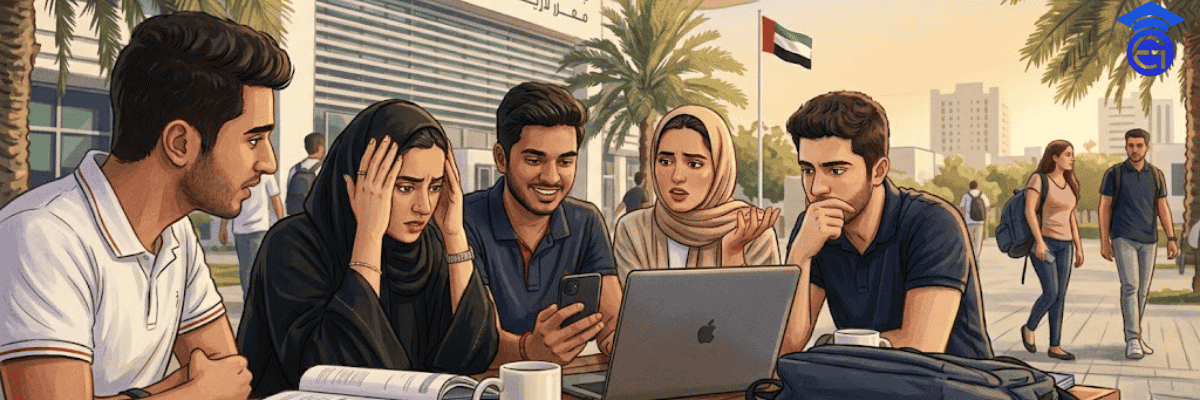
The news came on 2 April. Cambridge, OxfordAQA, and Pearson Edexcel all confirmed that British IGCSE and A-Level exams would not go ahead in the UAE. For students who had spent months, some of them years, working toward these exams, that announcement landed in very different ways. Some cried. Some exhaled. Some opened a group chat and got the news there before their school even sent the official email.
What’s in this piece
How the News Actually Landed
Exam cancellations don’t hit everyone the same way. And that’s kind of the point nobody is saying out loud. Whether this feels like a catastrophe or a reprieve has everything to do with where a student was sitting academically when the news came in.
For a Year 13 student with strong predicted grades and a university offer already in hand, this was probably a moment of complicated relief. For a Year 11 student who knew their mocks had been rough, it’s a different kind of uncertainty. And for students who specifically needed this exam window to resit or improve scores from last year — the gut-punch is real.
The cancellations cover Cambridge IGCSE, O Level, AS and A Level, Pearson Edexcel International GCSE and A Level, and OxfordAQA’s full suite of IGCSE and International A-Level qualifications. Over 120 Cambridge schools operate in the UAE alone. This affects thousands of students across Dubai, Abu Dhabi, Sharjah, and beyond.
Context: The British exam cancellations follow earlier decisions affecting IB, CBSE, and CISCE students. By the time these boards announced, the pattern was already set. Still, for UK-curriculum students, many of whom had been told to keep revising as normal until almost the last moment, the confirmation hit hard.
The Students Who Feel Genuinely Robbed
Valrani, a 17-year-old Year 12 student in Dubai, described the cancellation of his AS Level exams as “a lost opportunity” he worries could cost him a university seat. He’d been preparing seriously. The predicted grades process for Year 12 feeds directly into university applications, and now those predicted grades are the only grades.
“I am in Year 12, and the predicted grades in this year are vital for university applications. This year because the exams are cancelled, the grade we get will be more portfolio-based. It is indeed a lost opportunity, and I hope it won’t be something that will cost me a university seat.”
Valrani, Year 12 student, Dubai (via Khaleej Times)That feeling — of being denied a chance to prove yourself — keeps coming up. Rhea Nihalani, a Year 13 twin who had already secured a place at a US university, still felt it. She’d put serious work into her literature paper. Wanted to sit it. Wanted that version of the ending to her school years.
“I had worked really hard for my literature paper. I was looking forward to it. Also, I feel like I have been robbed of a proper graduation experience of preparing for the exams and the relief after it is over.”
Rhea Nihalani, Year 13 student, Dubai (via Khaleej Times)There’s something worth sitting with in that. Even students with good outcomes ahead of them are grieving a particular experience. The cramming, the stress, the strange camaraderie of exam season — it has its own rhythm. When that gets taken away without warning, some students don’t feel relieved. They feel like something that was supposed to happen didn’t. And there’s no clean way to process that.
Relief That Comes with an Asterisk
Then there’s the other camp. Rhea’s twin brother Rohan had also secured US university admission, and he was more direct about being relieved.
“I am relieved that I don’t have to worry about writing a final exam and preparing for it. I can now focus on preparing for my university. However, if I had known that my mock exams were going to be the last exams I ever write in school, I might have prepared a little bit better.”
Rohan Nihalani, Year 13 student, Dubai (via Khaleej Times)That last line is honest in a way that’s easy to miss. The relief is real. But so is the quiet regret that comes with not having known. If mock exams were always going to be the final performance on record, students would have shown up differently. Not necessarily smarter, but with more intention. That window is now closed.
This is the “asterisk” that comes with relief. Students who are genuinely glad they don’t have to sit exams are also, in some corner of their thinking, wishing they’d known sooner. The uncertainty that dragged through March and into early April meant students spent weeks in a kind of anxious limbo — preparing for something while not quite believing it would happen, trying not to emotionally let go of revision because that might jinx it.
“Honestly didn’t know how to feel when I saw the notification. I’ve been revision-mode for so long it’s almost weird to stop. But I keep thinking about whether my coursework was strong enough. I guess we’ll see.”
“My mocks went really badly in February and I was counting on the real exams to fix that. Now my mocks ARE my final performance? Great. Just great.”
The Grade Anxiety Nobody Is Talking About Clearly
Here’s the piece of this that deserves more attention than it’s getting. Students aren’t just worried about whether they get to sit exams. They’re worried about whether the alternative assessment process accurately captures who they are.
Damien Dexter Goveas, a Year 11 student, articulated this better than most official statements have:
“I am concerned about whether I will meet the thresholds to get the subjects I want for my A-levels. Right now, it is not very clear how schools will decide the final grade. For the IGCSEs, the national average is taken into consideration when giving a grade. However, in the case of mock exams, there is nothing like that. Also, it is something that affects just a small part of the world, unlike Covid, when everyone was facing the same situation.”
Damien Dexter Goveas, Year 11 student (via Khaleej Times)That last point is sharper than it looks. During Covid, every student globally was in a version of the same situation. Universities, boards, and universities had a shared frame of reference. This time, UAE students are in a regional disruption while students in the UK, Singapore, Canada, and most of the world are sitting their exams normally. That asymmetry matters and students can feel it, even if they can’t fully articulate why it makes them uneasy.
Relief
Students with strong predicted grades and secured university offers. The exam is no longer a risk they have to manage.
Fear
Students whose mock performance doesn’t reflect their actual ability. They were counting on the real exam to close that gap.
Grief
Students who genuinely wanted to sit the exam. Who worked toward it. Who feel cheated of an experience they can’t get back.
Uncertainty
Everyone, to some degree. What goes in the portfolio? Who decides the final grade? What will universities make of all this?
What Students Are Saying Online
Beyond the official quotes, students have been vocal in spaces exam boards and school principals don’t typically monitor. The tone on Reddit’s exam communities and in WhatsApp groups captures something the polished press statements can’t quite reach.
“Anyone else feel like they’re in a weird grief stage? Like I spent the entire year building toward something and now there’s nothing to build toward. Just… waiting.”
“My school told us to ‘stay in revision mode’ as if that makes any sense now. Revise for what exactly? A portfolio of stuff my teacher already marked in January?”
“The worst part isn’t even the cancellation. It’s all those weeks of ‘keep preparing, nothing is confirmed’ while knowing it was basically already decided. We just weren’t told.”
That last sentiment comes up a lot. Students felt the lag between what was obviously happening on the ground — weeks of distance learning, no exam hall access, regional disruption clearly continuing — and the official messaging that encouraged them to keep preparing as normal. The gap between those two realities created its own kind of stress that the formal announcements haven’t fully acknowledged.
There’s no clean answer to that question. The honest reality is that alternative assessments are built to be statistically fair across groups, not perfectly accurate for every individual. Some students perform better in coursework than in timed exams; others are the reverse. This system helps the former and doesn’t help the latter. That’s not a flaw that can be fixed. It’s just the nature of the situation.
Students Forced Into Gap Years
The most difficult stories are from students who specifically needed this exam window to resit. One Year 13 student, who didn’t want to be named, was blunt about his situation:
“I did not score as well as I would have liked for my AS level exams and was meant to resit those in May this year. However, in this circumstance, those exams have been cancelled as well. This means I will not be able to get into the university I want. So, I will take a gap year and then figure out what to do from there. It is very unfortunate, and I am still trying to wrap my head around it.”
Anonymous, Year 13 student (via Khaleej Times)This is real harm. A student who needed an exam opportunity and no longer has it. Not because of their choices, not because of anything within their control, but because of a regional conflict that found its way into their school year.
Gap years aren’t the end of the world. But planning one under duress, on short notice, without it being something you chose — that’s a fundamentally different experience than the planned gap year. Universities may or may not factor in the context when applications come around next cycle. There’s no guarantee, and the student has to live with that uncertainty.
If this is your situation: some universities will consider deferred entry or late applications with contextual notes explaining the disruption. It’s worth contacting admissions offices directly, explaining the specific circumstance, and asking what options exist. Some will be more flexible than you expect. Others won’t. But not asking guarantees the harder path.
What Schools and KHDA Are Saying
Dubai’s education regulator KHDA moved quickly to address what it called a “stressful time.” A spokesperson shared a video on Instagram drawing a direct comparison to the Covid disruptions and offering a clear message to parents: reassure your children, and stay in contact with schools.
“We have been here before. We expect that most of the protocols during COVID will apply again this time.”
KHDA spokesperson, via InstagramSchool principals have been careful and, in some cases, genuinely thoughtful in how they’ve communicated. Natalia Svetenok, Principal of Woodlem British School in Ajman, described the portfolio route as something to be embraced rather than mourned. Simon Jodrell from Jebel Ali School in Dubai spoke about maintaining academic rigour while also managing the emotional weight of the situation for students and staff.
The phrase you hear from school leaders who are handling this well: calm, clarity, and continuity. It’s not a platitude if the school is actually delivering on it — if they’re telling students specifically which coursework pieces are going into the portfolio, keeping communication clear and frequent, and not leaving students to guess what’s happening.
The schools where that isn’t happening — where communication has been vague or where students still don’t know what’s going into their portfolios — are the ones where students are most anxious right now. And anxious is probably an understatement.
What Actually Matters Now
I want to say something that isn’t just reassuring noise. The emotional reality here is complicated, and it varies by student. Some people are genuinely okay. Some are not. Both responses make sense given the circumstances.
What tends to help students in disrupted assessment cycles isn’t inspirational messaging. It’s knowing specifically what’s in their record and what, if anything, they can still influence. That clarity is more valuable right now than any amount of “you’ve got this” energy.
If you’re a student reading this: find out exactly which pieces of work your teachers are submitting for your portfolio. Not a vague “the best three pieces” — the actual pieces. Then decide whether there’s any remaining coursework or assessment you can complete to add to that picture before the submission window closes on 12 June. That’s where your energy belongs.
If you hold a conditional university offer and you’re worried about whether alternative grades will satisfy it, contact the admissions office now. Not after results day. Now. Most universities have already prepared guidance for the 2026 UAE cycle, and the answer is usually more reassuring than the silence of not knowing.
Valrani — the student who called this “a lost opportunity” — said he planned to spend the summer going back through the content he’d studied, to give himself the best foundation going into his A2 year. That’s a calm, practical response to an unfair situation. Not every student will have the headspace for it right away. But eventually, that’s where the focus has to go.
The exams are cancelled. The grades will come. What students do between now and university shapes the trajectory more than most people give it credit for.
Worried about how the cancellations affect your grades or your university offer?
At Edugravity, we work with IGCSE and A-Level students across Sharjah, Dubai, and Ajman. With exams cancelled and assessment routes changing fast, having the right support matters more now, not less. Small groups, maximum 6 students, subject specialists who understand what’s at stake. If you’re not sure what to focus on right now, get in touch — we’ll work it out together.
WhatsApp Us Book Free DemoRelated Reading on Edugravity
- Cambridge Cancels IGCSE, O Level, AS & A Level and IPQ June 2026 Exams in UAE
- Pearson Edexcel Cancels IGCSE and A-Level UAE May/June 2026
- OxfordAQA Cancels IGCSE and A-Level Exams in UAE
- IB May 2026 Exams Cancelled in UAE — Results via NECM
- UAE Exam Cancellations 2026: Complete Guide to New Grading Rules
Free consultation available. If you’re a student or parent navigating the alternative assessment process and you’re not sure what your next steps should be, we’re happy to talk it through. No pressure — just a conversation. Reach out here.
Key Takeaways
- UAE students are reacting to British exam cancellations with a mix of genuine relief, grief, fear, and uncertainty — often all at once, and often depending on their specific academic situation.
- Students who needed this window to resit or improve AS Level scores face the most concrete harm, with some now planning gap years they didn’t choose.
- The “asymmetry” compared to Covid-era cancellations — where UAE students face disruption while students elsewhere sit normally — is creating specific anxiety around how grades will be perceived by universities.
- School principals and KHDA have emphasised calm and continuity, but the quality of communication varies considerably between schools, and the gap shows in student anxiety levels.
- The most useful thing students can do right now is find out exactly what’s going into their portfolio, finish any outstanding coursework, and contact universities directly about conditional offers.